

With average credit card processing fees in the United States now ranging between 1.5% and 3.5%, are you tired of watching your profit margins shrink with every swipe, tap, or click? It’s a common frustration for merchants who feel trapped between rising interchange rates and the need to offer a seamless checkout experience. You’ve probably noticed how difficult it’s to keep track of customer behavior when your data is scattered across different platforms, making compliance with standards like PCI DSS v4.0 feel like a constant hurdle. When your sales channels don’t talk to each other, your business loses more than just money; it loses the clear insights needed to grow.
The good news is that you don’t have to choose between convenience and profitability. This article will teach you how to build a high-conversion omnichannel payment strategy that creates a single source of truth for all your transaction data. You’ll learn how to eliminate processing fees entirely using a modern, surcharge-integrated approach that remains compliant with complex state laws and network rules. We’ll walk through the essential tools, from dual pricing engines to AI-driven fraud prevention, that allow you to offer maximum payment flexibility while keeping your revenue where it belongs.
Key Takeaways
- Understand how to transition from fragmented multichannel sales to a unified omnichannel payment strategy that merges data from online, mobile, and in-person transactions.
- Discover how to use virtual terminals and secure payment links to settle invoices instantly without the need for physical hardware.
- Learn how to protect your margins by implementing a surcharge and dual pricing engine that passes credit card processing fees to customers.
- Follow a practical five-step framework to audit your current touchpoints and select a processor that supports seamless API integrations.
- Explore advanced tools like ClearSplit™ to automate partner compensation and manage complex payment portfolios as your business scales.
What is an Omnichannel Payment Strategy in 2026?
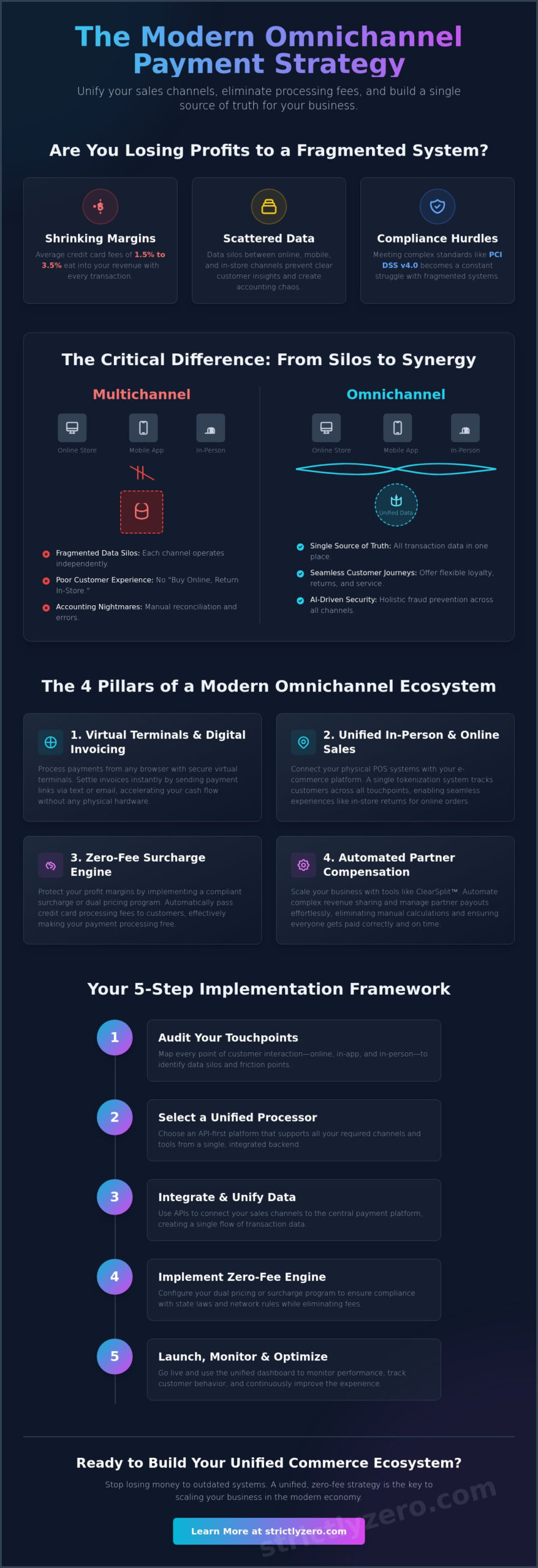
In 2026, commerce isn’t just about where you sell; it’s about how you connect those points of sale into a coherent journey. Developing a robust omnichannel payment strategy is the baseline for survival in a market where customers move fluidly between digital and physical spaces. To truly compete, you need to understand What is an Omnichannel Payment Strategy and how it functions as a unified ecosystem. While multichannel setups treat your website, mobile app, and physical store as separate islands, a unified approach merges these data streams into a single, visible flow.
To better understand this concept, watch this helpful video:
The shift toward unified commerce is driven by the death of data silos. In the past, merchants struggled with fragmented records that made reconciling a single day’s sales a manual, error-prone process. By 2026, the industry has moved toward API-first platforms that ensure every transaction is visible in real-time. Whether a customer pays through a mobile link or at a physical counter, the data flows to one central hub. This visibility is essential for meeting expectations like “buy online, return in-store” (BORIS). If your backend can’t instantly verify an online payment when a customer walks into your shop, you’ve created a friction point that damages your brand.
Omnichannel vs. Multichannel: The Critical Difference
Multichannel environments create data silos that lead to accounting nightmares and poor customer experiences. When your web store doesn’t talk to your physical location, you can’t offer personalized loyalty rewards or easy cross-channel returns. A modern omnichannel payment strategy solves this by using a single tokenization system to track a customer across every touchpoint. This unified commerce approach also improves security. By analyzing holistic data patterns, AI-driven fraud prevention tools can identify suspicious behavior across the entire network, providing a level of protection that fragmented systems simply can’t match.
The Economic Impact of Unified Payments
Consolidating your reporting into one dashboard drastically reduces administrative overhead. You won’t need to pay a team to manually match spreadsheets from three different processors every month. This efficiency allows you to focus on growth rather than data entry. You’ll also see higher customer lifetime value (LTV) because the cross-channel experience is entirely frictionless. An omnichannel payment strategy is a data-synchronization strategy rather than just a hardware setup. It ensures that your business remains agile as new payment methods and consumer habits emerge in the coming years.
The 4 Pillars of a Modern Omnichannel Ecosystem
Building a successful omnichannel payment strategy requires more than just a website and a card reader. It’s about creating a cohesive network where every transaction method works in harmony. While some experts are reconsidering omnichannel payments due to the complexity of managing multiple vendors, the solution lies in a unified pillar-based approach. By focusing on these four core areas, you ensure that your business remains flexible and responsive to how customers want to pay in 2026.
Virtual Terminals and Digital Invoicing
The first two pillars focus on digital flexibility. Secure virtual terminals allow your team to process payments directly through a web browser. This is a game-changer for phone and mail order (MOTO) environments, as it provides high-level security without requiring physical hardware. You can also leverage payment links to bridge the gap between a digital quote and a settled transaction. For service-based businesses, sending a quick link via text or email accelerates cash flow significantly. When you combine this with automated recurring billing, you can manage subscriptions across the entire customer lifecycle while reducing involuntary churn caused by expired cards.
Consistency is the third pillar. Whether your team is closing a sale in a retail store or out in the field, they should operate under the same merchant ID. This integration ensures that your inventory and financial reports stay perfectly synced. You don’t want your accounting team chasing down data from three different apps at the end of the month. Centralized processing makes it easy to unify your payment touchpoints for a cleaner bottom line.
API-First Architecture for Developers
Solving the Cost Paradox: Integrating Zero-Fee Processing
A seamless omnichannel payment strategy is essential for growth, but it comes with a significant price tag. Every time you expand into a new channel, you’re hit with interchange fees that typically range from 1.15% to 3.15%. While a 2025 settlement reduced average rates by about 0.10%, total credit card processing fees in 2026 still hover between 1.5% and 3.5%. For high-volume merchants, these small percentages quickly compound into thousands of dollars in lost revenue every month. You shouldn’t have to sacrifice your bottom line just to provide the convenience your customers expect.
Integrating a zero-fee processing model allows you to reclaim these margins without compromising the customer experience. By using a surcharge and dual pricing engine, you can pass the cost of credit card processing directly to the consumer. This isn’t about penalizing buyers; it’s about transparency and providing options. In a 2026 landscape where regulatory scrutiny of fees is at an all-time high, having an automated system to handle state-by-state compliance is the only way to scale safely. Your backend should automatically adjust based on where the transaction occurs to ensure you stay within the lines of varying state laws.
The Mechanics of a Compliant Surcharge Program
A smart pricing engine is the heart of this system. It must instantly detect whether a customer is using a debit or credit card at the point of sale. This is critical because surcharging debit cards is restricted under the Durbin Amendment and various network rules. If your system can’t tell the difference, you risk heavy fines and account termination. Clear communication is also vital. You need transparent signage at your physical locations and explicit disclosures on your digital checkout pages. When you explain how zero fee credit card processing protects profit margins, you create a sustainable business model that can weather future interchange fee increases.
Overcoming the “Customer Pushback” Objection
Many merchants fear that surcharges will drive customers away, but the data suggests otherwise. Most consumers value convenience and flexibility over a small transaction fee, especially when they’re offered a choice. Positioning your strategy as a dual pricing model is a highly effective way to handle this. Instead of a “penalty” for using a card, you present a “discount” for using cash or debit. This psychological shift makes the customer feel rewarded for choosing a lower-cost payment method. By framing the conversation around choice, you maintain high retention rates while effectively eliminating your processing overhead. It’s a win for your operational efficiency and a win for your transparency.
A 5-Step Framework for Implementation
Moving from a fragmented setup to a unified commerce model requires a deliberate, step-by-step approach. You can’t just flip a switch and expect your web store and physical POS to sync perfectly. Executing a high-conversion omnichannel payment strategy involves aligning your technical infrastructure with your business goals. By following this five-step framework, you’ll create a resilient system that captures every sale while protecting your margins from unnecessary fee erosion.
Auditing Your Payment Landscape
Your first task is to map out every point where money changes hands. This includes your online checkout, in-store terminals, mobile field sales, and even phone orders. Look for data leaks where transactions aren’t being recorded in a central hub. Many merchants find they’re paying multiple monthly fees for separate merchant accounts that don’t talk to each other. When you evaluate your current credit card processing for small business, identify which channels have the highest markups. Consolidating these under a single, unified processor is the most effective way to gain clarity and leverage better rates.
Data Integration and Reporting
Once you’ve audited your touchpoints, focus on the backend. Your payment gateway should sync directly with your CRM or ERP system to create a single source of truth. This integration allows for automated reconciliation, which saves your accounting team hours of manual work every week. By using a single dashboard to view web, mobile, and retail sales, you can spot trends faster and respond to customer needs in real time. This unified data also feeds into your AI-driven fraud prevention. When your security tools can see cross-channel behavior, they become much more effective at identifying sophisticated fraud patterns that siloed systems would miss.
The next steps involve technical configuration and team alignment. You’ll need to set up your Smart Pricing Engine to handle compliant surcharging across all channels automatically. Since state laws regarding surcharges can vary, your system must be smart enough to apply the correct rules based on the customer’s location. Finally, don’t overlook the human element. Your staff needs training on how to explain dual pricing and cash discounts to customers. Clear, transparent disclosures at checkout are essential for maintaining trust and staying compliant with network rules. If you’re ready to stop losing margins to fragmented systems, connect with a payment processing expert to begin your audit and build a stronger foundation for your omnichannel payment strategy.
Scaling with Strictly: The Ultimate Partner Platform
Managing a single merchant’s omnichannel payment strategy is one thing, but overseeing a portfolio of hundreds requires a different level of infrastructure. Scaling a payment business in 2026 demands more than just basic connectivity. You need tools that simplify the complex web of cross-channel data and provide instant visibility into every transaction. Strictly provides the technical foundation for ISOs and developers to lead the market by offering a “Trust-First” processing environment. This platform helps partners focus on acquisition and growth while the backend handles the heavy lifting of security, fraud prevention, and compliance.
Managing residuals and commissions across an omnichannel portfolio can be a logistical nightmare without the right automation. ClearSplit™ solves this by automating the entire partner compensation process, ensuring that every stakeholder is paid accurately and on time, regardless of how complex the transaction flow is. To keep your portfolio healthy, ChurnIQ™ uses merchant retention intelligence to identify accounts that might be at risk of leaving. This proactive data allows you to address merchant concerns before they result in lost revenue, keeping your residuals stable and your business growing.
Partner Tools for ISOs and MSPs
Independent Sales Organizations (ISOs) and Managed Service Providers (MSPs) need a competitive edge to win in a crowded market. Strictly offers a white-label-ready interface that lets you manage multiple merchants from a single, centralized point of control. You can customize the merchant experience to match your brand while leveraging powerful API integrations and virtual terminal tools. These payment processing platforms for ISOs are essential for scaling without adding massive administrative overhead. Automated residual tracking removes the manual guesswork from your monthly earnings, allowing you to focus on high-level strategy rather than auditing spreadsheets.
Why Zero-Fee Is the Future of Merchant Services
The industry is shifting toward merchant-centric pricing models that prioritize transparency and profit preservation. Strictly’s Smart Pricing Engine is at the forefront of this movement. It removes the burden of fee management by automatically applying compliant surcharges and dual pricing across every channel, from web checkouts to in-person terminals. This ensures that merchants can maintain their margins even as interchange fees fluctuate or card network assessment fees increase. For partners, offering a zero-fee model is a powerful selling point that resonates with business owners who are tired of watching processing costs eat their profits.
Whether you’re a merchant looking to unify your touchpoints or a partner aiming to scale your portfolio, the right omnichannel payment strategy is built on a foundation of trust and advanced technology. Modernizing your payment stack isn’t just a technical upgrade; it’s a strategic move to future-proof your revenue and improve customer retention. It’s time to embrace a platform that values your growth and provides the tools necessary to lead the omnichannel revolution in 2026 and beyond.
Future-Proof Your Revenue with Unified Commerce
The landscape of 2026 demands more than just being present on multiple channels; it requires a perfectly synchronized omnichannel payment strategy. By merging your online, mobile, and in-person data into a single source of truth, you eliminate the friction that costs businesses both time and customers. You’ve seen how a compliant surcharge model can reclaim your margins and how technical pillars like virtual terminals bridge the gap between digital quotes and instant settlement. This isn’t just about accepting payments. It’s about building a scalable ecosystem that protects your bottom line while providing the flexibility today’s buyers expect.
Success in this environment depends on the tools you choose to support your growth. With a Smart Pricing Engine for automated compliance and AI-driven fraud prevention, you can scale without the constant fear of data silos or security breaches. Partners can also leverage ClearSplit™ for automated residual tracking to simplify complex portfolios. It’s time to take control of your transaction costs and streamline your operations. Eliminate your processing fees today with Strictly’s Omnichannel Platform and start building a more profitable future. Your business deserves a payment stack that works as hard as you do.
Frequently Asked Questions
What is the difference between omnichannel and multichannel payments?
Omnichannel payments create a unified ecosystem where online, mobile, and in-person data merge into one central hub. Multichannel setups treat each platform as a separate silo, which often leads to fragmented records and manual accounting errors. In an omnichannel payment strategy, a single tokenization system tracks the customer journey across every touchpoint. This provides real-time visibility and allows for seamless cross-channel experiences like buying online and returning in-store.
Is surcharging legal in all 50 states in 2026?
Surcharging is legal in most of the United States, but it remains a complex legal area governed by specific state laws and card network rules. As of 2026, several states still have restrictions or very strict disclosure requirements that merchants must follow. It’s essential to use an automated engine that detects the customer’s location and card type. This ensures you don’t accidentally surcharge a debit card, which is prohibited under the Durbin Amendment.
How does an omnichannel strategy reduce credit card processing fees?
An omnichannel approach reduces costs by integrating a surcharge and dual pricing engine directly into your checkout flow. This allows you to pass the average credit card processing fee, which typically ranges from 1.5% to 3.5%, on to the customer. By automating this process across every sales channel, you effectively shift the burden of interchange and assessment fees away from your business. This model protects your profit margins while maintaining payment flexibility for your buyers.
Do I need special hardware for an omnichannel payment system?
Can I integrate omnichannel payments with my existing website or app?
Modern payment platforms are designed for easy integration with existing websites and mobile apps through robust SDKs and hosted payment fields. These tools allow your developers to embed secure checkout experiences without taking on the full burden of PCI compliance. Real-time webhooks ensure that your inventory and order fulfillment systems update instantly after a successful transaction. This connectivity is the backbone of a high-conversion omnichannel payment strategy that keeps your data synced across all platforms.
What is a virtual terminal and how does it fit into an omnichannel strategy?
A virtual terminal is a secure, web-based application that lets you process credit card payments through a browser without physical hardware. It’s a vital pillar of an omnichannel strategy because it enables your team to handle phone, mail, or back-office orders securely. Since it uses the same merchant ID as your online and retail stores, all transaction data flows into a single dashboard. This simplifies your reporting and provides a holistic view of your sales.
How does dual pricing differ from a standard surcharge program?
Dual pricing differs from standard surcharging by presenting two distinct prices to the customer: a credit card price and a lower price for cash or debit payments. Standard surcharging simply adds a percentage fee to the transaction at the final stage of checkout. Dual pricing is often more palatable for consumers because it’s framed as a “cash discount.” This transparency helps reduce pushback while still allowing you to eliminate the cost of card processing.
What are the security requirements for omnichannel payment processing?
Security for omnichannel processing requires strict adherence to PCI DSS v4.0 standards to protect sensitive cardholder data. You should use tokenization to ensure that actual card numbers are never stored on your systems, reducing your risk during a breach. Additionally, AI-driven fraud prevention tools analyze behavior across all channels to spot suspicious patterns in real time. These layers of protection build trust with your customers and safeguard your business from evolving digital threats.