

What if the best Merchant One alternative isn’t the processor with the lowest advertised rate, but the one that fits how your business actually takes payments? Comparing Merchant One alternatives is easier when you start with the details of your payment workflows: where customers pay, what tools your staff uses, and how charges are priced.
A processor change can affect checkout, recurring billing, integrations, and the total cost of acceptance. Contract terms, equipment, and migration work can add to the decision. A useful comparison looks beyond a headline rate to the full cost and operational fit.
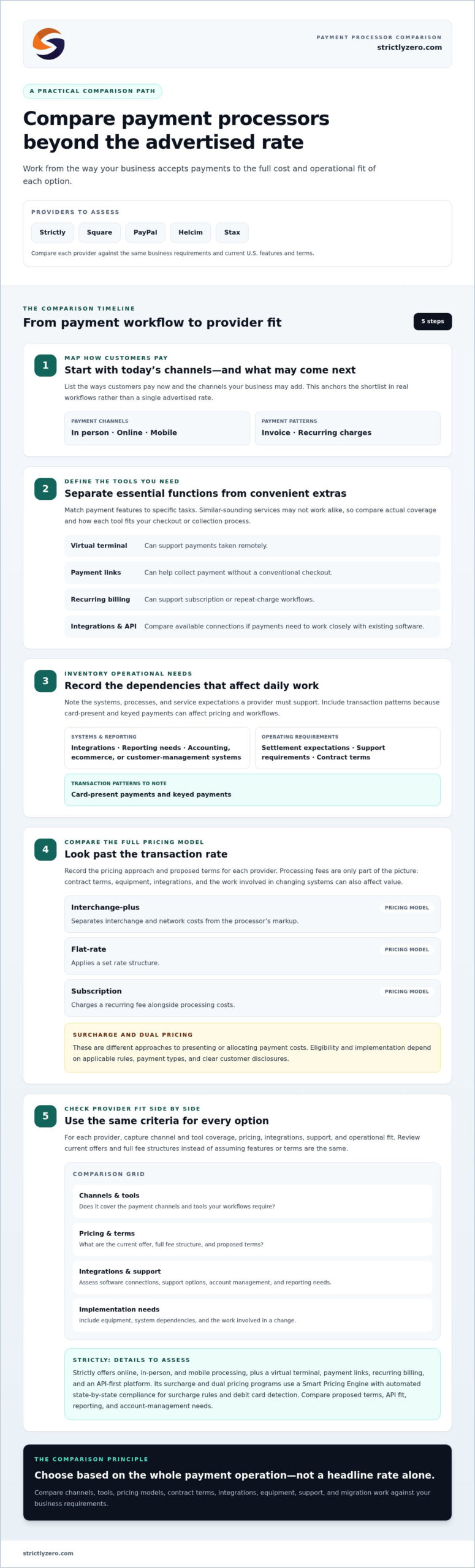
This guide compares options including Square, PayPal, Helcim, Stax, and Strictly using consistent criteria: payment channels, pricing model, operational fit, and implementation needs. Strictly provides a unified platform for online, in-person, and mobile payments, with a virtual terminal, payment links, recurring billing, and surcharge and dual pricing programs. You’ll also find practical steps for reviewing terms, planning a transition, and comparing providers against your own requirements.
Key Takeaways
- Shortlist Merchant One alternatives by matching payment channels and tools to your everyday workflows.
- Compare pricing models alongside contract terms, integrations, equipment needs, and other potential costs.
- Assess how Strictly’s omnichannel processing and surcharge or dual pricing programs fit your payment mix.
- Plan a processor change in stages: review agreements and dependencies, map workflows, test the setup, then transition.
- Use a decision matrix for must-have channels, pricing, integrations, support, and migration needs to narrow your options.
Why look for Merchant One alternatives? Start with the business need
Changing payment processors is a decision about workflow and total cost, not simply a search for a lower advertised rate. A business that adds ecommerce, takes more payments by invoice, or shifts toward recurring billing may need different tools than it did when it first chose a processor. Comparing Merchant One alternatives can show whether your current setup still supports the way you sell.
Start with where customers pay, how transactions are processed, which systems need to connect, and what your team needs to manage payments. Processing fees are only one part of the picture. Contract terms, equipment, integrations, reporting, and the work involved in changing systems can all affect the value of an option.
For background on the companies and services involved, see this overview of the Payment Service Provider (PSP) role in the payments ecosystem.
For a provider comparison, watch this video:
What should prompt a Merchant One comparison?
A comparison can make sense when your sales channels, transaction volume, or business operations change. A retailer adding online sales, for instance, may want connected workflows for in-person and ecommerce payments. A service business might need simpler invoicing or recurring billing, while a growing team may prioritize consolidated reporting or integrations with accounting, ecommerce, or customer-management systems.
You don’t need to be dissatisfied to compare options. A processor that suited an earlier stage of your business may no longer match customer payment preferences or operational needs. Treat a review as a way to understand your choices, not as an assumption that something is wrong.
Which business details should shape your shortlist?
List how customers pay today and how they may pay next: in person, online, on mobile, by invoice, or through recurring charges. Then separate essential functions from convenient extras. Payment links can simplify remote collection, for example, while an API-first integration may matter more if payments need to connect closely with existing software. Strictly combines online, in-person, and mobile processing with a virtual terminal, payment links, and recurring billing.
Document your current systems, reporting needs, settlement expectations, support requirements, and contract terms. Note transaction patterns, including card-present and keyed payments, because these can affect pricing and workflows. This inventory gives you a practical shortlist based on how your business accepts and manages payments, rather than on a single advertised rate.
How to compare Merchant One alternatives beyond advertised rates
A useful comparison looks at the whole payment operation, not just the transaction rate. For each provider, record how it handles in-person, ecommerce, mobile, invoice, and recurring payments. Then note what it offers for remote payment entry, reporting, fraud tools, integrations, and account management. Compare current U.S. features and terms, since they can change.
Which payment features matter in a processor comparison?
Start with the workflows your business relies on. A virtual terminal can support payments taken remotely, payment links can help collect payment without a conventional checkout, and recurring billing can support subscription or repeat-charge workflows. If payments need to connect with business software, compare available integrations and API options. Strictly offers online, in-person, and mobile processing, along with a virtual terminal, payment links, recurring billing, and an API-first platform.
Use a comparison grid to capture what matters without assuming similarly named services work alike:
| Provider | Channels and tools | Pricing model | Integrations and support |
|---|---|---|---|
| Strictly | Online, in-person, mobile; virtual terminal, payment links, recurring billing | Compare proposed terms and the surcharge or dual pricing program | Assess API fit, reporting, and account-management needs |
| Square | Compare current channel and payment-tool coverage with your workflows | Review the current offer and full fee structure | Assess software connections, support options, and workflow fit |
| PayPal | Compare current channel and payment-tool coverage with your workflows | Review the current offer and full fee structure | Assess software connections, support options, and workflow fit |
| Helcim | Compare current channel and payment-tool coverage with your workflows | Review the current offer and full fee structure | Assess software connections, support options, and workflow fit |
| Stax | Compare current channel and payment-tool coverage with your workflows | Review the current offer and full fee structure | Assess software connections, support options, and workflow fit |
How should you compare pricing and payment models?
Interchange-plus pricing separates interchange and network costs from the processor’s markup. Flat-rate pricing applies a set rate structure, while subscription pricing charges a recurring fee alongside processing costs. Surcharging and dual pricing are different approaches to presenting or allocating payment costs. Eligibility and implementation depend on applicable rules, payment types, and clear customer disclosures. Strictly’s surcharge and dual pricing programs use a Smart Pricing Engine with automated state-by-state compliance for surcharge rules and debit card detection. Compare the model against your transaction mix rather than assuming one option will cost less.
Separate processing costs from contract length, termination terms, equipment, chargeback-related costs, and other applicable fees. The Federal Trade Commission offers background to help understand interchange fees in the context of debit-card rules. For more pricing-model context, read this zero-fee processing guide. You can also explore Strictly’s payment processing approach as part of your comparison.
Merchant One alternatives compared: which providers fit different needs?
The right processor depends on the payment setup you need, not on a provider’s reputation alone. Square, PayPal, Helcim, and Stax are candidates to compare alongside Strictly. Their features, terms, and integrations can change, so focus your research on your own workflows and the details that affect your costs.
| Provider | Business fit to assess | Channels and tools to compare | Pricing and integrations to review |
|---|---|---|---|
| Strictly | Businesses seeking unified payment acceptance and surcharge or dual pricing capabilities | Online, in-person, mobile; virtual terminal, payment links, recurring billing | Review proposed pricing terms, API fit, and connections to current systems |
| Square | Businesses weighing payment acceptance for their sales setup | Compare in-person, ecommerce, mobile, remote, and recurring options | Review pricing structure and available integrations |
| PayPal | Businesses comparing customer payment options across sales channels | Assess in-person, ecommerce, remote, and recurring capabilities | Review applicable pricing and connections to business systems |
| Helcim | Businesses evaluating another processing setup against their transaction mix | Compare channels, payment tools, and reporting | Review pricing terms and available integrations |
| Stax | Businesses considering a different pricing approach and payment workflow | Compare channel coverage, recurring tools, and reporting | Review pricing structure and software connections |
Compare each option against your actual sales channels, transaction mix, system dependencies, and contract needs rather than treating the names as universal recommendations. The U.S. Small Business Administration’s overview of a merchant services account offers broader context on accepting card payments.
Where does Strictly fit among Merchant One alternatives?
Strictly provides a unified platform for online, in-person, and mobile payments. Its tools include a virtual terminal, payment links, recurring billing, and an API-first approach to integrations. This combination suits businesses handling both face-to-face and remote transactions or connecting payment workflows with their software.
Strictly also offers surcharge and dual pricing programs. Its Smart Pricing Engine automates state-by-state compliance for surcharge rules and detects debit cards. These models aren’t universally eligible or interchangeable: requirements can vary by location and payment type, and customers need clear disclosures. Consider how the program fits your payment mix and operating processes. For a closer look, explore Strictly’s payment processing approach.
How to switch payment processors without avoidable disruption
Switching processors is easier to manage as a planned migration, not a single changeover date. Before selecting among Merchant One alternatives, map how payments move through your business, review your current agreement, and identify what needs testing. This preparation helps protect checkout, billing, and reconciliation workflows while your team learns the new setup.
Use a clear sequence: map workflows, review terms, plan the migration, test the new setup, then transition. The small business processing guide offers broader context on payment acceptance as you plan.
What should you prepare before changing processors?
Inventory every payment touchpoint and the systems connected to it. Include terminals, ecommerce checkout, mobile workflows, accounting software, integrations, invoices, and recurring transactions. Note which team members use each process and what customers experience. This map can reveal dependencies that a simple account switch might miss.
Next, review recent processing statements and your existing agreement. Look for applicable fees, contract timelines, notice requirements, termination terms, and equipment obligations. If you use stored payment credentials or recurring charges, find out how those records can be migrated and whether customers will need to take action. Credential transfers are provider-specific, so build the plan around the actual transfer process rather than assuming saved details will move automatically.
Plan communications, too. Tell staff what changes at checkout, how to handle refunds or payment questions, and where to find updated procedures. If customer payment details or recurring billing steps will change, prepare clear customer messaging before the transition.
How can you test the new payment setup?
Before moving all transactions, test representative workflows in the new environment. Run through an in-person sale, an online checkout, a remote or invoice payment, and a recurring transaction if those apply to your business. Test refunds, review reports, and confirm that integrations pass the information your team needs.
Choose a transition window that avoids your busiest sales periods where possible, and keep the old workflow available until essential checks are complete. After launch, verify that transactions appear correctly in reports and accounting records, settlements align with expectations, and staff know how to route support issues. A post-launch review can catch mismatches before they become routine problems.
Planning a processor change? Explore Strictly’s payment processing options as you map your channels, integrations, and migration needs.
Choose the Merchant One alternative that fits, and take the next step
The best choice among Merchant One alternatives supports your essential payment workflows, fits your cost priorities, and can be adopted without avoidable operational strain. Use the comparison to narrow options, then decide against your own requirements rather than a headline rate or a long feature list.
What is the final processor selection checklist?
Before you commit, review these areas side by side:
- Channels and tools: Confirm the provider supports the ways customers pay you, such as in person, online, mobile, by invoice, or through recurring billing.
- Pricing model and terms: Compare processing charges alongside contract conditions, other applicable fees, and the pricing approach that fits your transaction mix.
- Integrations and reporting: Check that payment data works with the systems your staff uses and that reporting supports reconciliation.
- Support and operations: Consider how account management and issue resolution align with your team’s needs.
- Migration fit: Account for integrations, equipment, stored credentials, recurring payments, testing, and notice requirements in your transition plan.
A provider that looks suitable on paper may still require substantial workflow changes. Include those operational demands in your comparison, and make sure your migration plan covers routine payments as well as exceptions such as refunds or recurring charges.
When is Strictly worth evaluating?
Strictly provides a unified platform for online, in-person, and mobile payments. Its tools include a virtual terminal, payment links, recurring billing, and an API-first approach to integrations. This combination fits businesses managing multiple channels or connecting payment workflows with existing software.
Businesses considering surcharge or dual pricing can evaluate Strictly’s programs and Smart Pricing Engine, which automates state-by-state compliance for surcharge rules and detects debit cards. These approaches aren’t universally eligible, and requirements may vary by location and payment type. Clear customer disclosures and attention to applicable rules remain important. No pricing model guarantees a particular saving, so weigh the program against your payment mix and operating needs.
Once you’ve identified your must-haves, explore Strictly’s payment processing platform and its partner management tools as part of your final review.
Make your next payment decision with confidence
The right Merchant One alternatives are the ones that fit your business’s channels, transaction patterns, integrations, and contract needs. Compare total costs and operational requirements, not advertised rates alone, then map a transition that accounts for recurring payments and connected systems.
If you’re looking for a unified way to accept online, in-person, and mobile payments, Strictly provides a platform with a virtual terminal, payment links, recurring billing, and an API-first approach. Its surcharge and dual pricing programs use a Smart Pricing Engine for state-by-state surcharge compliance and debit card detection. Evaluate these features against applicable rules, payment types, and your customer disclosure process.
Explore Strictly’s payment processing platform to see how its payment tools fit your workflows. Build your shortlist around your actual requirements, then plan a transition that keeps connected systems and recurring payments in view.
Frequently Asked Questions
What are the best alternatives to Merchant One?
The best option depends on your channels, transaction patterns, integrations, and pricing priorities. Square, Stripe, PayPal, Helcim, and Stax are candidates to compare, alongside Strictly for businesses seeking unified online, in-person, and mobile processing. Compare each provider’s U.S. features, pricing structure, contract terms, and support against your actual workflows. No single processor is automatically the right fit for every business, so use your must-have requirements to narrow the shortlist.
Is Strictly a Merchant One alternative?
Yes. Strictly is a payment processing alternative for businesses seeking a unified platform for online, in-person, and mobile transactions. Strictly also offers surcharge and dual pricing programs with a Smart Pricing Engine for state-by-state surcharge compliance and debit card detection. Assess the programs against applicable requirements, payment types, and your customer disclosure process.
How do I choose a Merchant One alternative for my business?
Start with the way your business accepts payments today and the workflows it needs next. List essential channels, such as in-person, ecommerce, mobile, invoice, or recurring payments, then identify required integrations, reporting, and support. Compare pricing models alongside contract terms and other applicable costs. Finally, account for migration effort, including stored payment credentials and recurring billing. A strong shortlist reflects your transaction mix and operations, not just advertised rates.
Can I switch payment processors without losing recurring customers?
You can plan a transition to reduce the risk of interrupting recurring payments, but continuity depends on the providers’ processes and how stored payment credentials are handled. Before switching, learn how recurring transactions and payment credentials can be migrated, identify any customer steps, and map billing dates. Test recurring charges and related reporting before moving all activity. Communicate clearly with affected customers if they need to update payment details or take another action.
Does switching from Merchant One lower processing fees?
Not necessarily. A different provider or pricing model may change your overall costs, but the result depends on transaction volume, card mix, channels, contract terms, and other applicable charges. Compare recent processing statements with a prospective offer using your actual transaction patterns. Include recurring fees, equipment, chargeback-related costs, and termination terms. A lower advertised rate or a change in processor does not automatically reduce your total cost of acceptance.
What should I compare besides payment processing rates?
Compare supported channels and tools, such as online checkout, in-person payments, virtual terminals, payment links, and recurring billing. Also review integrations, reporting, fraud tools, settlement expectations, account support, contract conditions, equipment needs, and costs beyond processing rates. If switching, include the work to migrate stored credentials and recurring transactions, update connected systems, and test refunds and reconciliation. These operational details can affect the fit of Merchant One alternatives as much as pricing does.
Can a payment processor support surcharge or dual pricing?
Yes, some processors offer surcharge or dual pricing programs, but eligibility and implementation depend on applicable rules, payment types, and customer disclosures. These approaches aren’t interchangeable, and requirements may vary by location. Strictly offers both program options and a Smart Pricing Engine for state-by-state surcharge compliance and debit card detection. Review how a program applies to your payment mix and workflows, and don’t assume it guarantees savings or eliminates every processing cost.