

Accepting a card payment and managing your business’s money are two different jobs. That’s the key to understanding merchant account vs business bank account: one helps process card transactions, while the other holds and manages business funds. If you’re unsure where card payments go or whether a merchant account replaces business checking, the distinction comes down to what each part of your payment setup does.
In many payment setups, a merchant account supports card acceptance and settlement, and funds are then directed to a business bank account. The two functions work together, but they aren’t interchangeable. A payment service provider may bundle some merchant-account functions into its service, which can make the distinction less obvious.
This guide explains what each account does, how card payments move from customer to business, and when you may need one or both. It also covers practical considerations for matching payment tools to your sales channels and understanding processing fees and settlement. Strictly helps businesses accept payments online, in person, and on mobile, with tools such as payment links and a virtual terminal.
Key Takeaways
- A merchant account supports card-payment processing; a business bank account holds and manages business funds.
- Card authorization and the later movement of funds are separate steps, though the exact process depends on the payment arrangement.
- Your sales channels and payment workflows can help you identify the banking and payment tools your business needs.
- The merchant account vs business bank account comparison clarifies where everyday banking ends and payment processing begins.
- Strictly’s online, in-person, and mobile payment tools support different ways of accepting customer payments.
Merchant Account vs. Business Bank Account: What Each One Does
The simplest way to understand merchant account vs business bank account is to separate payment acceptance from money management. A business bank account holds and manages company funds. A merchant account supports card-payment processing, helping a business accept credit and debit cards.
These functions are related, but distinct, even when a payment provider combines or simplifies parts of the setup. A merchant account may be a dedicated account, or a provider may use a different processing model. Either way, accepting customer payments and managing business funds aren’t the same task.
For a brief overview of the merchant account’s role in card transactions, watch this educational video:
What is a business bank account used for?
A business bank account is a hub for everyday finances. A business can use it to receive deposits, pay suppliers and other expenses, and keep business transactions separate from personal spending. A business checking account is commonly used for routine deposits and payments. Other deposit-account types may support different cash-management needs. The right option depends on how the business uses its funds, and account terms and protections depend on the institution and specific account.
What is a merchant account used for?
A merchant account supports the card-payment process. It connects a business’s transactions with the systems involved in authorizing and processing card payments and arranging for funds to be settled. A Merchant account is commonly described as part of the relationship between a merchant and the acquiring side of card processing.
Not every business opens a separate, conventional bank account called a merchant account. Providers may structure processing and funding differently, and some payment services bundle these functions into a streamlined setup. The important distinction is what the arrangement handles: card acceptance and processing, not the full range of business banking.
So, the answer to merchant account vs business bank account isn’t that one replaces the other. One supports taking card payments; the other gives the business a place to manage funds and pay its obligations. Understanding each function makes it easier to see how your payment setup fits together.
How Card Payments Move from Customer Checkout to Business Funds
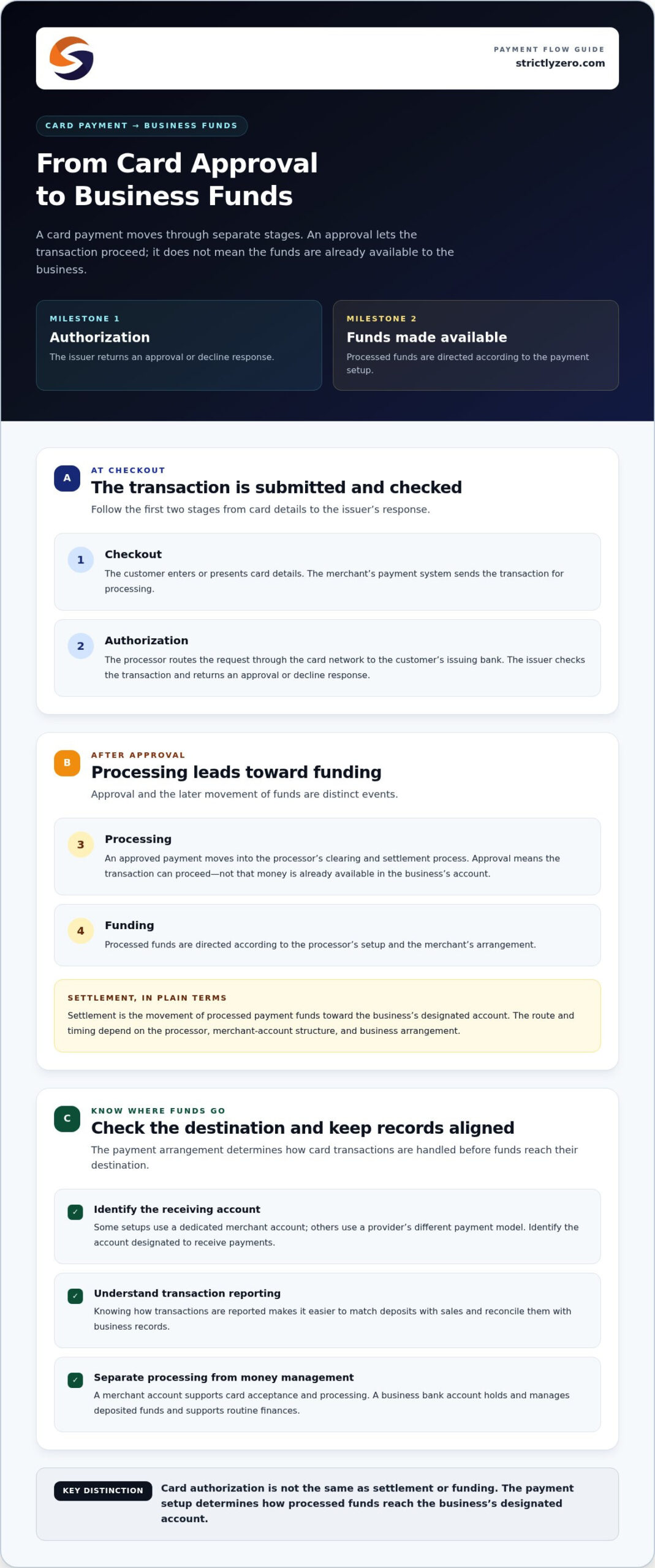
A card payment has two separate milestones: the transaction can be approved, and the funds can later be made available to the business. Understanding that distinction helps explain how the merchant account vs business bank account relationship works in practice.
What happens when a customer pays by card?
Here’s the usual sequence. The details can vary by processor and payment arrangement:
- Checkout: The customer enters or presents card details, and the merchant’s payment system sends the transaction for processing.
- Authorization: The processor routes the request through the card network to the customer’s issuing bank. The issuer checks the transaction and returns an approval or decline response.
- Processing: An approved payment moves into the processor’s clearing and settlement process. Approval means the transaction can proceed, not that the money is already available in the business’s account.
- Funding: Processed funds are directed according to the processor’s setup and the merchant’s arrangement.
Hypothetical example: A customer pays for an order online. The issuing bank approves the card transaction, so the merchant can treat the payment as authorized. The processor handles the next steps, and funds are directed according to the business’s payment setup. Approval and the eventual availability of funds are distinct events.
Settlement is the movement of processed payment funds toward the business’s designated account. The route and timing depend on the processor, merchant-account structure, and business arrangement. Authorization alone does not mean funding is complete.
Where do processed payments go?
Some setups use a dedicated merchant account as part of processing; others use a provider’s different payment model. The destination for funds depends on that setup. A business should be able to identify the account designated to receive payments and understand how transactions are reported. That makes it easier to match deposits with sales and reconcile them with business records.
The business bank account remains important for managing deposited funds and routine finances. The U.S. Small Business Administration explains considerations for opening a business bank account, while the payment arrangement determines how card transactions are handled before funds reach their destination.
For a broader look at the steps and tools involved, explore this guide to credit card processing services. Businesses accepting payments online, in person, or on mobile can also review omni-channel payment processing options to see how payment acceptance can support different customer checkout channels.
Do You Need Both a Merchant Account and a Business Bank Account?
Usually, a business needs a way to manage its funds and a payment solution if it wants to accept card payments. That doesn’t always mean opening two separately named accounts. Payment services are structured in different ways, so focus on what each part of your setup does rather than the labels alone.
| Function | Business bank account | Merchant account or payment solution |
|---|---|---|
| Purpose | Holds and manages business funds | Supports card-payment acceptance and processing |
| Typical use | Receiving deposits, paying expenses, and managing cash | Taking credit or debit card payments online, in person, or by mobile |
| Role in card acceptance | Doesn’t automatically provide card-processing functionality | Handles the payment-processing function, though the provider’s model may vary |
| Relationship to customer payments | May receive funds according to the payment setup | Processes card transactions and directs funds according to the arrangement |
When does a business need payment processing?
If customers pay by credit or debit card, the business needs a way to accept and process those transactions. That could mean taking a card at an in-person checkout, on an ecommerce site, or through a mobile payment workflow. Receiving a bank transfer or another non-card payment method is different. Those options don’t, by themselves, let a business accept cards.
For a closer look at the considerations involved, explore this guide to credit card processing for small business. Forbes also explains why merchant-account functionality can be essential for business accepting card payments.
Can one account replace the other?
Not by function. Banking supports the day-to-day handling of business funds; payment processing enables card acceptance. A business bank account alone doesn’t automatically provide the tools or processing arrangements needed to accept cards. Some payment providers streamline or combine parts of the payment setup, so a business may not have a separately opened account called a merchant account.
That’s the practical answer to merchant account vs business bank account: identify the banking function and card-acceptance function your business needs, then understand how they connect. Strictly supports online, in-person, and mobile payment acceptance through its omni-channel processing platform. Explore omni-channel payment processing to see how payment acceptance can fit different sales channels.
How to Choose the Right Business Banking and Payment Setup
Start with how customers pay, then consider what your business needs to manage the resulting funds. The right merchant account vs business bank account setup depends on two related questions: which banking features support daily operations, and which payment tools fit your sales channels?
Checklist: Match your payment channels, transaction tools, and funding workflow to the banking and processing setup your business needs.
Match payment tools to how customers pay
List how customers pay today and how they may pay as your business grows. In-person sales, ecommerce checkouts, and mobile payments can call for different acceptance tools. Payment links can help you collect payment remotely, while recurring billing can suit repeat charges. A virtual terminal may be useful when a customer provides card details for a payment you enter manually, rather than completing checkout through a website or card-present interaction.
Strictly supports online, in-person, and mobile payment processing, with payment links, a virtual terminal, and recurring billing. For more on matching payment acceptance to different channels, read this guide to omni-channel payment processing.
Review costs, reporting, and operating needs
Keep banking and processing requirements distinct as you compare your needs. For a bank account, consider its terms and whether its features suit routine deposits, payments, and cash management. For payment processing, consider the processing charges and program terms that apply. A pricing structure that suits one business may not suit another, so compare options against your transaction patterns rather than assuming one model is universally best.
Think through the back-office work, too. Can you reconcile card transactions with deposits? Do reports help you track sales across channels? Does the setup support the way you send invoices, handle recurring payments, and keep records? Clear answers can help prevent payment workflows from becoming disconnected from everyday bookkeeping.
Surcharge and dual pricing are optional payment-program considerations, not banking features. Requirements can vary by state and card network, so account for applicable rules and program terms before making either part of your checkout approach. Neither option should be assumed to remove every processing cost.
Once you’ve mapped your channels, tools, and reporting needs, you can make a more informed decision about how payment processing fits alongside business banking. Explore Strictly’s payment processing tools for online, in-person, and mobile transactions.
How Strictly Fits Into the Merchant Account and Banking Picture
Once you’ve identified the difference between payment acceptance and money management, it’s easier to see where a payment processor fits. Strictly supports businesses accepting payments online, in person, and on mobile. Its platform handles customer payment transactions, while a business bank account remains the tool for everyday banking.
What a payment processing platform can help you manage
Customers may pay through different channels, so a business can benefit from tools that fit each transaction. Ecommerce payments take place online, while a mobile payment workflow can support sales away from a fixed checkout. In-person transactions create another point of acceptance. An omni-channel platform brings these payment journeys into a broader processing setup.
Specific tools can support distinct tasks:
- Payment links let a business send a link for a customer to pay online, such as when collecting payment for an invoice.
- A virtual terminal supports manually entered payments, which can be useful when a customer provides payment details remotely.
- Recurring billing helps manage repeat charges for ongoing services or other recurring arrangements.
These tools address payment workflows. They don’t manage all of a business’s funds, pay its expenses, or handle broader cash needs. That’s why the merchant account vs business bank account distinction still matters, even when a processor makes payment acceptance feel like one streamlined service.
Choose a setup that fits your payment workflow
Before choosing tools, map where customers pay, what kinds of transactions you handle, and what information you need for reporting and reconciliation. A business that invoices remotely may prioritize payment links or a virtual terminal. A business with repeat charges may focus on recurring billing. If customers pay across several channels, consider how those transactions fit into one processing workflow.
Surcharge and dual pricing are optional program considerations, not universal recommendations or banking features. Applicable requirements can vary by state and card network, so account for the relevant rules and program terms before deciding whether either approach fits. Neither option should be treated as a promise that every processing cost will disappear.
In short, banking manages business funds; payment processing helps a business accept customer payments. To explore tools for online, in-person, and mobile transactions, Explore Strictly’s payment processing platform.
Build a Payment Setup That Works for Your Business
The key takeaway from the merchant account vs business bank account comparison is that payment acceptance and money management serve different purposes. Your business bank account helps manage funds, while a payment processing setup handles card transactions. Providers may package these functions differently, so focus on what each part of your setup actually does.
Choose payment tools around how customers buy and how your team manages transactions. Strictly supports online, in-person, and mobile payment acceptance, with payment links, a virtual terminal, and recurring billing for different workflows. Its surcharge and dual pricing program includes automated state-by-state compliance features and debit card detection. These are optional payment-program considerations, not bank-account features.
With your channels, transaction types, and reporting needs in view, you can make more confident choices about how to accept and manage payments. Explore Strictly’s payment processing platform to see how its tools can support your payment workflows.
Separate the jobs, choose tools that fit, and take the next step toward a payment setup that works for your business.
Frequently Asked Questions
Is a merchant account the same as a business bank account?
No. A business bank account holds and manages business funds, while a merchant account arrangement supports card-payment processing. The terms describe different functions, even if a provider combines parts of the setup. In the merchant account vs business bank account comparison, the key distinction is payment acceptance versus everyday money management. Focus on how the payment service handles processing and directs funds, rather than relying on the account label alone.
Do I need both a merchant account and a business bank account?
You generally need a way to manage business funds, and you need a payment solution if you want to accept credit or debit cards. That doesn’t always mean opening two separate accounts. Some providers use a streamlined processing model rather than a separately held merchant account. The practical question is whether your setup supports the payment methods you accept and provides a process for managing incoming funds.
Can a business bank account accept credit card payments?
A business bank account alone doesn’t automatically let you accept credit card payments. Card acceptance requires payment-processing functionality, which may come through a traditional merchant account arrangement or a provider that bundles processing into its service. For example, a customer paying by card online needs a checkout or payment tool connected to processing. A bank account may receive funds according to the setup, but it doesn’t perform card authorization and processing by itself.
How does money get from a merchant account to a business bank account?
After a card transaction is authorized and processed, funds are directed according to the processor’s and merchant’s arrangement. In a traditional setup, processed payments are settled toward the business’s designated bank account. Authorization and funding are separate steps, and the exact route and timing can vary by provider and account structure. Settlement and funding information describes how transactions appear in reports and when funds are made available.
Can I accept card payments without a merchant account?
You may be able to accept cards without opening a separate, conventional account called a merchant account. Some payment service providers bundle the processing function into a broader service or use another arrangement. You still need a payment solution that accepts and processes card transactions. Consider the channels you use, such as online checkout, in-person sales, or mobile payments, and how the payment arrangement handles funding and reporting.
What is the difference between a merchant account and a payment processor?
A merchant account is an account arrangement associated with accepting card payments, while a payment processor handles transaction-processing work, such as routing payment information through the relevant systems. In a traditional setup, these functions are distinct but connected. Some providers combine or simplify them, so merchants may interact with one service rather than separate account and processing providers. The service terms describe which functions it performs and how funds are directed.
Is money in a merchant account FDIC-insured?
Not automatically. FDIC deposit insurance applies to eligible deposits held at an FDIC-insured bank, subject to applicable requirements; the term “merchant account” alone doesn’t establish whether funds qualify. Coverage can depend on where funds are held, the legal account structure, and whether relevant records meet FDIC requirements. Provider disclosures describe the arrangement and any applicable protections. Don’t assume card-processing funds have the same insurance status as deposits in your business bank account.