

What if the payment API that handles your first subscription charge can’t support what happens next? A payment API for recurring revenue needs to fit your product and payment workflows, not just process a transaction. Failed payments, changing payment methods, and the customer experience all matter over the life of a subscription. Payment processing also isn’t automatically the same as recurring billing.
Comparing APIs is easier when you separate the billing decisions your business makes from the payment tasks the platform supports. The right choice depends on how well the full workflow fits your systems, your team, and your customers.
This guide provides a practical framework for evaluating recurring-payment APIs, from integration requirements and billing workflows to payment management and customer experience. It also explains how recurring billing can fit into a unified platform alongside online, in-person, and mobile payments, so you can compare options using clear technical and business criteria.
Key Takeaways
- Separate recurring billing rules and customer agreements from the payment API that processes each transaction.
- Use the payment lifecycle, from enrollment through reconciliation, to identify your workflow requirements.
- Compare a payment API for recurring revenue by integration fit, payment channels, reporting, and day-to-day operations.
- Build your shortlist around your business model, since SaaS, membership, and service businesses may prioritize different capabilities.
- See how Strictly combines API-first processing and recurring billing with online, in-person, and mobile payments.
What a Payment API for Recurring Revenue Needs to Handle
A payment API for recurring revenue connects a business’s systems to scheduled, repeat payment workflows. Billing orchestration sets the terms and timing, while payment execution attempts to collect each amount. This distinction matters when comparing platforms. A recurring plan might specify the price, billing interval, and customer agreement, while the payment-processing layer handles the transaction using the customer’s payment details.
A one-time charge can end with a payment result. A recurring relationship continues, so the surrounding operations matter too: keeping account details aligned with the agreed plan, recognizing whether a scheduled payment succeeded, and deciding what to do when it didn’t. The API is part of a wider process. It doesn’t automatically define your billing policies or manage every customer interaction.
Payment APIs and gateways provide the technical connection for moving payment information between systems and processing a transaction. For foundational context on that role, see Payment gateway. For recurring use, focus on what the integration supports around each transaction and which billing tasks remain in your own software or operations.
Recurring billing versus one-time payment processing
With a single purchase, a customer chooses an item, enters payment details, and authorizes one charge. A subscription or service plan creates an ongoing relationship: the business and customer agree to repeat charges on a schedule, and the system connects each scheduled billing event to a payment attempt.
These functions are related, but distinct. Billing rules determine what is due and when; payment processing attempts to collect it. Capabilities vary by API, so don’t assume every platform handles schedules, account changes, and payment outcomes in the same way. Define your workflow first, then assess how an integration supports it.
Which businesses benefit from recurring-payment workflows?
SaaS companies may bill for continued software access, membership organizations may collect dues, and service businesses may charge for ongoing plans. In each case, scheduled billing can make collection more consistent and help teams associate payments with customer accounts and agreed services.
Before selecting an API, define what “consistent” means for your operation. Consider how staff will identify an account, understand its billing arrangement, and respond to a payment result. A membership team, for example, may need to connect a charge to a member’s status, while a service business may need to match payments to a plan. An API can support these workflows, but adopting one doesn’t guarantee growth or retention.
How to Evaluate the Recurring Payment API Lifecycle
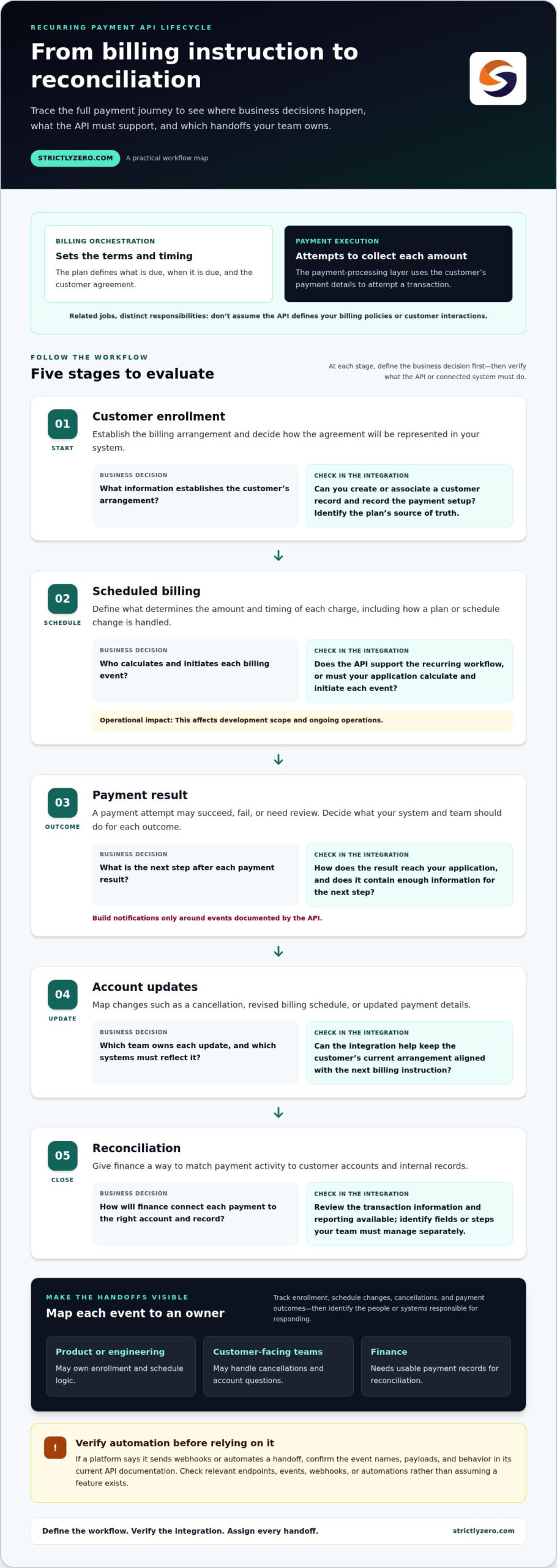
Trace a payment from the moment a customer agrees to pay through the point your team can reconcile the result. This shows where billing decisions happen, where the payment API is involved, and which handoffs might otherwise require manual work. A recurring payment moves from a billing instruction to a payment attempt, an account update, and finally a record your business can reconcile.
Use the lifecycle to separate essential workflow needs from optional automation. At each stage, write down the business decision first, then identify what the API or connected system needs to do. Don’t assume a feature exists because it’s common in recurring billing. Confirm the relevant endpoint, event, webhook, or automation in current API documentation.
- 1. Customer enrollment. Decide what information your business needs to establish a customer’s billing arrangement and how that agreement will be represented in your system. Identify the API requirements for creating or associating a customer record and recording the relevant payment setup. Make clear which system is the source of truth for the customer’s plan.
- 2. Scheduled billing. Define what determines the amount and timing of each charge, including how your team handles a plan or schedule change. Then determine whether the API supports the recurring workflow you need or whether your application must calculate and initiate each billing event. This affects both development scope and ongoing operations.
- 3. Payment result. Decide what your system should do after a payment attempt succeeds, fails, or needs review. Establish how the result reaches your application and whether it contains enough information for the next step. Don’t build a customer or staff notification around an event the API doesn’t document.
- 4. Account updates. Map changes such as a cancellation, revised billing schedule, or updated payment details. Determine which team owns each update and which systems must reflect it. The integration should help prevent a mismatch between the customer’s current arrangement and the next billing instruction.
- 5. Reconciliation. Decide how finance will match payment activity to customer accounts and internal records. Review the transaction information and reporting available, then identify any fields or steps your team must manage separately.
These stages also reveal who needs to act. Product or engineering may own enrollment and schedule logic; customer-facing teams may handle cancellations and account questions; finance needs usable payment records. Map events such as enrollment, schedule changes, cancellations, and payment outcomes to the people or systems responsible for responding. If a platform claims to send webhooks or automate a handoff, confirm the event names, payloads, and behavior in its current documentation before relying on it.
Plan for exceptions, too. A failed payment may require staff follow-up, a customer notice, or a change to the account’s status. Updated payment details may need to flow into the next billing instruction. Document who sees each issue, how it is resolved, and what record confirms the resolution. Treat retries, card updates, and dunning as requirements to confirm, not assumed features.
Strictly includes recurring billing in its API-first payment processing platform, which also supports online, in-person, and mobile payments. Compare that combination with your workflow and channel requirements at Strictly’s recurring billing.
Compare Payment APIs by Integration, Security, and Scale
A useful comparison starts with your operating model, not the longest feature list. Mark each capability as a must-have, useful extra, or irrelevant to your business. A SaaS company with custom billing logic may prioritize integration flexibility, while a membership organization may care more about clear account records and straightforward reconciliation. The same payment API for recurring revenue won’t suit every workflow.
Use the table to compare options consistently. Write down your specific requirement in each row, then record what the provider’s documentation demonstrates. Treat unanswered questions as items to resolve during evaluation, not capabilities you can assume.
| Category | What to compare | Typical priority |
|---|---|---|
| Integration approach | How the API fits your software architecture, development experience, and existing systems. | Must-have if you need a custom product flow; a simpler integration may suit a standard setup. |
| Recurring workflows | How billing instructions, payment outcomes, and account changes can be represented in your systems. | Must-have for the specific workflow you plan to operate. |
| Payment channels | Whether the platform aligns with the channels you use, such as online, in-person, or mobile. | Must-have for active channels; other channel support may be a useful extra. |
| Reporting | Whether transaction and billing records support your customer-service and reconciliation tasks. | Must-have when teams rely on these records to manage accounts or close their books. |
| Support and resources | What technical documentation and support options are described for implementation and ongoing use. | Priority depends on your team’s experience and internal capacity. |
Assess developer fit and integration effort
Read the API documentation as an implementation plan. Can your team understand how to authenticate, make the required calls, handle responses, and connect payment activity to existing customer records? Match the approach to your architecture and experience. A team building a custom checkout will assess different trade-offs than one connecting an established commerce system.
Review the current documentation for SDKs, sandbox access, relevant endpoints, and support options before including them in your implementation plan. Note dependencies and unanswered questions, then estimate the engineering and maintenance work your team would need to handle.
Compare security, reporting, and payment channels
Security is a shared evaluation area, not a badge to infer from a provider’s marketing. Understand how sensitive payment data is handled, what PCI DSS responsibilities remain with your business, and how the integration affects your own environment. PCI DSS v4.0.1 is the current standard; the payment security and compliance guide offers deeper context for assessing payment-processing responsibilities.
Next, check whether available records support the reporting your teams actually use: identifying transaction activity, reviewing recurring billing, and reconciling payment records. Compare online, in-person, and mobile capabilities with your real sales channels rather than focusing on channel breadth alone. A channel you don’t use isn’t automatically valuable. Reliable coverage for the channels you do use is the more practical test.
Keep optional automation in its proper place. It can be useful when it removes a documented operational burden, but it shouldn’t outweigh a gap in a core workflow, integration fit, or security responsibility. Consistent criteria make your shortlist more useful than letting one headline feature decide.
Build a Shortlist Around Your Recurring-Revenue Business
A shortlist should reflect how your business bills, serves customers, and manages payments, not a generic feature checklist. Start by choosing the criteria that matter most, then weight each one according to its business impact. A payment API for recurring revenue that fits a software company’s plan changes may not suit a membership organization with simpler billing and different account-management needs.
Match API priorities to your business model
SaaS teams may place more weight on subscription changes and visibility into customer accounts. Membership businesses may prioritize dependable repeat billing and records staff can use to answer member questions. Service businesses may focus on connecting ongoing plans with customer and payment records. These are starting points, not templates. Use your own workflows to decide which capabilities are essential.
If you accept payments across different sales channels, include channel fit in your criteria rather than assuming online payments cover every need. Businesses weighing online, in-person, and mobile payments can use this omni-channel payment processing guide to consider how those channels fit together.
Use a practical evaluation scorecard
Score each candidate against the same criteria, using a simple scale such as 1 to 5. Set the weight of each criterion first: a high-impact requirement should matter more than a useful extra. For every score, record the documentation or test result behind it. This keeps the shortlist grounded in evidence instead of impressions.
| Criterion | What to assess | Weight it more if… |
|---|---|---|
| Recurring workflow | Documented support for the billing steps your business needs. | Billing changes or exceptions are central to daily operations. |
| Integration fit | Implementation effort against your team’s skills and existing systems. | Your product needs a custom payment experience. |
| Channel fit | Coverage for the sales channels you actually use. | Customers pay both online and in person, or through mobile. |
| Reporting | Whether records support customer service and reconciliation. | Teams need payment details to resolve account or finance questions. |
| Operating ownership | Who handles testing, maintenance, exceptions, and customer updates. | Your team has limited capacity to manage manual tasks. |
Test the shortlist against representative cases before choosing. Include customer enrollment, a successful charge, a payment issue, a change to the billing arrangement, and the records your finance team needs afterward. Confirm which steps the API handles and which belong to your application or staff. Don’t count an undocumented retry or update process as part of the score.
Plan implementation ownership early. Name the people responsible for integration, testing, support handoffs, and ongoing maintenance. If you’re migrating from another setup, map customer records and billing arrangements, decide how to validate them, and plan how to avoid gaps or duplicate actions during the transition. These details affect the real effort of adoption, even when a platform looks like a strong feature match.
Use your scorecard to compare your requirements with Strictly’s payment processing platform, including recurring billing alongside online, in-person, and mobile payment acceptance.
How Strictly Supports Recurring Revenue and Unified Payments
Once you’ve defined your workflow, channel needs, and evaluation priorities, compare them with what a platform brings together. Strictly offers an API-first, unified payment processing platform with recurring billing and online, in-person, and mobile payment acceptance. Businesses can evaluate recurring billing alongside their other payment channels within one platform.
Use your shortlist to assess how Strictly aligns with your integration plans, customer payment experience, and internal operations. For technical details such as API endpoints, retries, webhooks, supported payment methods, and reporting, consult current documentation rather than inferring a capability from the platform’s broader description.
Where Strictly fits in a recurring-payment evaluation
Strictly’s recurring billing is part of its unified payment processing platform. Businesses accepting payments online, in person, and through mobile channels can evaluate those needs alongside recurring billing. The key question is how well that range aligns with the channels and workflows you identified, not simply how many capabilities a platform offers.
Strictly also offers a virtual terminal and payment links as additional platform tools. These can be relevant to payment operations, but they don’t establish that a particular API endpoint or automated recurring workflow is available. Keep the distinction clear in your evaluation: platform tools describe ways to accept or manage payments, while API-specific requirements depend on the documented technical details.
Consider payment costs and program fit carefully
Strictly’s platform includes surcharge and dual-pricing capabilities. Its Smart Pricing Engine includes state-by-state compliance automation and debit-card detection. These features are distinct from recurring billing, so evaluate them based on your broader payment-acceptance needs and the transactions to which a program may apply. Don’t assume surcharge applies to every payment type or recurring charge.
For a practical comparison, add separate questions to your shortlist: Does the platform’s recurring billing align with your workflow? Do its online, in-person, and mobile capabilities match your sales channels? Are surcharge or dual-pricing tools relevant to your payment operations? Keeping these criteria separate helps you compare platform features without confusing one capability for another.
Strictly brings API-first payment processing together with recurring billing and payment acceptance across multiple channels. Compare the platform with your documented requirements, including the technical details your team needs to evaluate. Explore Strictly’s payment processing platform and see how it aligns with your recurring-payment requirements.
Make Your Next Step a Workflow Review
Before choosing, bring the people who own product, payments, customer accounts, and finance into one conversation. Agree on what a successful payment experience should look like for customers and what your team needs to see when something changes. That shared baseline helps distinguish a genuine requirement from a feature that sounds useful but won’t solve an operational problem.
Then use your shortlist to evaluate how a payment API for recurring revenue fits the systems and responsibilities your business already has. A thoughtful decision isn’t about choosing the platform with the most features. It’s about choosing an approach your team can implement, operate, and adapt as your recurring-payment needs evolve.
Explore Strictly’s payment processing platform against your requirements and consider how its capabilities align with your planned workflow. With clear priorities and the right stakeholders involved, you can move forward with greater confidence and build a payment operation ready to support your business.
Frequently Asked Questions
What is a payment API for recurring revenue?
A payment API for recurring revenue connects business software with payment processing so a business can collect repeat payments as part of an ongoing customer relationship. For example, a software company might use one system to manage access and another to process the customer’s scheduled payment. Before implementation, identify which system owns the customer’s plan, amount, and billing schedule so updates don’t leave payment records out of sync.
How does a payment API process recurring payments?
A payment API connects a business’s software to a payment platform and supports the payment steps defined in the integration. The business’s billing setup determines when to initiate a charge; the platform then processes the payment request. A practical early test is to trace one scheduled billing event through your application and note what information your system needs to continue the workflow after receiving the result.
Can a payment API handle subscriptions and one-time payments together?
Some payment platforms support both recurring and one-time payment activity, but shared platform access doesn’t mean both flows work identically. A customer might maintain a subscription and also make a separate purchase, for example. Map how each transaction should appear in the customer’s account and internal records. Strictly’s unified payment processing platform combines recurring billing with payment acceptance, while your implementation should reflect the rules of each workflow.
Is a recurring payment API secure?
A recurring payment API can be part of a secure setup, but security depends on the provider, integration, and how your business handles payment data. Review the technical documentation to understand data flows and your PCI DSS responsibilities. For instance, determine whether sensitive payment details pass through your own systems or are handled elsewhere in the payment flow. An API alone doesn’t make an integration secure.
What happens if a recurring payment fails?
A failed payment can leave an invoice or customer balance unresolved, so decide how your business will respond before launch. For example, your policy might direct a staff member to review the account or provide the customer with a way to address the issue. Confirm how payment outcomes reach your systems, and verify any retry or reminder features in current documentation rather than assuming they’re built in.
How can a business change a customer’s recurring payment details?
A business can change recurring payment details through the update process supported by its integration and payment platform. Define whether customers make changes themselves or authorized staff handle them, then decide how your systems record the update and apply it to future billing. Test a realistic change, such as replacing an expired payment method, and confirm the customer account and internal records reflect the new information.
What should developers test before launching recurring payments?
Developers should test ordinary transactions and situations that affect customer accounts or staff workload. In a suitable test environment, exercise enrollment, a scheduled charge, a failed result, a billing-detail change, and the resulting internal records. Confirm that your software handles repeated or delayed information safely and that staff can identify unresolved cases. Review access to payment data and security responsibilities before enabling the live workflow.