
Did you know that 85% of shoppers make an unplanned purchase when they walk into your shop to grab their click-and-collect order? While that foot traffic is a win, many retailers are still losing margin by paying standard 2.9% e-commerce rates on transactions that end at a physical counter. Managing buy online pickup in store payment processing shouldn’t mean choosing between high fees and fragmented data silos that don’t talk to each other.
It’s frustrating to deal with higher fraud risks on card-not-present transactions and the headache of manual inventory syncing. We understand that you need your online and in-store systems to work as one. This guide will help you master the technical and financial side of BOPIS to eliminate unnecessary merchant fees, prevent fraud, and create a frictionless experience for your customers.
We’ll explore how a unified omni-channel gateway provides a single dashboard for all transactions while ensuring your business stays ahead of the latest PCI DSS 4.0 security requirements and 3D Secure 2.0 authentication standards.
Key Takeaways
- Learn how a unified omni-channel gateway connects your e-commerce checkout to your physical storefront to keep inventory and transaction data perfectly synced.
- Discover how to optimize your profit margins by identifying when to use card-not-present versus card-present rates for different pickup models.
- Follow a five-step plan to implement buy online pickup in store payment processing that eliminates data silos and reduces manual reconciliation.
- Protect your revenue with AI-driven fraud prevention and strategic “Capture on Pickup” workflows that significantly lower your chargeback risks.
- Leverage a smart pricing engine to eliminate merchant fees on every order while viewing all activity through a single, unified reporting dashboard.
What is BOPIS Payment Processing and How Does it Work?
Most retailers think of BOPIS as a logistical challenge, but it’s actually a financial one. At its core, buy online pickup in store payment processing acts as the technical bridge between your e-commerce checkout and your physical point-of-sale (POS). It’s the engine that ensures a customer’s digital payment journey ends successfully at your physical counter. In 2026, the U.S. click-and-collect market is estimated to reach $177.9 billion, which means your payment infrastructure has to be more than just functional; it has to be invisible.
To better understand how different processors handle these complex needs, watch this helpful comparison:
Effective buy online pickup in store payment processing relies on a unified gateway. This system syncs “Card Not Present” (CNP) data from your website with “Card Present” (CP) data from your store. Without this synchronization, your inventory and your bank account will never quite match up. Integrating this technology into a broader omnichannel retail strategy is essential for modern growth, especially as 11% of all e-commerce sales now happen through pickup orders.
The Anatomy of a BOPIS Transaction
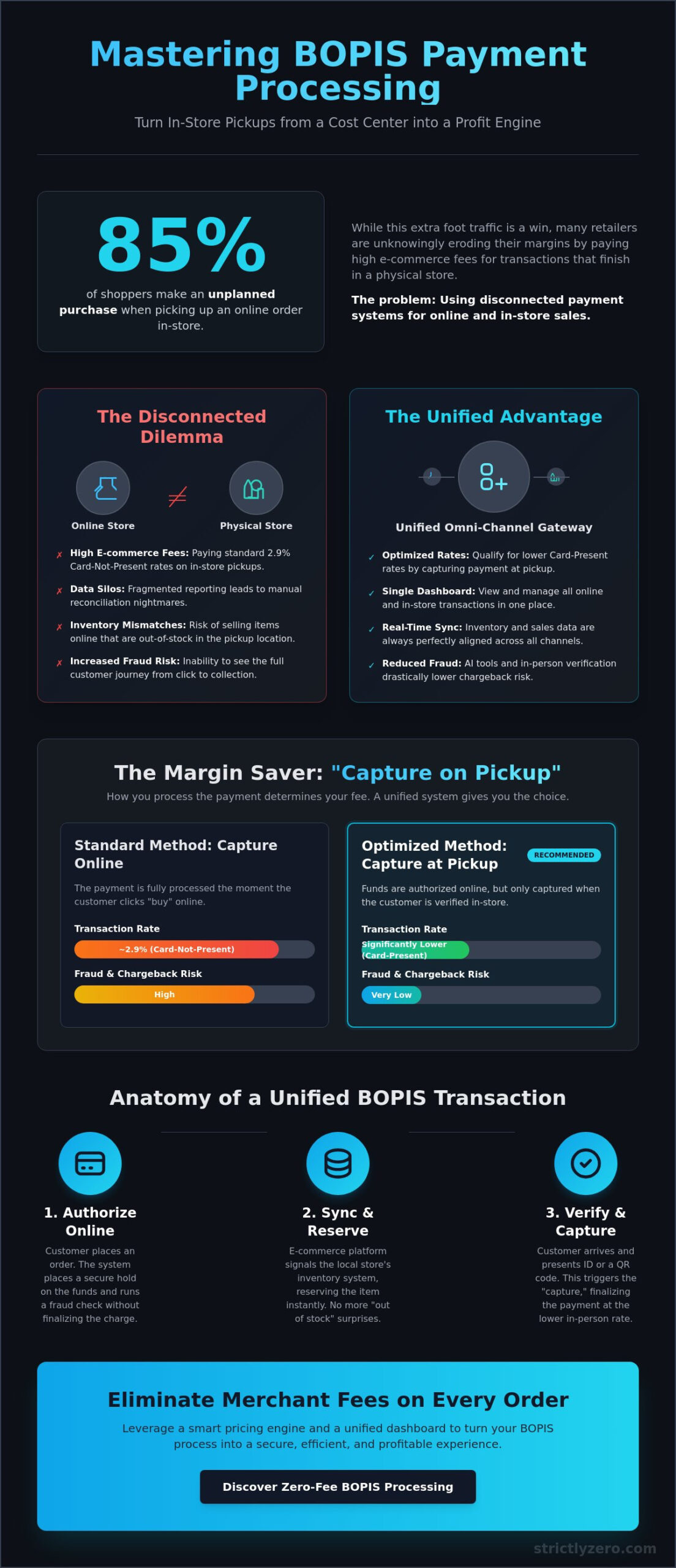
- Step 1: Authorization. When a customer clicks “buy,” the gateway places a hold on their funds and verifies the transaction for fraud.
- Step 2: Digital Handshake. Your e-commerce platform sends a signal to the local store’s inventory system to reserve the item immediately.
- Step 3: Verification. The customer arrives at the store and presents a QR code or ID. This triggers the “capture,” finalizing the payment on the ledger.
Why Traditional Payment Silos Fail
Using separate processors for online and in-store sales is a recipe for disaster. This fragmentation leads to reconciliation nightmares where accounting teams must manually pair web orders with physical receipts. You’ll often find yourself “double-dipping” on gateway fees because you’re paying for two different services that don’t talk to each other. It’s also harder to catch fraud when your AI-driven prevention tools can’t see the full customer journey from the initial click to the final pickup. Modern omni-channel payment processing solves this by placing every transaction into a single, searchable dashboard.
The Technical Mechanics: Authorization, Capture, and Syncing
The success of buy online pickup in store payment processing hinges on a two step dance: authorization and capture. When a customer places an order on your website, the system initiates a pre-authorization. This secures the funds on the customer’s card without finalizing the charge. It’s a critical safeguard that allows you to verify inventory before the money actually changes hands. If an item is out of stock, you can cancel the authorization easily, avoiding the messy process of issuing a full refund and waiting days for it to clear.
Many high volume retailers are moving toward a “Capture on Pickup” model. In this scenario, the final payment capture only occurs when the customer is physically standing at your counter. This significantly reduces the risk of “friendly fraud” and chargebacks. Because the customer has to show up to finalize the transaction, it’s much harder for them to claim they never received the goods. Accuracy is paramount here. A study involving 300 secret shoppers found that the biggest friction point in click and collect is the “Out of Stock” notification. Real time inventory syncing ensures your payment gateway and warehouse talk to each other every second, preventing you from authorizing payments for items you don’t have.
Unified Omni-Channel Gateways
To run a modern BOPIS operation, an ecommerce payment processing strategy must be unified. You need a single API that manages the customer profile from the mobile app to the retail desk. This eliminates the need for manual data entry and ensures that your reporting is consistent across all locations. If you’re scaling to multiple stores, integrating a robust gateway allows you to see every transaction in one place, regardless of where the order was initiated or picked up.
AI-Driven Fraud Prevention for Hybrid Orders
Hybrid orders present unique security challenges that manual ID checks can’t solve alone. In 2026, sophisticated AI-driven fraud prevention tools use geolocation and behavioral data to verify the buyer before they even arrive. These systems can flag a transaction if the digital footprint doesn’t match the pickup location. By automating this layer of security, your team can focus on the customer experience rather than playing detective at the register. If you want to protect your margins while scaling, you should explore how AI fraud prevention integrates with your existing checkout flow.
Pay Online vs. Pay at Pickup: Which is Better for Your Margin?
Choosing when to collect payment isn’t just a matter of customer preference. It’s a strategic decision that directly impacts your profitability. Research shows that a well-executed click-and-collect strategy Gives Retailers an Edge by increasing in-store traffic and boosting overall sales. However, the financial implications of buy online pickup in store payment processing vary significantly depending on whether the transaction is finalized on your website or at your retail counter.
Paying at pickup often yields higher conversion rates because it removes the friction of entering credit card details on a mobile device. It also allows you to take advantage of lower in-person processing rates. As of May 2026, standard flat-rate online fees remain around 2.9% plus $0.30, while in-person rates are typically lower, such as 2.6% plus $0.15. While these fractions of a percent seem small, they represent a significant portion of your margin over time. Conversely, paying online provides immediate security. It ensures you aren’t left with “zombie orders” that take up shelf space and waste labor hours without ever being collected.
Comparing the Costs of BOPIS Workflows
The total cost of your buy online pickup in store payment processing involves more than just the transaction fee. You have to account for the risk profile of each method. Card Not Present transactions carry a higher risk of fraud because the physical card isn’t verified by the merchant, which is why mandatory PCI DSS 4.0 compliance became the industry standard in early 2025. Pay at pickup models avoid some of this risk but introduce the cost of no-shows. If a customer doesn’t have “skin in the game” through an upfront payment, they’re less likely to prioritize the trip to your store, leaving you with prepared orders that never turn into revenue.
Optimizing for the Dual Pricing Model
You can further protect your margins by using a surcharge and dual pricing engine. This technology allows you to offer a lower price for cash or in-person payments while passing the cost of credit card processing on to the consumer for online orders. In 2026, the rules for this are strict. You must notify card brands like Visa and Mastercard 30 days in advance and post clear signage at your point of sale. Using a unified system makes this communication seamless. It ensures the price shown online matches the logic used at the store level, keeping you legally compliant while eliminating your processing fees entirely.
How to Implement BOPIS Payment Processing in 5 Steps
Transitioning to a high performance click and collect model requires more than a simple software update. It’s a strategic overhaul of your financial workflow. Implementing buy online pickup in store payment processing involves synchronizing your digital and physical environments so they act as a single unit. This five step framework will help you build a system that scales without increasing your administrative burden.
- Step 1: Audit for Compatibility. Review your e-commerce platform and store software to ensure they can communicate through a single API. If your systems are siloed, you’ll face constant reconciliation errors.
- Step 2: Select a Unified Processor. Choose a partner that offers omni-channel payment processing. This ensures that a customer’s digital profile follows them from the web checkout to the retail counter.
- Step 3: Configure Auth and Hold. Set your gateway to authorize funds at the time of the online order. This secures the money while giving you time to verify inventory before the final capture.
- Step 4: Train Your Team. Your staff must know how to trigger the “Capture” event and verify customer identity without creating long lines at the pickup desk.
- Step 5: Deploy a Surcharge Engine. Use a dual pricing engine to offset the higher costs of online transactions. This allows you to maintain your margins even on smaller pickup orders.
Hardware vs. Software Requirements
You don’t always need new physical scanners to get started, but you do need software that is mobile ready. Your credit card processing for small business setup should allow employees to use tablets or mobile devices for curbside check-in. Virtual terminals are also essential. They allow your team to process “Pay at Pickup” orders through a secure web interface, which is perfect for satellite pickup locations or temporary holiday kiosks that don’t have permanent POS hardware. This flexibility ensures your buy online pickup in store payment processing works anywhere on your property.
Staff Training and Customer Communication
Training should focus on security and the customer experience. Script the “ID Check” process to ensure your team stays compliant with PCI DSS 4.0 standards while remaining friendly. Use your gateway’s automation features to send SMS or email triggers the moment an order is “Ready for Capture.” This keeps the customer informed and reduces the “no show” rate. When it comes to returns, your staff can use the original digital token to issue a refund. This means they can process the return instantly without the customer needing to present their physical card again. If you’re ready to modernize your checkout, contact us to build your omni-channel strategy and eliminate unnecessary processing fees.
The Strictly Advantage: Zero-Fee BOPIS Processing
Most merchants accept high transaction costs as an unavoidable expense. When you integrate Strictly’s Smart Pricing Engine into your buy online pickup in store payment processing, those fees finally disappear. Our technology automatically identifies the transaction type and applies the correct pricing logic to ensure you keep 100% of your sale price. By shifting the processing cost to the cardholder where permitted, you can stop subsidizing the convenience of credit card rewards programs and start reinvesting that capital into your inventory.
Strictly provides a unified reporting dashboard that brings your entire operation into focus. Instead of logging into three different portals to check your web sales, physical store receipts, and warehouse stocks, you get a single source of truth. This level of transparency is why many retail leaders consider Strictly the best credit card processing for small business in 2026. We also handle the heavy lifting of automated state-by-state compliance. Whether you’re operating in a state with strict surcharging disclosures or one with specific receipt requirements, our engine updates in real time to keep you protected.
Eliminating the “E-commerce Tax”
Retailers often pay an “E-commerce Tax” of 2.9% plus $0.30 or more for every order placed online, even if the customer does the work of picking it up. Over a year, these fractions of a percent can drain tens of thousands of dollars from your bottom line. Our zero fee credit card processing model is built specifically for omni-channel merchants who want to offer digital convenience without the digital price tag. You can calculate your annual savings by looking at your total volume of “Card Not Present” transactions that are fulfilled in-store; with Strictly, that fee column drops to zero.
Scalability for ISOs and Partners
We don’t just help individual merchants; we empower partners to scale. ISOs can now offer sophisticated buy online pickup in store payment processing solutions to their entire retail portfolio, providing a competitive edge that flat-rate processors can’t match. Managing these complex relationships is simple with ClearSplit™. This tool allows you to manage multi-location merchant residuals and partner splits with total accuracy. You can monitor every transaction and every penny of margin from a high-level view, making it easier than ever to grow your book of business. Scale your payments business with Strictly today and lead the zero-fee revolution in the retail sector.
Future-Proof Your Retail Margins
The shift toward click and collect isn’t just a trend; it’s a fundamental change in how Americans shop. By mastering the technical side of buy online pickup in store payment processing, you’ve already taken the first step toward reclaiming your margins. You now understand how a unified gateway prevents data silos and how strategic “Capture on Pickup” workflows can slash your chargeback risks. These aren’t just logistical improvements. They’re essential financial upgrades for any retailer looking to thrive in 2026.
You shouldn’t have to choose between customer convenience and your bottom line. With Strictly, you get a PCI DSS Level 1 Compliant partner that prioritizes your profitability. Our Smart Pricing Engine is designed to eliminate fees entirely, while our Unified Omni-Channel Dashboard gives you total clarity over every transaction. It’s time to stop paying an “e-commerce tax” on orders your customers pick up themselves. Eliminate your BOPIS processing fees with Strictly and start keeping more of what you earn today. Your business deserves a payment strategy that works as hard as you do.
Frequently Asked Questions
Is BOPIS payment processing more expensive than standard in-store processing?
Yes, buy online pickup in store payment processing is often more expensive if the customer pays on your website. Online transactions are classified as Card Not Present (CNP), which carries higher risk and higher processing rates. If you choose a “Pay at Pickup” model where the card is physically swiped or tapped at your counter, you can access lower Card Present (CP) rates and improve your margins.
How do I prevent fraud with buy online pickup in store orders?
The most effective way to prevent fraud is to implement AI-driven fraud prevention tools that analyze behavioral data and geolocation. You should also use the “Capture on Pickup” model, which requires the customer to be physically present to finalize the charge. Always verify a government-issued ID at the counter to ensure the person picking up the order matches the name on the digital authorization.
Can I use a surcharge program for BOPIS orders paid online?
You can use a surcharge program if you have a compliant surcharge and dual pricing engine. This technology allows you to pass the cost of credit card processing to the customer for online orders. You must follow specific card brand rules, which include notifying Visa and Mastercard 30 days in advance and ensuring the surcharge is clearly listed as a separate line item on the digital receipt.
What happens if a customer never picks up their BOPIS order?
If you used an “Auth and Hold” strategy, the authorization will eventually expire and the funds will be released back to the customer. If you captured the payment upfront, you’ll need to process a refund through your dashboard. No-shows are a common challenge, so many merchants use automated SMS reminders to encourage customers to complete their buy online pickup in store payment processing journey.
Do I need a separate merchant account for my online store and physical shop?
No, you don’t need separate accounts if you use a unified omni-channel payment processing solution. A modern system consolidates your web and retail transactions into a single merchant account. This gives you one dashboard for all reporting, making it much easier for your accounting team to reconcile daily sales without jumping between different platforms or processors.
How does tokenization help with BOPIS security?
Tokenization replaces sensitive credit card data with a unique digital identifier or “token.” This means your staff can finalize a pickup or process a return without ever seeing or storing the customer’s actual card number. It’s a vital security layer that helps you maintain PCI DSS 4.0 compliance while ensuring that customer data remains safe even if it’s accessed across multiple store locations.
Can I offer “Pay at Pickup” without a physical POS terminal?
Yes, you can process these payments using a virtual terminal. This software allows your staff to enter payment details or send a secure payment link through a web browser on a tablet or mobile phone. It’s an excellent solution for curbside pickups or temporary outdoor kiosks where traditional hardware isn’t available, allowing you to maintain a professional checkout experience anywhere.
Is dual pricing compliant for e-commerce pickup orders in all states?
Surcharging and dual pricing regulations vary by state and are subject to frequent legal updates. While it’s a powerful tool for eliminating merchant fees, you must ensure your system follows local laws and card brand requirements. Using an automated compliance engine is the safest way to manage these rules, as it updates your pricing logic in real time based on the merchant’s specific location.