
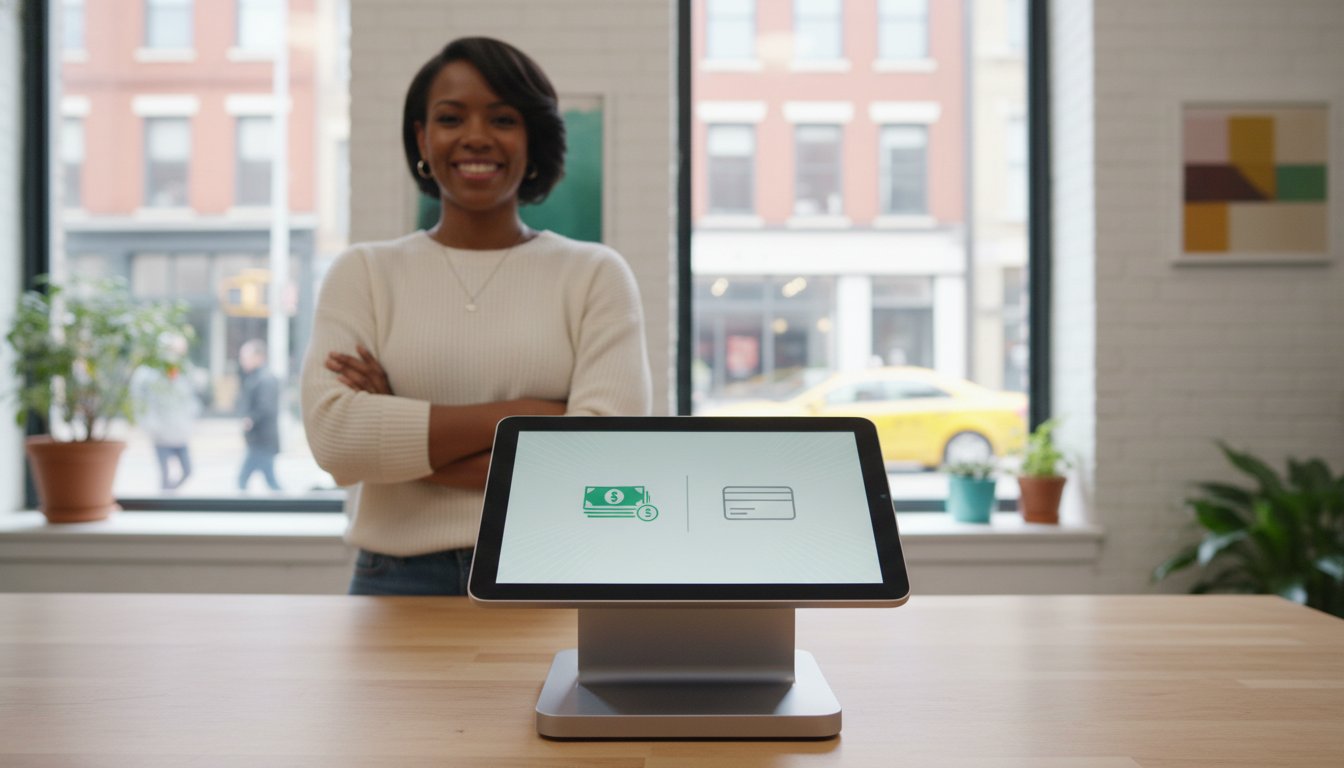
What if your monthly processing statement showed a balance of exactly zero dollars, without risking a single customer complaint or legal headache? You’ve likely watched your margins shrink as Visa and Mastercard interchange rates hit averages of 1.97% and 1.79% this April 2026. It’s frustrating to feel like you’re losing a chunk of every sale to fees that only seem to go up. By implementing dual pricing merchant services, you can legally eliminate 100% of these processing costs while offering your customers total transparency and the power of choice.
You know that staying compliant with state laws and the 3% Visa surcharge cap feels like a full-time job. We’ll show you how to automate that process across all 50 states so you can focus on your business instead of complex fine print. This guide breaks down why dual pricing is legal in every state, explains how the Durbin Amendment protects your debit transactions, and provides a clear roadmap to securing your profit margins for good.
Key Takeaways
- Discover why displaying a clear card price alongside a cash price is the most reliable way to eliminate processing fees without violating card brand rules.
- Identify the critical legal distinctions between dual pricing merchant services, surcharging, and cash discounting to avoid state-level compliance traps.
- Learn how modern point-of-sale technology automates “non-cash adjustments” to keep your digital and physical receipts 100% transparent for every customer.
- Master a simple two-step audit process to transition your business to a zero-fee model while protecting your margins and customer loyalty.
- Explore how unified omni-channel platforms handle complex debit detection and multi-state regulations automatically so you don’t have to.
What Are Dual Pricing Merchant Services?
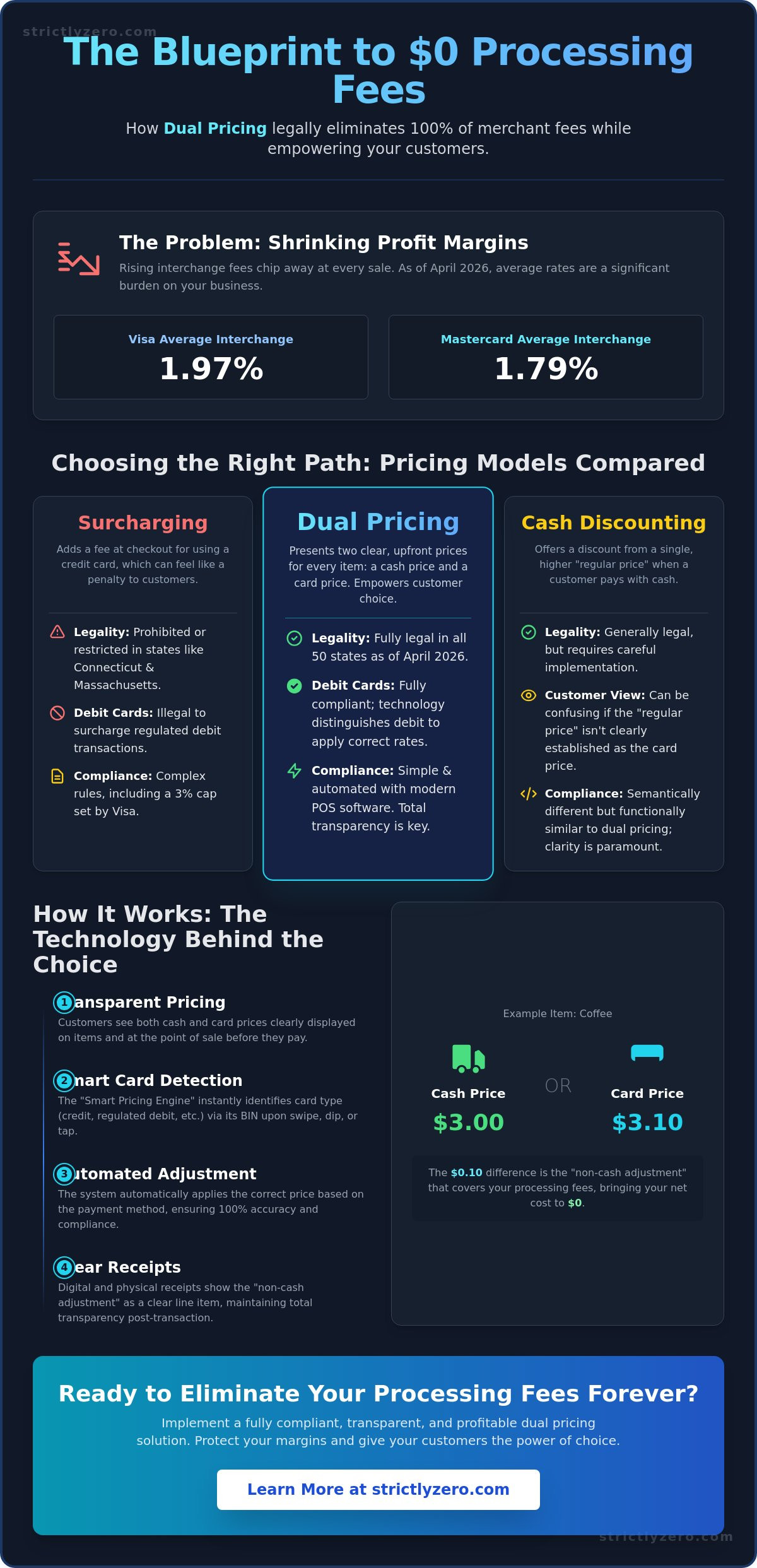
Dual pricing merchant services represent a fundamental shift in how small businesses manage the cost of commerce. Instead of a single price where the merchant absorbs a 1.5% to 3.5% processing fee, this model displays two distinct prices for every item: one for cash and one for card. This approach is rooted in the economic principle of Price discrimination, where different prices are offered to reflect the varying costs of transaction methods. By April 2026, this has become the gold standard for merchants who want to protect their bottom line without compromising on transparency.
To see how this model functions in a real-world setting, watch this detailed breakdown:
Traditional processing is quickly becoming a relic of the past for industries with thin margins. While surcharge-only programs often face legal hurdles in states like Connecticut or Massachusetts, dual pricing remains legal in all 50 states as of April 2026. This is because the model frames the cash price as a discount rather than a penalty for using a card. By building the processing costs into the card-price margin, you can effectively offset 100% of your merchant fees while remaining fully compliant with card brand regulations.
The Mechanics of the Dual Price Model
Modern dual pricing relies on sophisticated software rather than manual calculations. When a customer approaches the point of sale, the “Smart Pricing Engine” within the terminal identifies the card type instantly. This is crucial because it distinguishes between credit cards and regulated debit cards, which are capped at 0.05% plus 21 cents under the Durbin Amendment. The software automatically calculates the correct card-present or card-not-present rate, ensuring the merchant doesn’t overcharge or under-collect. Transparency is the engine of success here; when customers see both prices upfront, they feel empowered by the choice rather than surprised by a fee at the end of the transaction.
Why 2026 is the Year of Dual Pricing
The urgency for adopting dual pricing merchant services has never been higher. As of April 2026, average interchange fees for Visa and Mastercard have stabilized at 1.97% and 1.79% respectively, but when you add processor markups, many businesses are paying over 3% per swipe. Consumer behavior has also evolved. What was once seen as an unusual practice in gas stations is now a standard retail and service industry norm. Customers appreciate the honesty of a dual-price tag over hidden service fees that appear only during checkout. Dual pricing is the most compliant and transparent path to achieving $0 in processing fees for any business operating in 2026.
How Dual Pricing Works: The Technology Behind the Choice
Modern dual pricing merchant services are far more than a simple labeling strategy. They represent a dynamic software solution that bridges the gap between your merchant account and the customer-facing display in milliseconds. When a customer initiates a transaction, the system performs a high-speed digital handshake with the payment gateway to determine the exact fee structure for that specific card. This technology ensures that both the cash price and the card price are clearly visible before the payment is finalized, fulfilling the transparency requirements mandated by major card brands.
The backend logic of these systems automates the heavy lifting that used to require manual accounting. Digital and physical receipts now feature automated line items that clearly distinguish between the two price points. This level of clarity is vital for staying aligned with state-by-state laws, which often hinge on how clearly a merchant communicates pricing to the consumer. Cloud-based synchronization allows these price adjustments to stay consistent across mobile terminals, countertop units, and online storefronts simultaneously.
Smart Pricing Engines and Card Detection
The heart of a compliant dual pricing model is the Smart Pricing Engine. This AI-driven tool identifies the card type through the Bank Identification Number (BIN) as soon as the card is swiped, dipped, or tapped. This detection is critical because federal law, specifically the Durbin Amendment, treats debit cards differently than credit cards. While credit transactions can be offset via dual pricing, surcharging a debit card is a violation of federal regulations. By using backend logic that recognizes regulated debit cards, which carry a capped interchange rate of 0.05% plus $0.21, the software prevents unauthorized adjustments. This precision is the only way to maintain a truly compliant zero fee credit card processing environment without risking heavy fines.
Omni-Channel Synchronization
Managing a business in 2026 requires a unified approach to payments. API-first integrations allow you to manage dual pricing on e-commerce platforms just as easily as in a physical store. If you send invoices to remote clients, you can use payment links that present the same dual-priced options, ensuring your margins stay protected regardless of how the customer pays. This consistency across all ecommerce payment processing touchpoints builds trust with your audience. If you’re ready to modernize your checkout, you might review your current hardware compatibility to see how quickly you can switch to a cloud-synced model.
Dual Pricing vs. Surcharging vs. Cash Discounting
Understanding the difference between these three models is vital for any merchant looking to combat the rising costs of credit card processing fees. While they all aim to protect your margins, their execution and legal standing vary significantly. Surcharging involves adding a specific fee, capped at 3% or your actual cost as of 2023, to a credit card transaction at the point of sale. Many customers view this as a penalty, which can hurt your brand loyalty. Cash discounting offers a reduction from a standard price, but it often creates confusion in accounting departments because the base price isn’t always clearly defined.
Dual pricing merchant services solve these issues by presenting two separate, fixed prices for every item. This model is the most transparent of the three because there are no surprise fees added at the end of the checkout process. Instead of feeling penalized for using a card, customers simply see two different prices and choose the one that fits their preferred payment method. This clarity removes the “stigma” associated with surcharging while ensuring you cover your costs on every transaction.
Compliance and Legal Safeguards
Navigating the legal landscape of payment processing requires precision. While surcharging programs are banned or heavily restricted in states like Connecticut and Massachusetts, dual pricing is legal in all 50 U.S. states as of April 2026. This legality hinges on the fact that dual pricing is presented as a discount for cash rather than a punishment for card use. Unlike surcharging, dual pricing requires no complex state-by-state surcharge registrations or formal notifications to card brands. This makes it the most robust option for businesses operating across state lines or those that want to avoid the administrative burden of regulatory filings.
The Debit Card Dilemma
A major compliance pitfall that many competitors ignore is the treatment of debit cards. Federal law makes it strictly illegal to surcharge a debit card, even if the customer chooses to run it as “credit” at the terminal. If your system adds a fee to a debit transaction, you’re in violation of the Durbin Amendment and risk severe penalties. Dual pricing handles this naturally by treating debit cards like cash or by having a specific price point that reflects the lower interchange rates, which are capped at 0.05% plus $0.21 for large banks. Integrating this logic is a core part of the best credit card processing for small business strategies. It ensures you stay compliant while still benefiting from the lower costs associated with debit transactions.
Implementing Dual Pricing in Your Business
Implementing dual pricing merchant services is a strategic move that requires more than just a software update. It begins with a comprehensive audit of your current processing volume. By April 2026, most merchants find their effective rates hovering between 2.5% and 4% once all markups are included. Comparing this to the 1.97% Visa interchange average helps you see exactly where your revenue is leaking. Once you’ve identified the gap, the next step is selecting a provider with a compliant dual pricing engine. This engine must be capable of handling both in-person swipes and online transactions to ensure your margins stay protected across every channel.
After selecting your technology, focus on the physical and digital environment. You must update your signage and digital displays to reflect both the “Cash” and “Card” prices clearly. This isn’t just about compliance; it’s about setting expectations. Design your price tags so the cash discount is the highlight. Finally, establish a monthly routine to monitor your residuals. Within the first 30 days, most businesses see a 90% to 100% reduction in their processing bill, but verifying these savings against your actual sales volume ensures the system is calibrated correctly.
Setting Up Your Virtual Terminal
Configuring your credit card processing for small business dashboard is where the automation happens. You’ll need to set default price increments that cover the standard interchange rates plus network fees. For omni-channel businesses, this means syncing your physical POS with your e-commerce storefront via a unified API. If you run a subscription model, ensure your recurring billing software is updated to offer dual price options. This allows subscribers to choose a lower monthly rate by paying via ACH or cash equivalent, further reducing your overhead. To see how these tools integrate with your current setup, you can request a custom hardware audit to identify potential gaps in your system.
Customer Communication Strategies
Staff training is the most overlooked part of a successful rollout. Your front-line employees shouldn’t apologize for the pricing; they should present it as a choice. A simple script like, “Your total is $10.00 for cash or $10.40 for card. How would you like to pay today?” works best. This framing shifts the focus to “Cash Savings” rather than “Card Fees.” Clear, compliant signage at the point of sale reinforces this message. By the time the customer reaches the counter, they should already be aware of the two-tier pricing, making the transaction smooth and professional.
Why Strictly is the Leader in Dual Pricing Solutions
Strictly stands out in April 2026 by solving the technical hurdles other processors often ignore. While many competitors offer dual pricing as a surface-level feature, the Strictly Smart Pricing Engine provides a deep-tech solution. It automates compliance and debit detection at the point of interaction. This ensures you aren’t accidentally surcharging debit cards, which remains a major legal risk under the Durbin Amendment. By integrating dual pricing merchant services into a single, unified platform, Strictly provides a seamless experience whether you’re selling in-person, through a mobile terminal, or via a web storefront.
Reliability is the backbone of our model. Many merchants on community forums report being abandoned by large processors when technical issues arise, leaving their businesses unable to accept payments during peak hours. Strictly counters this with 24/7 US-based support. Our team understands the 2026 regulatory environment and can help you transition from traditional fee-heavy models to a zero-fee structure without the usual downtime. We focus on partner-focused tools like ClearSplit™ for ISOs and MSPs to ensure that every stakeholder in the payment chain has the transparency they need.
Zero-Fee Processing Without the Headache
Most monthly processing statements are cluttered with “junk” fees that have nothing to do with interchange rates. Strictly eliminates this noise by providing a transparent statement that reflects a true zero-fee outcome. Our “Trust as a Payment Processor” model prioritizes security and reliability above all else. Because we utilize an API-first payment processing platform, you can integrate our dual pricing logic into your existing business tools without replacing your entire tech stack. This flexibility is why dual pricing merchant services from Strictly have become the preferred choice for businesses looking to scale without increasing their overhead.
Scaling for Partners and ISOs
For partners looking to expand their portfolio, our payment processing platform for ISOs offers the tools needed for rapid merchant onboarding. We provide proprietary technology like ChurnIQ™ to help you identify and retain merchants who are most likely to benefit from a zero-fee model. This data-driven approach ensures your clients stay satisfied and your portfolio remains stable even as market conditions shift. We’ve designed every part of the onboarding process to be as fast as possible, allowing you to move merchants from high-fee environments to a compliant dual pricing model in a matter of days.
Eliminate your processing fees today with Strictly.
Take Control of Your Profit Margins Today
Eliminating credit card processing fees doesn’t have to be a legal gamble or a customer service nightmare. By choosing dual pricing merchant services, you’re adopting a model that’s legal in all 50 U.S. states and fully compliant with the April 2026 interchange updates. You’ve seen how this technology automates the complex task of debit detection while maintaining the transparency your customers expect. It’s time to stop letting 3.5% of your revenue disappear into a monthly statement of junk fees.
Strictly provides the infrastructure to make this transition seamless. Our Smart Pricing Engine™ handles the regulatory heavy lifting, while our PCI-DSS Level 1 Secure Platform keeps every transaction safe. Partners also benefit from ClearSplit™ to ensure residual transparency at every level. Don’t let rising interchange rates dictate your business’s future success. Start Saving Today: Get Your Zero-Fee Dual Pricing Quote and join the growing number of merchants who have reached a zero-dollar processing balance. Your bottom line will thank you.
Frequently Asked Questions
Is dual pricing legal in all US states?
Yes, dual pricing is legal in all 50 U.S. states as of April 2026. Unlike surcharging, which faces heavy restrictions or bans in states like Connecticut and Massachusetts, dual pricing is framed as a cash discount model. This approach is protected by federal law because it offers a lower price for cash rather than adding a surprise penalty at the end of a card transaction. It’s the most stable way to implement dual pricing merchant services nationwide.
What is the difference between dual pricing and a credit card surcharge?
The primary difference lies in transparency and presentation at the point of sale. Surcharging adds a fee, which was capped at 3% or the actual cost of processing as of 2023, to the advertised price when a customer pays by credit card. Dual pricing presents two separate, clearly marked prices for every item before the customer chooses their payment method. This eliminates the “penalty” feel of a surcharge and ensures full compliance with card brand rules.
Can I use dual pricing for my online store (e-commerce)?
You can absolutely use dual pricing for e-commerce through API-first integrations and specialized payment gateways. Modern online storefronts use real-time logic to display both the cash or ACH price and the credit card price in the digital shopping cart. This ensures your online margins stay as protected as your in-store sales. It’s a growing trend for 90% of omni-channel retailers who want consistent pricing and margin protection across all their digital platforms.
Do I have to pay a fee when a customer pays with a debit card?
You still pay a processing fee for debit cards, but it’s significantly lower than credit card rates due to federal regulations. The Durbin Amendment caps interchange for large banks at 0.05% plus $0.21 or $0.22. Because federal law prohibits surcharging debit cards, dual pricing systems often treat debit payments as “cash” or apply a specific lower rate. This keeps you compliant while covering the minimal cost of the transaction without violating card brand agreements.
How do I explain dual pricing to my customers without losing sales?
Focus your explanation on the benefit of the cash discount rather than the cost of using a card. A simple “We offer a lower price for cash payments” is often all it takes to maintain a positive experience. By April 2026, roughly 75% of consumers have encountered dual pricing in restaurants or retail shops. Clear signage that displays both prices upfront removes the element of surprise, which is the main cause of customer friction.
What equipment do I need to start a dual pricing program?
You need a smart terminal or point-of-sale (POS) system specifically programmed with a dual pricing engine. Traditional legacy terminals can’t always handle the real-time calculation and dual-receipt printing required for total transparency. Your hardware must be able to display two distinct prices to the customer on the checkout screen and print both the cash and card totals on the final itemized receipt to satisfy current 2026 merchant service standards.
Does dual pricing affect my PCI compliance requirements?
Dual pricing doesn’t change your fundamental PCI compliance requirements, but your choice of provider can simplify the administrative burden. Your business must still follow standard security protocols to protect cardholder data. However, modern dual pricing merchant services providers often handle the heavy lifting of data encryption and secure transmission. This helps you maintain your annual PCI-DSS certification with less effort by using a Level 1 secure platform that prioritizes data integrity.
Can I switch back to traditional processing if I don’t like dual pricing?
You can switch back to traditional processing at any time if you find the model isn’t the right fit for your specific customer base. Most reputable providers offer flexible contract terms that allow for a transition back to standard interchange-plus or flat-rate pricing. It’s a good idea to run the program for at least 90 days to accurately measure the impact on your profit margins and customer retention before making a final decision.