

Did you know that U.S. merchants paid a staggering $187.20 billion in card processing fees in 2024? For a startup, these costs are more than just a line item; they’re a direct hit to your bottom line. You’re likely here because you want to know how to get a merchant account for a new business without getting buried in hidden surcharges or facing an unexpected application rejection. It’s completely normal to feel overwhelmed by complex underwriting or the strict PCI DSS 4.0.1 compliance standards that became mandatory on March 31, 2025.
Don’t just look at the percentage on the application. You must also account for batch fees, which range from $0.10 to $0.30 daily, and the monthly cost of maintaining PCI compliance. If you process $25,000 a month with a traditional aggregator, you could be losing over $8,500 annually in processing costs. A surcharge model eliminates that drain. When deciding how to get a merchant account for a new business, the most cost-effective choice is the one that allows you to keep the full sticker price of your products. Utilizing a provider like LyrxPay for Credit Card & ACH Processing ensures you can reinvest that capital back into your marketing or hiring efforts instead of losing it to avoidable bank fees.
We believe your focus should stay on your customers, not on why you’re losing 1.5% to 3.5% on every swipe or tap. This guide simplifies the path to approval and shows you how to implement a compliant zero-fee processing model to keep every cent of your sales. We’ll walk through the essential documentation, explain how to avoid “high-risk” traps, and help you select a platform that scales with your ambition from day one.
Key Takeaways
- Understand the mechanics of how merchant accounts facilitate secure money flow from customer payments directly to your business bank account.
- Learn exactly how to get a merchant account for a new business by preparing for the 2026 underwriting process and mitigating potential high-risk flags.
- Compare traditional flat-rate pricing against modern zero-fee surcharge models to protect your profit margins from day one.
- Follow a practical application roadmap that helps you accurately project processing volumes and select the right omni-channel sales setup.
- Discover how a unified commerce solution can eliminate unnecessary fees and help you retain 100% of your sales revenue across all platforms.
What Is a Merchant Account and Why Does Your New Business Need One?
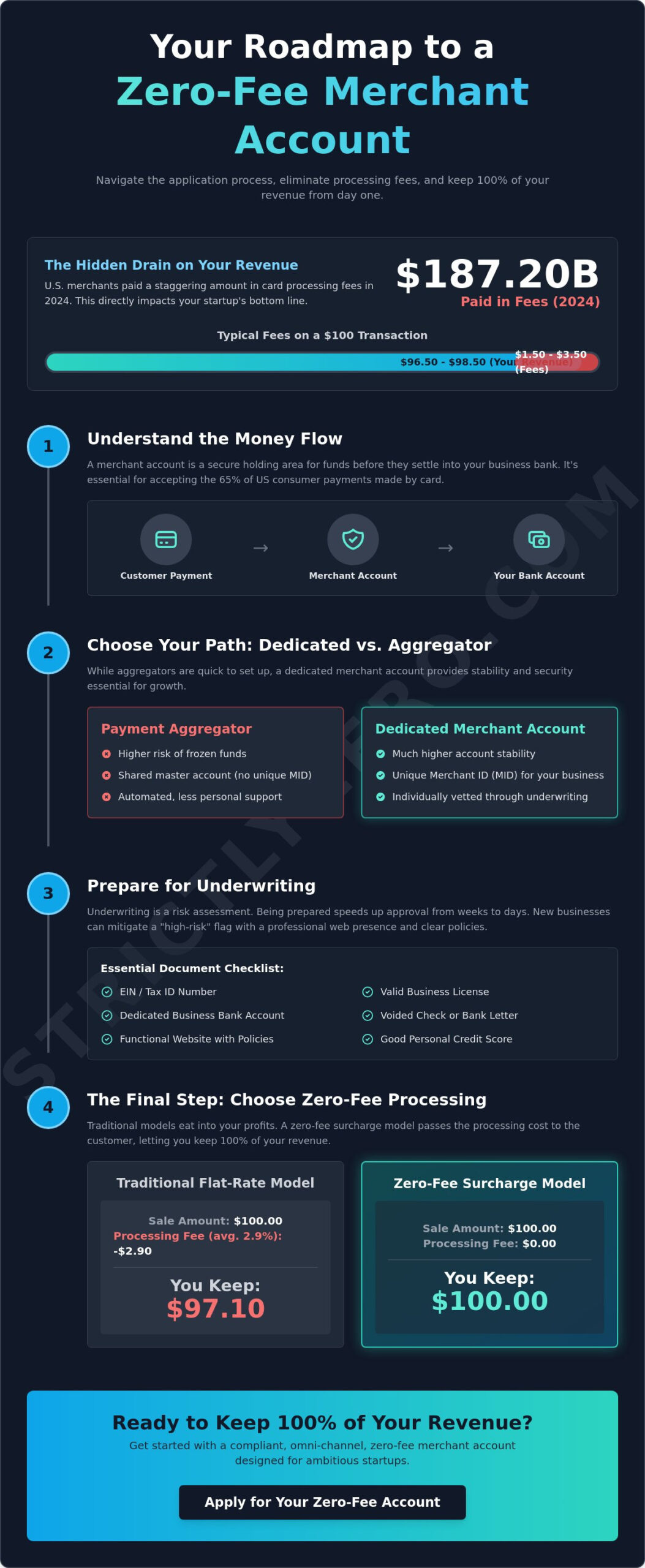
A merchant account is a specialized financial arrangement that acts as a staging area for credit and debit card funds before they are settled into your primary bank. Understanding What Is a Merchant Account is a vital step in learning how to get a merchant account for a new business. In 2024, credit and debit cards made up 65% of all consumer payments in the US. Without this dedicated account, you simply can’t participate in the modern economy or meet your customers’ payment expectations.
The money flow is a multi-step journey. When a customer pays, the funds are authorized and captured, then held in your merchant account. After a short settlement period, the processor transfers that money to your business bank account. In the May 2026 landscape, a merchant account must be omni-channel by default. This means your account should handle mobile wallets, tap-to-pay, and online checkouts through a single, unified interface. If your setup isn’t built for this flexibility, you’re likely losing sales to competitors who offer more convenience.
To better understand this concept, watch this helpful video:
Merchant Accounts vs. Payment Aggregators
Many entrepreneurs start with entry-level payment aggregators. These platforms pool your business with thousands of others under one master account. While setup is fast, it carries significant risks. Aggregators often use automated algorithms that can freeze your funds without warning if they see a sudden spike in sales or a change in your business model. A dedicated merchant account gives you a unique Merchant Identification Number (MID). This provides much higher stability and lower long-term risk because your business has been individually vetted through an underwriting process. For any business planning to grow past the initial startup phase, a dedicated account is the safer, more professional choice.
The Role of the Payment Processor
The processor is the technical bridge between the card networks and your bank account. Choosing the right payment processor is often more critical than the bank itself. By 2026, top-tier processors have integrated AI-powered fraud prevention to stop account takeovers and card-not-present fraud in real-time. They also manage the heavy lifting of PCI DSS 4.0.1 compliance, which became mandatory on March 31, 2025. Your processor doesn’t just move money; they protect your business from the $187.20 billion in fees and fraud losses that U.S. merchants face annually.
The Underwriting Process: What New Businesses Must Prepare
Underwriting is essentially a financial stress test for your company. When you’re researching how to get a merchant account for a new business, you’ll find that processors aren’t just looking at your potential sales; they’re analyzing your risk of chargebacks. Since credit cards made up 35% of all consumer payments in 2024, processors take on significant liability every time they approve a new account. They want to ensure your business won’t disappear if a customer disputes a transaction or if a fraud event occurs.
New businesses are often flagged as high-risk simply because they lack a processing history. You can mitigate this perception by showing stability through a professional digital presence. In 2026, underwriters expect to see a functional website with clear terms of service and a visible refund policy. This level of transparency builds trust and demonstrates how a merchant account can help your business grow securely while protecting your revenue. Your personal credit score also plays a role here. Since the business is new, underwriters use your personal history as a proxy for how you manage financial obligations.
The Essential Document Checklist
Gathering your paperwork ahead of time can speed up your approval from weeks to just a few days. You’ll need to provide:
- Business Essentials: Your EIN (Employer Identification Number) and a valid business license from your state or municipality.
- Financial Records: A dedicated business bank account is mandatory. Underwriters often ask for a bank verification letter or a voided check for brand-new ventures.
- Operating Proof: This includes marketing materials, a price list, or a live website. Even if you haven’t sold anything yet, you must show that you’re ready to operate.
Avoiding Common Application Pitfalls
A single mistake can trigger an automatic rejection. Ensure your business name is identical across your EIN, bank account, and application. Inconsistencies suggest a lack of organization or potential fraud. If your industry is on the “high risk” list, such as supplements or travel, don’t try to hide it. Be upfront and provide extra documentation to prove your legitimacy. When describing your business, keep it simple. A sentence like “We sell organic skincare products directly to consumers through our e-commerce store” is far better than vague corporate jargon. If you want to skip the complexity of traditional underwriting, you can explore a streamlined application process that focuses on getting you up and running quickly.
Evaluating Costs: Flat-Rate vs. Zero-Fee Models
Traditional processing fees act as a silent tax on your growth. While you’re figuring out how to get a merchant account for a new business, you might be tempted by simple flat rates offered by popular aggregators. However, paying a fixed 2.9% on every transaction often means you’re overpaying for debit cards, which typically only cost between 0.5% and 1.5% to process. Interchange-plus models offer more transparency by showing the wholesale cost from card brands plus a markup, but they can be difficult for a new owner to audit without specialized software.
The 2026 market has pivoted toward zero-fee models to protect thin margins. The U.S. Chamber of Commerce emphasizes that accepting credit card payments is non-negotiable for modern startups, but it shouldn’t come at the expense of your inventory budget. By passing the cost of convenience to the cardholder, you can offset the thousands of dollars typically lost to bank fees. This shift transforms processing from a variable expense into a neutral utility, allowing you to focus on your product rather than your processing statement.
The Surcharge and Dual Pricing Advantage
For many startups, zero fee credit card processing is the most sustainable way to scale. Surcharging adds a small fee, usually capped at 4%, to credit card transactions while leaving debit card prices untouched. In 2026, compliance is automated. Your processor must use a smart engine to block surcharges in states like Connecticut, Maine, or Massachusetts where they are restricted. This ensures you stay within the law while utilizing dual pricing to offer cash discounts to your local customers, effectively rewarding them for using lower-cost payment methods.
Calculating Your Real Cost of Acceptance
Don’t just look at the percentage on the application. You must also account for batch fees, which range from $0.10 to $0.30 daily, and the monthly cost of maintaining PCI compliance. If you process $25,000 a month with a traditional aggregator, you could be losing over $8,500 annually in processing costs. A surcharge model eliminates that drain. When deciding how to get a merchant account for a new business, the most cost-effective choice is the one that allows you to keep the full sticker price of your products and reinvest that capital back into your marketing or hiring efforts.
Step-by-Step Guide to Applying for Your Merchant Account
Applying for payment processing is often the final hurdle before a grand opening. Successfully mastering how to get a merchant account for a new business requires following a specific sequence to avoid delays. First, you must determine your projected processing volume and average ticket size. Be realistic here. If you tell an underwriter you expect $100,000 in your first month but only do $5,000, it looks suspicious. Conversely, blowing past a low estimate can trigger a manual review and a temporary hold on your funds.
Once your numbers are set, choose your primary sales channel. In 2026, most businesses are omni-channel, but your processor needs to know if the bulk of your sales are in-person or online. After gathering the documents we discussed in the previous sections, submit your application. Prepare for a brief verification call. Underwriters often use this five minute conversation to confirm you understand your own business model and refund policies. Finally, once approved, you’ll receive your credentials to integrate your gateway or set up your hardware.
Setting Up Your Payment Gateway
A payment gateway is the digital equivalent of a physical card terminal. You need one to securely transmit data, even if you are only using a virtual terminal to take orders over the phone. Modern gateways in 2026 use API-first integrations, allowing your sales data to flow directly into accounting software like QuickBooks. Before you process a real order, always run a “Penny Test.” Process a $0.01 transaction to ensure the funds route correctly to your bank. If you’re ready to start this process now, you can apply for your zero-fee account today and get a decision in hours.
PCI Compliance and Security Post-Approval
Approval is just the beginning of your security journey. As of March 31, 2025, every merchant must adhere to PCI DSS 4.0.1 standards. This involves completing a Self-Assessment Questionnaire (SAQ) to prove your network is secure. Most new owners miss this step, which can lead to monthly non-compliance fees. In 2026, AI-driven fraud prevention is no longer optional. These systems analyze transaction patterns in real-time to block stolen cards before they cost you a chargeback. Protect your account by using clear descriptors on receipts so customers recognize your business name on their bank statements.
The Strictly Solution: Why New Businesses Choose Zero-Fee Omni-Channel
Starting a venture is expensive enough without an invisible “startup tax” eating into your first year of revenue. While most guides on how to get a merchant account for a new business focus solely on the approval, Strictly focuses on your long-term profitability. By implementing a compliant surcharge model from the start, you keep 100% of your sales revenue. This isn’t just about saving a few dollars; it’s about reclaiming the $187.20 billion that U.S. merchants collectively lost to fees in 2024 and reinvesting it into your own growth.
Modern retail is no longer siloed. You might sell a product at a pop-up market in the morning and through an Instagram link in the afternoon. Strictly provides a unified commerce experience, meaning your online, in-person, and mobile payments all flow through one dashboard. You don’t need to manage multiple processors or reconcile different fee structures. Our Smart Pricing Engine handles the legal heavy lifting by automatically identifying card types and state-specific regulations. This ensures your surcharging remains compliant with 2026 standards without you ever having to read a legal brief.
Smart Tools for Modern Growth
We provide more than just a way to swipe cards. If you don’t have a complex website yet, you can use our Virtual Terminals and Payment Links to accept secure payments instantly. As you grow, our proprietary tools help you stay ahead of the competition. ChurnIQ™ uses intelligent data to identify at-risk customers and helps you bring them back before they disappear. For those who scale into larger operations, ClearSplit™ simplifies complex partner compensation. This level of sophistication is usually reserved for massive corporations, but we make it accessible for every new merchant account from day one.
Getting Started with Strictly
We’ve simplified how to get a merchant account for a new business by removing the friction typically found in credit card processing for small business. Our goal is to get you from application to your first transaction in record time. Once you submit your documentation, our team works to get your account live within 24 hours. You’ll receive your login credentials, access to your zero-fee dashboard, and immediate support to help you integrate your first payment link or terminal.
Ready to eliminate your processing fees? Apply for your Strictly account today.
Launch Your Business with a Competitive Edge
Securing your financial future starts with a single, strategic decision. We’ve explored the technical hurdles of underwriting and the mandatory PCI DSS 4.0.1 standards that redefined the industry on March 31, 2025. You now understand that the old way of losing 2.9% plus $0.30 on every transaction is no longer the only option. By choosing a dedicated account over an aggregator, you protect your funds from sudden freezes and ensure your brand is built on a stable foundation.
Mastering how to get a merchant account for a new business is about choosing a partner that values your margins as much as you do. Strictly provides the tools you need to scale without the “startup tax” of traditional processing. Our unified platform combines in-person, mobile, and online sales into one dashboard, while our Smart Pricing Engine handles automated compliance across state lines. With AI-driven fraud prevention included, you can focus on building your legacy instead of fighting chargebacks.
Eliminate Your Processing Fees Today with Strictly. Your business deserves to keep every cent it earns. You’ve got the vision; now it’s time to take the first step toward total profit retention.
Frequently Asked Questions
How long does it take to get a merchant account for a new business?
Most standard applications receive a decision within 24 to 72 hours. If you are operating in a high-risk sector, the manual underwriting process can extend this timeline to 10 or 14 business days. You can speed up the process by having your EIN and a bank verification letter ready before you start the application. Digital-first processors in 2026 often provide same-day approval for low-risk retail and professional services.
Can I get a merchant account with no prior business history?
Yes, you can certainly secure an account without a track record of sales. When learning how to get a merchant account for a new business, you’ll find that processors look at your personal credit history as a proxy for business stability. Approximately 40% of new business approvals rely on the owner’s personal financial standing. Providing a clear business plan and a functional website helps underwriters feel confident in your startup’s legitimacy.
What is the difference between a merchant account and a payment gateway?
A merchant account is a specialized bank account that holds your funds, while a payment gateway is the technology that sends transaction data to the card networks. You need both to accept credit cards. Think of the gateway as the digital version of a physical card swipe machine and the merchant account as the temporary vault where the money sits before it’s moved to your business checking account.
Do I need a separate merchant account for my online store and my physical shop?
You do not need separate accounts if you choose an omni-channel provider. A single Merchant Identification Number (MID) can manage both in-person taps and online checkouts. Using one account for all sales channels reduces your administrative workload and can lower your annual PCI compliance costs. It also gives you a unified view of your inventory and customer behavior across all platforms.
Is it possible to get a merchant account with bad personal credit?
It is possible, but you may be required to have a rolling reserve. This means the processor holds 5% to 10% of your daily sales for a set period, often 90 days, to cover potential chargebacks. While traditional banks might reject applicants with scores below 600, specialized high-risk processors focus on your business model and industry rather than just your personal credit score.
What are the typical fees associated with a new merchant account?
Expect transaction fees to range from 1.5% to 3.5%, depending on whether the card is present or entered online. You’ll also encounter batch fees of $0.10 to $0.30 for each day you settle your sales. Some processors charge a monthly service fee or an annual PCI compliance fee that can range from $75 to $150. Always check for hidden “statement fees” that can add $10 to $20 to your monthly bill.
How does a zero-fee merchant account actually work?
This model uses surcharging or dual pricing to shift the processing cost to the cardholder. When a customer pays with a credit card, a small fee of up to 4% is added to the transaction. This allows the merchant to keep 100% of the original sale price. It’s an effective way of understanding how to get a merchant account for a new business while protecting your profit margins from the start.
What happens if my merchant account application is denied?
If you face a rejection, ask for the specific reason code provided by the underwriter. Common issues include a lack of website transparency or an incorrect business classification code. You can often fix these errors and reapply or seek out a high-risk processor that is more comfortable with your industry. In 2026, many denied merchants find success by moving from a traditional bank to a specialized fintech processor.