

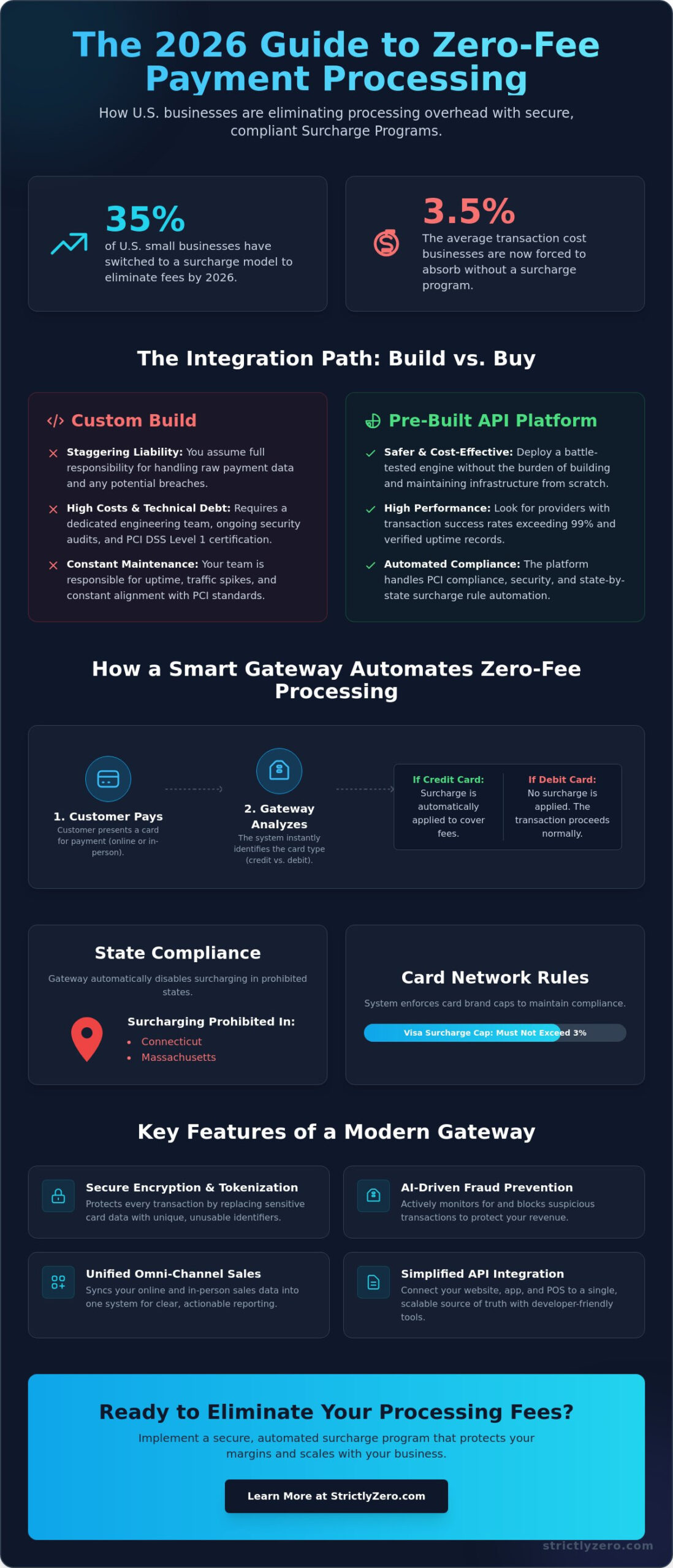
Did you know that 35% of U.S. small businesses have already eliminated their processing overhead by switching to a surcharge or dual-pricing model in 2026? It’s a massive shift for merchants who are tired of watching hidden fees eat their margins while struggling with complex API integrations. Setting up a payment gateway with surcharge program is no longer just a technical chore; it’s a strategic move to reclaim your revenue. You likely feel the pressure of rising transaction costs, which now average up to 3.5% per swipe, and the anxiety of keeping up with shifting PCI standards.
You don’t have to accept these costs as a permanent tax on your business. This guide will help you master the steps to implement a secure system that automates state-by-state compliance and targets a zero-fee processing configuration. We’ll walk through the technical setup, explain why you must avoid surcharging in states like Connecticut and Massachusetts, and show you how to stay under the 3% Visa cap. You’ll learn how to unify your sales data and deploy a secure engine that works across every channel you use, ensuring your margins stay protected as you scale.
Key Takeaways
- Understand how AI-driven fraud prevention and modern encryption create a secure bridge between customers and your merchant account.
- Learn why choosing a pre-built API platform is safer and more cost-effective than managing the high maintenance and audit costs of a custom build.
- Discover the exact process for obtaining secure API credentials and setting up your merchant account to ensure a smooth technical launch.
- Master the configuration of a payment gateway with surcharge program to automatically distinguish between card types and eliminate processing fees.
- Find out how to sync your online and in-person sales data into one unified system to prevent fragmented reporting and improve business growth.
Understanding the Payment Gateway Ecosystem in 2026
A payment gateway is the secure bridge connecting your customer’s bank account to your business’s merchant account. In 2026, this bridge does more than just pass data; it protects every transaction through high-level encryption and tokenization. These security protocols ensure that sensitive cardholder details are replaced with unique identifiers. This makes it nearly impossible for bad actors to intercept usable information during transmission. By using a modern payment gateway with surcharge program, you can automate the process of identifying eligible credit cards while keeping your data safe and compliant.
The distinction between gateways and processors is rapidly disappearing. Modern merchants no longer want to manage multiple vendors for a single transaction. Instead, they look for API-first platforms that offer scalability across every sales channel. These systems allow you to connect your website, mobile app, and physical sales points to a single source of truth. This unified approach eliminates fragmented data and makes it easier to manage your revenue in real time.
To better understand how these systems function in a live environment, watch this helpful video:
Gateway vs. Processor: What is the Difference?
Think of the gateway as the “digital handshake” at the front end of a sale. It collects the payment information and asks the bank if the funds are available. The processor is the back-end engine that actually moves those funds between financial institutions. While these were once separate services, Strictly combines both into a unified credit card processing service. This integration reduces technical friction and ensures your surcharge rules are applied consistently across all transactions.
The Key Players in Every Transaction
Every swipe or click involves several entities working in seconds. The Merchant is your business, while the Customer provides the payment method. The Issuing Bank is the institution that gave the customer their card. On your side, the Acquiring Bank is where your funds eventually land after settlement. Before they reach your bank account, funds sit in a Merchant Account, which acts as a temporary holding pen. Gaining a deep level of Understanding Surcharging is vital because your payment gateway with surcharge program must communicate perfectly with these players to ensure fees are correctly routed and disclosed.
Build vs. Buy: Choosing the Right Integration Path
Building a custom payment gateway often seems like a path to ultimate control, but it frequently leads to a mountain of technical debt. In 2026, the liability associated with handling raw payment data is staggering. You aren’t just writing code; you’re assuming responsibility for every transaction. This means your engineering team must stay in constant alignment with the PCI Security Standards Council to maintain compliance. Most organizations find that the resources required to build and maintain such a system far outweigh the benefits.
Choosing a pre-built, customizable API platform is the logical choice for 99% of businesses. These platforms allow you to deploy a payment gateway with surcharge program without the burden of building the infrastructure from scratch. When evaluating a provider, focus on their performance metrics. Look for transaction success rates that exceed 99% and verified uptime records. High-volume partners and ISOs should also consider white-label solutions that offer the flexibility of a custom build with the security of a battle-tested engine.
The Hidden Costs of Custom Development
Custom development requires more than just an initial build. You must account for ongoing security audits and the rigorous requirements of PCI DSS Level 1 certification. Maintaining payment stability requires a dedicated engineering team ready to handle spikes in traffic or potential outages. For those looking to scale quickly, leveraging a payment processing platform for ISOs is much more efficient. It removes the liability of data storage while providing a robust foundation for growth.
Integration Methods: Hosted vs. Integrated
Your choice of integration affects both user experience and developer workload. Hosted checkouts offer the lowest friction by redirecting customers to a secure external page, which keeps your servers out of the scope of many security audits. Direct API integration provides complete brand control but requires significant developer resources to manage the data flow correctly. For service-based businesses, payment links are often the fastest route to getting paid. If you’re ready to streamline your operations, consider how a unified surcharge engine can automate these complex configurations for you.
Step-by-Step Guide: How to Set Up Your Payment Gateway
Moving from the planning phase to a live environment requires a systematic approach. Setting up a payment gateway with surcharge program involves more than just entering API keys; it’s about aligning your business credentials with a secure financial network. You’ll start by applying for a merchant account through your platform provider. Once approved, you’ll receive your secure API credentials, typically consisting of Secret and Public Keys. These are the digital signatures that allow your website or software to communicate safely with the processor.
Before processing real money, you must configure a “Sandbox” environment. This is a mirrored version of the live gateway where you can simulate and test transactions without moving actual funds. During this stage, you’ll map your checkout fields to the gateway’s specific requirements, such as postal codes and CVV checks. It’s vital to reference State-by-State Surcharge Laws during configuration to ensure your engine correctly identifies transactions in prohibited states like Connecticut or Massachusetts. You only go live after verifying that test transactions result in successful settlement records within your admin dashboard.
Phase 1: Merchant Account Underwriting
Underwriting is the foundation of your payment system. You’ll need to provide documentation like Tax IDs, recent bank statements, and detailed business descriptions. Processors use this data to determine your risk profile, which directly impacts your approval speed and transaction limits. Working with a provider that treats trust as a core product can streamline this process. They help you present your business accurately to the acquiring bank, reducing the likelihood of delays or unexpected freezes on your funds.
Phase 2: Technical Configuration and Testing
Once you have your keys, the technical work begins. You must implement Webhooks to receive real-time notifications about payment statuses, such as “approved,” “declined,” or “refunded.” Testing for edge cases is critical; you need to know exactly how your system handles expired cards or triggered fraud alerts before a customer sees them. If you take orders over the phone, you should also set up a virtual gateway. This allows you to manually enter card data securely, ensuring your surcharge rules apply consistently across every transaction channel you manage.
Configuring for Profit: Surcharge Programs and Compliance
Fees are the silent killer of business growth. For years, merchants accepted that 1.5% to 3.5% of every sale belonged to the bank. By 2026, this has changed. Smart business owners now use a payment gateway with surcharge program to reclaim those lost points. The core of this strategy is a Smart Pricing Engine. This technology doesn’t just add a flat fee to every order. It analyzes the card data in milliseconds to distinguish between debit and credit cards. Since surcharges can only be applied to credit transactions, this automation is essential for staying within card network rules. You can also implement Dual Pricing, which displays a cash price and a card price side-by-side. This transparency builds trust and gives customers a clear choice at the point of sale.
Automating state-by-state compliance is another critical feature. Regulations vary wildly; for instance, Colorado caps surcharges at 2%, while states like Connecticut, Maine, and Massachusetts prohibit them entirely. A manual disclosure process is a recipe for legal trouble. Your gateway should automatically adjust based on the customer’s location and the specific card network caps, such as Visa’s 3% limit or Mastercard’s 4% cap. If you want to maximize your margins without the headache of manual tracking, you can automate your surcharge compliance here.
The Zero-Fee Processing Model
Shifting the cost of acceptance to the customer creates a zero fee credit card processing environment. This model relies on transparency. Most customers understand that processing high-value rewards cards costs money. When they see a small, clearly disclosed fee for the convenience of using credit, they rarely object. Integrating this logic directly into your gateway API ensures that every invoice or checkout page displays the correct pricing without manual intervention. It’s a seamless way to protect your bottom line while offering modern payment flexibility.
PCI Compliance and AI Fraud Prevention
Security and profit go hand in hand. In 2026, standard TLS encryption is the bare minimum for protecting data. To truly protect your margins, you need AI-driven fraud tools that reduce chargebacks before they happen. These systems analyze transaction patterns in real-time to flag high-risk behavior. Additionally, modern gateways simplify the PCI Self-Assessment Questionnaire (SAQ). By using a tokenized solution, you keep sensitive data off your servers. This reduces your liability and makes the annual compliance process much less stressful for small business owners.
Omni-Channel Mastery: Syncing Online and In-Person Sales
Fragmented data is the primary enemy of modern business growth. When your online sales live in one silo and your in-person transactions live in another, you lose the ability to see the full picture of your revenue. This separation often leads to accounting errors and missed opportunities for customer retention. By connecting physical card readers to the same payment gateway with surcharge program that powers your website, you create a single source of truth. This ensures that your surcharge rules and compliance logic are applied consistently, regardless of how or where your customer chooses to pay.
A unified dashboard for credit card processing for small business allows you to manage every transaction from a single interface. You can track high-level trends or drill down into specific sales without switching between different apps or logins. This setup also enables advanced features like recurring billing for both digital subscriptions and in-store memberships. Whether you’re charging a monthly service fee or a gym membership, the same gateway handles the logic, security, and surcharge automation for every recurring charge.
Unified Reporting and Inventory Sync
Having one gateway ID simplifies your tax and accounting preparation. Instead of reconciling spreadsheets from three different providers, you get a clean, consolidated report at the end of every month. You also gain access to real-time churn intelligence, known as ChurnIQ™, across all your sales channels. This data helps you understand why customers stop paying and allows you to take action before you lose revenue. Seeing a customer’s full history across retail and web platforms gives you the power to provide better service. If a customer bought an item online and wants to return it in-store, your unified system makes that transaction seamless.
Next Steps: Launching Your Gateway
Before you go live, complete a final checklist to ensure a smooth launch. Verify that your SSL certificates are active and that your website clearly displays your privacy policy and refund terms. These are not just for customer trust; they’re often required for final underwriting approval. Once your system is ready, promote your new payment options to your existing customer base. Explain the benefits of your new pricing model transparently to maintain the trust you’ve built. If you’re ready to stop letting fees eat your margins, start your zero-fee gateway setup with Strictly today.
Reclaim Your Revenue with Smart Payment Infrastructure
The shift toward zero-fee processing is no longer a trend; it’s a necessity for competitive businesses in 2026. You now have the roadmap to move beyond complex API hurdles and the anxiety of shifting PCI standards. By unifying your sales channels into a single source of truth, you eliminate the fragmented data that often slows down growth. Implementing a payment gateway with surcharge program allows you to automate the detection of credit versus debit cards while maintaining strict adherence to varying state regulations.
Success depends on choosing a partner that provides more than just a connection to the banks. Strictly offers an API-first omni-channel platform equipped with a Smart Surcharge Engine for 50-state compliance. You also gain access to ChurnIQ™ merchant retention intelligence, which helps you understand and protect your customer base as you scale. If you’re ready to stop letting processing costs eat your profits, eliminate your processing fees-set up your gateway with Strictly. Taking control of your payment strategy today sets the foundation for a more profitable and secure future.
Frequently Asked Questions
How long does it take to set up a payment gateway in 2026?
Approval for a merchant account typically takes between 24 and 72 hours depending on your business risk profile. Once your account is underwritten, you can generate API keys instantly. The technical integration time varies based on whether you use a pre-built plugin or a custom API setup, but most businesses can go live within a few days.
Do I need a developer to set up my payment gateway with surcharge?
You don’t always need a developer if you use low-code solutions like hosted checkout pages or secure payment links. These tools allow you to accept payments by simply sharing a URL or embedding a pre-built button. However, if you want a fully custom checkout experience integrated into your proprietary software, a developer will be needed to manage the API calls.
What is the difference between a merchant account and a gateway?
The gateway is the digital handshake that encrypts and transmits transaction data between the customer and the bank. The merchant account is a specialized financial account that holds the settled funds before they’re transferred to your business bank account. Modern providers usually bundle these two services together to simplify your reporting and fee structures.
Can I use a payment gateway with a surcharge program without a website?
Yes, you can use a payment gateway with surcharge program through a virtual terminal or digital invoicing system. This is ideal for service-based businesses or those taking phone orders. You simply log into a secure dashboard, enter the transaction details, and the engine automatically applies the correct surcharge based on the card type and customer location.
Are payment gateways secure for 2026 encryption standards?
Modern gateways utilize TLS 1.3 encryption and advanced tokenization to ensure maximum security. Tokenization replaces sensitive card data with a unique identifier, meaning the actual card numbers never touch your servers. This setup protects you from data breaches and simplifies your annual PCI compliance requirements by keeping your business out of the scope of sensitive data handling.
How do I avoid high transaction fees when setting up a gateway?
The most effective strategy is to implement a payment gateway with surcharge program that automatically shifts the cost of credit card acceptance to the cardholder. By using a smart pricing engine, the system detects credit cards and applies a small fee while keeping debit card transactions at their standard rate. This approach allows you to maintain your margins and reach a zero-fee processing configuration.
What documents are required to get approved for a merchant gateway?
You’ll need to provide your business Tax ID (EIN), a government-issued ID for the business owner, and recent bank statements to verify your financial standing. Some processors also require a brief description of your products or services and your estimated annual processing volume. These documents help the underwriting team assess your risk and set appropriate transaction limits.
Can one gateway handle both online and in-person payments simultaneously?
Yes, an omni-channel gateway is built to sync data from your website and your physical card readers into a single dashboard. This unified system prevents fragmented data and allows you to see all your sales in real time. It also ensures that your surcharge rules and fraud prevention settings are applied consistently across every channel where you do business.