

With e-commerce fraud projected to cost merchants $66.4 billion in 2026, your checkout page is either your strongest asset or your biggest liability. You’ve likely felt the sting of standard 2.9% transaction fees and the stress of meeting mandatory PCI DSS 4.0.1 requirements. It’s frustrating to watch your hard-earned margins vanish into processing costs while worrying if your security protocols actually stop modern identity theft. You want a system that works for you, not one that simply facilitates your loss.
This definitive guide explains exactly how to set up secure payment processing for online store 2026 using a modern architecture that prioritizes both safety and profitability. We will show you how to build a system that achieves zero processing fees through automated surcharging and dual-pricing engines while maintaining strict compliance. You’ll learn the step by step process for integrating AI-driven fraud prevention, managing omni-channel payments, and transitioning to a continuous compliance model that protects your business and your customers’ data every single day of the year.
Key Takeaways
- Modernize your business by integrating a unified omni-channel architecture that bridges the gap between your digital storefront and secure payment gateways.
- Discover how to set up secure payment processing for online store 2026 by selecting a processor that automates surcharge and dual pricing models to eliminate transaction fees.
- Master the mandatory PCI DSS 4.0.1 standards and use network tokenization to drastically reduce your compliance scope and protect sensitive cardholder data.
- Implement AI-driven fraud prevention tools to proactively stop identity theft and business email compromise before they impact your bottom line.
- Learn how an API-first platform allows you to deploy a cost-effective, $0 processing fee system while maintaining complete regulatory transparency.
The 2026 Online Payment Ecosystem: Key Components You Need
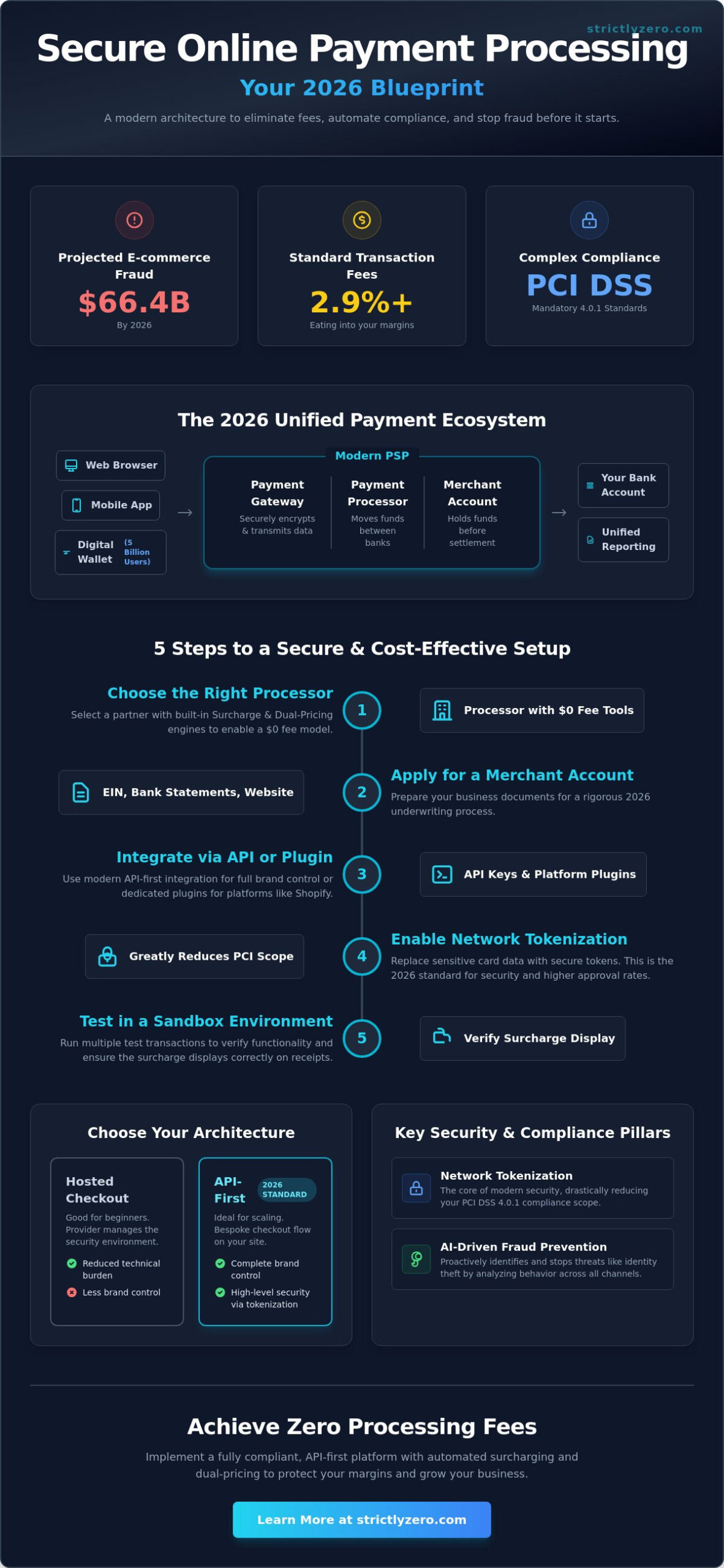
Understanding how to set up secure payment processing for online store 2026 starts with recognizing that the siloed approach to sales is dead. Modern commerce requires a unified architecture where every transaction, whether it happens on a mobile app, a web browser, or via a virtual terminal, feeds into a single source of truth. By 2026, 5 billion people will use digital wallets worldwide. Your backend must be flexible enough to handle these diverse methods while maintaining a friction-free experience for the customer.
To see these components in action on a popular platform, watch this helpful video:
A modern Payment service provider (PSP) bundles three core elements: the gateway, the processor, and the merchant account. The gateway acts as the secure bridge, encrypting data at the point of entry to protect against the $66.4 billion in e-commerce fraud projected for 2026. The processor is the engine that moves funds between banks, while the merchant account serves as the holding area where funds reside before they’re settled into your business bank account. In 2026, top-tier providers integrate these into one seamless platform.
Choosing Your Architecture: Hosted vs. API-First
Hosted checkout pages are excellent for beginners because the provider manages the security environment, reducing your immediate technical burden. However, API-first integrations have become the 2026 standard for scaling businesses. They allow you to design a bespoke checkout flow that keeps customers on your site while offloading the heaviest PCI DSS 4.0.1 compliance requirements to the processor through tokenization. It’s the ideal balance of complete brand control and high-level security.
Why Omni-Channel Is Non-Negotiable
If you only focus on web checkout, you’re missing a critical part of the modern market. True omni-channel processing connects your online sales with mobile data, virtual terminals, and even digital invoicing. This unified approach isn’t just about convenience; it’s about data integrity. When your system sees a customer’s behavior across all platforms, AI-driven fraud prevention can better identify anomalies in real-time. For a deeper dive into this strategy, check out our Ecommerce Payment Processing: The Ultimate Omni-Channel Guide. Having a single dashboard for reporting across every channel ensures you aren’t making business decisions based on fragmented information.
Step-by-Step: Setting Up Your Secure Payment Gateway
Choosing the right partner is the first hurdle in learning how to set up secure payment processing for online store 2026. You need a processor that supports surcharge and dual pricing engines out of the box. Since the Oklahoma law legalized surcharging on November 1, 2025, more merchants are looking for these cost-recovery tools to protect their margins. When you apply for a merchant account, have your EIN, business bank statements, and a fully functional website ready for underwriting. Modern processors look for a clear refund policy and visible contact information before they’ll approve your application.
Integration usually involves generating API keys from your dashboard. If you’re using a platform like Shopify or WooCommerce, a dedicated plugin might handle the heavy lifting. Ensure you enable network tokenization. This replaces sensitive card data with unique identifiers, keeping your server out of scope for many requirements found in the PCI Security Standards Council’s guide to PCI DSS. In 2026, tokenization is standard for improving approval rates on recurring payments. Finally, never skip the sandbox phase. Run at least five test transactions to verify that the surcharge displays correctly as a separate line item on receipts, as required by Visa and Mastercard rules.
Integrating Your Merchant Account
2026 underwriting is more rigorous than in previous years. Processors now look for clear refund policies, secure script management on your payment pages, and valid business registration. You’ll need to choose between a Payment Facilitator, which offers near-instant setup, and a traditional ISO, which provides more stability and lower long-term costs. Facilitators are great for speed, but ISOs often give you more control over fund settlement and payout schedules. If you want to maximize your margins, you might explore a processor that prioritizes dual pricing to offset those 2.9% average fees.
Configuring the Virtual Terminal
A virtual terminal is your secret weapon for omni-channel success. It allows your team to process mail or phone orders securely through a web browser without needing physical hardware. You can also set up recurring billing and subscription logic here, which is vital as the subscription economy continues to grow. For more detailed advice on these tools, read our Credit Card Processing for Small Business: The 2026 Essential Guide. This setup ensures that your business remains flexible enough to handle any transaction type while maintaining strict security standards.
Security and PCI Compliance: Protecting Your Store in 2026
While many beginners believe an SSL certificate is the pinnacle of security, it’s really just the first layer of defense. In a year where 79% of U.S. businesses have been targeted by payments fraud, learning how to set up secure payment processing for online store 2026 requires a deeper commitment to data integrity. You aren’t just protecting a credit card number; you’re protecting your brand’s reputation and financial stability. Modern security is about creating a multi-layered shield that stops threats before they reach your checkout page.
PCI DSS compliance is a mandatory security standard for all businesses handling cardholder data. As of 2026, the transition to version 4.0.1 is complete. This means you must adhere to stricter controls over website scripts and multi-factor authentication for all users. Consulting a Forbes guide to accepting online payments can provide a broad overview of these requirements, but the technical work happens in your backend architecture. By adopting network tokenization, you replace sensitive data with non-reversible identifiers. This effectively removes your server from the high-risk scope of PCI audits because you never actually store raw card details. It’s the most effective way to simplify how to set up secure payment processing for online store 2026 while maintaining ironclad safety.
Another vital tool is 3D Secure 2.0 (3DS2). Unlike the clunky pop-ups of the past, 3DS2 offers frictionless authentication by sharing rich data between the merchant and the bank. It helps verify the customer’s identity in the background without slowing down the checkout process. This is essential for maintaining high conversion rates while meeting the heightened security expectations of the current year.
AI-Driven Fraud Prevention
Static rules aren’t enough when fraud tactics evolve daily. AI-driven fraud prevention uses machine learning to analyze thousands of data points in milliseconds. It detects anomalous transaction patterns that humans would miss entirely. You should configure velocity checks to stop card cracking attempts and use geolocation filters to flag orders where the IP address doesn’t match the shipping destination. This proactive approach also simplifies chargeback management by automatically gathering evidence to prove a transaction’s legitimacy during a dispute.
Maintaining Continuous Compliance
Compliance isn’t a once-a-year checklist anymore; it’s a continuous process. Most online stores must complete an annual Self-Assessment Questionnaire (SAQ) to validate their security posture. However, you can significantly reduce this burden by choosing a partner that offers Trust as a Processor. By offloading the technical risk to a specialized provider, you ensure your store stays compliant with the latest 4.0.1 standards without needing to become a cybersecurity expert yourself.
Setting Up Compliant Surcharge and Dual Pricing Models
Most business owners accept 2.9% transaction fees as an unavoidable tax on growth. In 2026, this is no longer the case. When you learn how to set up secure payment processing for online store 2026, you discover that cost-recovery is a built-in feature, not an afterthought. Surcharging allows you to pass the cost of credit card processing directly to the consumer, but it requires precise execution to remain compliant with card network rules. For instance, Visa currently caps surcharges at 3%, while Mastercard allows up to 4%. These fees must be listed as a separate line item on the digital receipt, ensuring the customer sees exactly what they’re paying for.
Dual pricing offers an even more robust alternative for many e-commerce brands. Instead of adding a fee at checkout, you display two prices for every item: a “Card Price” and a “Cash Discount Price” for non-credit transactions. This model is often preferred in states with stricter consumer protection laws, such as California, where Senate Bill 478 took effect on July 1, 2024. A smart pricing engine automates this logic. It ensures your store displays the correct price based on the customer’s payment method and location without requiring manual updates to your inventory.
State-by-State Compliance Logic
The legal landscape for surcharging is complex and changes frequently. As of early 2026, states like Connecticut, Maine, and Massachusetts still prohibit credit card surcharges entirely. Meanwhile, Oklahoma legalized the practice on November 1, 2025, with a cap of 2% or the actual processing cost. Modern processing systems use real-time geolocation to apply these rules automatically. Crucially, these engines must detect debit cards instantly. Surcharging debit or prepaid cards is strictly prohibited by federal law and card network agreements. To see how these rules work in practice, read our Zero Fee Credit Card Processing: The 2026 Merchant Guide to $0 Fees.
Customer Communication and Transparency
Transparency is the key to maintaining brand trust while eliminating fees. You must notify your payment processor 30 days before you begin surcharging and place clear disclosures on your homepage and at the checkout. Best practices for 2026 involve showing the price breakdown early in the cart experience so there are no surprises at the final click. When your support team is trained to explain that these models allow you to keep base product prices lower, customers are generally receptive. If you’re ready to reclaim your margins, implement a surcharge and dual pricing engine today to start your journey toward a $0 fee storefront.
The Strictly Advantage: Unified Secure Processing
Setting your business up for success requires more than just a gateway. It requires a partner that views security and profitability as two sides of the same coin. When you research how to set up secure payment processing for online store 2026, you’ll find plenty of providers offering basic encryption. Strictly goes further by providing a unified, API-first platform designed to eliminate the 2.9% fees that traditionally eat into your margins. By integrating our surcharge and dual pricing engine, you transform your payment setup from a cost center into a streamlined, fee-free operation.
Most guides stop at the web checkout page. Strictly provides true omni-channel freedom. This means your online store, mobile app transactions, and virtual terminal orders are all managed through a single, secure dashboard. You don’t have to juggle multiple vendors or fragmented data sets. The dashboard serves as your mission control, providing real-time analytics that help you spot trends and manage cash flow across every sales channel. Whether you’re processing a subscription through our invoicing tool or taking a phone order via the virtual terminal, every transaction benefits from the same AI-driven fraud prevention and PCI DSS 4.0.1 compliance standards we’ve discussed.
Partnering for Success
Success in the 2026 landscape often involves complex partnerships. Developers and ISOs need infrastructure that scales without increasing technical debt. Our platform allows partners to leverage our robust security framework to build their own unique solutions. With tools like ClearSplit™, you can automate partner residuals and manage complex payout structures with zero manual intervention. If you’re looking for the Best Credit Card Processing for Small Business in 2026: The Zero-Fee Revolution, our infrastructure provides the foundation you need to scale profitably. We handle the heavy lifting of compliance so you can focus on growth.
Getting Started Today
Integration doesn’t have to be a multi-month project. Our API-first approach means you can deploy a secure, compliant checkout environment in days, not weeks. We provide 24/7 technical support and ongoing compliance monitoring to ensure your store remains protected against the evolving $66.4 billion fraud threat landscape. Our support team doesn’t just fix bugs; they help you optimize your configuration for the highest possible approval rates. You’ve already learned how to set up secure payment processing for online store 2026; now it’s time to execute. Book a consultation with our team to audit your current processing fees and see how much you can save by switching to a unified, secure system. Join the revolution and eliminate your processing fees today.
Future-Proof Your Store’s Profitability
The landscape of digital commerce has shifted. You now possess the blueprint for navigating PCI DSS 4.0.1 compliance and leveraging AI to combat the $66.4 billion fraud threat projected for this year. By moving beyond traditional processing models, you can transform your checkout from a cost center into a significant competitive advantage. Mastering how to set up secure payment processing for online store 2026 means integrating ironclad security with automated profitability. You’ve seen how tokenization and 3DS2 create a frictionless experience that protects both your customers and your hard-earned reputation.
Our API-first platform and Smart Pricing Engine automate the complex logic of state-specific surcharging and dual pricing. You gain access to unified omni-channel reporting that brings your web, mobile, and virtual terminal data into one clear dashboard. It’s time to stop letting hidden fees eat your margins and start scaling with a system designed for the modern era. Eliminate your processing fees today with Strictly. You’ve built a great business; it’s time you kept every dollar you earn.
Frequently Asked Questions
Is it legal to pass credit card processing fees to customers in 2026?
Yes, passing credit card fees to customers is legal in 47 states as of 2026. You must follow specific network caps, such as Visa’s 3% limit, and provide clear disclosure at the point of sale. Oklahoma joined the list of states allowing this practice on November 1, 2025. However, you still cannot surcharge in Connecticut, Maine, or Massachusetts due to local state laws.
How do I ensure my online store is PCI compliant?
You ensure compliance by adhering to the PCI DSS 4.0.1 standard, which became mandatory for all organizations on March 31, 2025. This involves using network tokenization to keep sensitive card data off your own servers. This approach is a core part of how to set up secure payment processing for online store 2026 while minimizing the complexity of your annual security audits.
What is the difference between a payment gateway and a payment processor?
A payment gateway is the software that securely captures and encrypts transaction data at the initial point of sale. The payment processor is the backend service that transmits that data between your business, the card networks, and the banks. Modern unified platforms often combine these roles to simplify your technical architecture and provide more cohesive financial reporting across your entire business.
Can I set up payment processing without a website?
You can absolutely process payments without a website by using a virtual terminal or digital invoicing tools. These features allow you to enter card details manually for phone orders or send secure payment links directly to customers via email. This is an effective strategy for B2B companies or service providers who don’t need a traditional e-commerce storefront to move products.
What happens if a transaction is flagged as fraud?
When a transaction is flagged, AI-driven fraud prevention tools either block the payment immediately or hold it for your manual review. In 2024, 79% of U.S. businesses were targets of payments fraud, making these real-time velocity and geolocation checks essential. You can then examine the transaction data and IP address to decide whether to fulfill the order or issue a refund.
How long does it take to set up an online merchant account?
Setting up an online merchant account typically takes between 24 and 72 hours for most businesses. While some payment facilitators offer near-instant approval, traditional accounts require a brief underwriting period to verify your business bank statements and EIN. This slightly longer process often results in more stable processing limits and lower long-term risk for your e-commerce operation.
What are the typical costs of setting up a secure payment gateway?
Typical industry costs for online transactions in the U.S. average around 2.9% plus a $0.30 per-transaction fee. While setup fees are often waived by modern providers, some may charge a nominal fee for gateway access or advanced fraud protection tools. Understanding these benchmarks is vital for how to set up secure payment processing for online store 2026 without overpaying for standard services.
Does surcharging apply to debit cards or just credit cards?
Surcharging applies strictly to credit card transactions. Federal law and card network regulations prohibit adding a surcharge to any debit or prepaid card payments, even if they are processed as credit. To remain compliant, your pricing engine must automatically detect the card type during the checkout process and only apply the fee when a valid credit card is used.