
Is Dual Pricing Legal in My State? The 2026 Merchant Compliance Guide
Published:
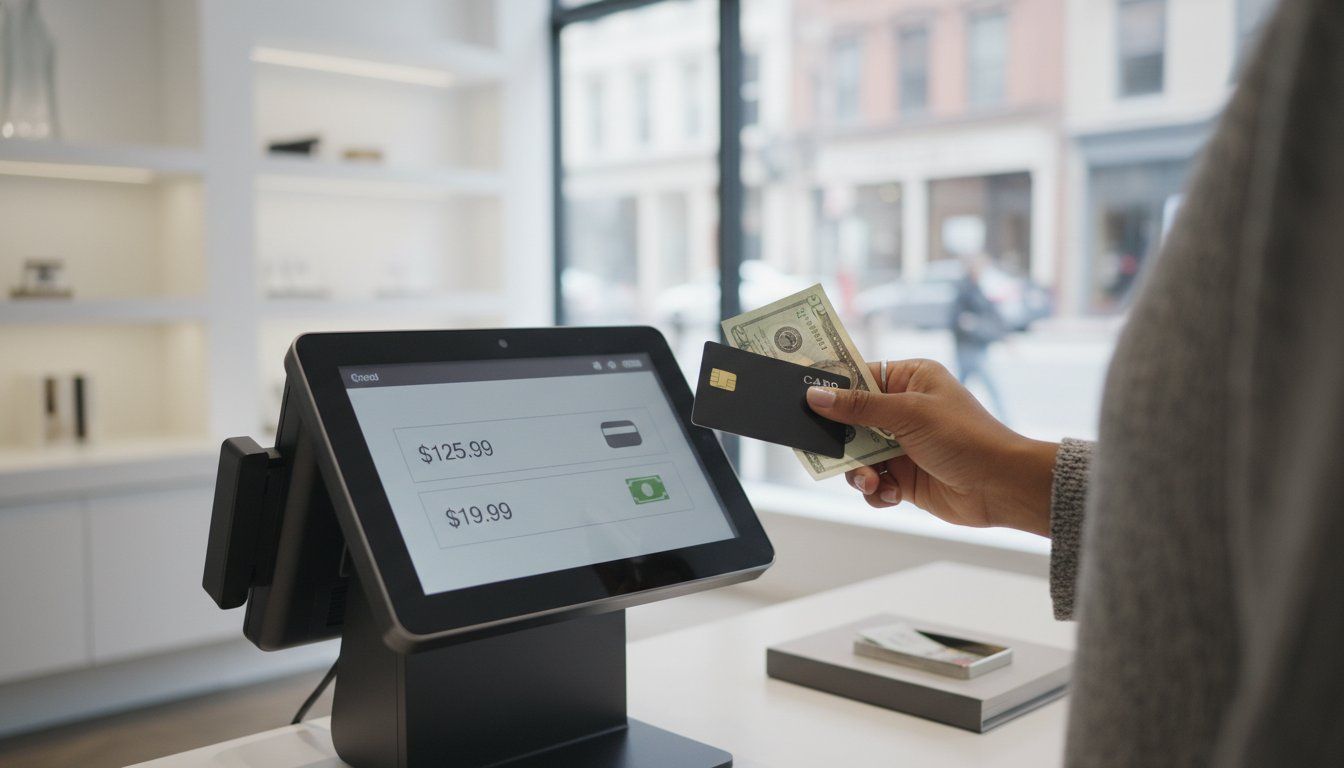
U.S. banks collected nearly $66 billion in interchange fees in 2025, and your business likely paid a significant portion of that total. If you’re tired of watching a chunk of every sale vanish into processing costs, you’ve probably asked: is dual pricing legal in my state? The short answer is a definitive yes. While credit card surcharging faces strict bans in Connecticut, Maine, and Massachusetts, dual pricing remains a federally protected right in all 50 states under the Durbin Amendment. It’s the most reliable way to offset rising costs without the legal headache of traditional surcharging.
We know how confusing it is to keep track of shifting card network rules and conflicting state laws that seem designed to keep you paying more. You want a clear path to protect your margins without risking a heavy fine from Visa or Mastercard. This guide clarifies exactly how to implement a compliant dual pricing engine that separates cash and card costs at the point of sale. We’ll walk through the 2026 compliance requirements, explain the 3% network cap, and show you the exact steps to reach $0 in processing fees legally.
Key Takeaways
- Confirm why dual pricing is legal in all 50 states because it is classified as a cash discount rather than a credit card penalty.
- Discover why the answer to “is dual pricing legal in my state” is a definitive yes, even in jurisdictions where traditional surcharging is prohibited.
- Learn how the Durbin Amendment provides the federal legal foundation for offering customer incentives based on their payment method.
- Identify the specific signage and point-of-sale disclosure requirements needed to satisfy Visa and Mastercard compliance rules.
- Understand how an automated dual pricing engine eliminates manual calculation errors and protects your merchant account from card network audits.
Table of Contents
- Is Dual Pricing Legal in My State? The Short Answer
- Federal Protections: The Dodd-Frank and Durbin Framework
- Dual Pricing vs. Surcharging: Navigating the Legal Gray Areas
- 2026 Compliance Checklist: How to Stay Legal
- Eliminating Compliance Risk with Strictly’s Smart Pricing Engine
Is Dual Pricing Legal in My State? The Short Answer
If you’re wondering, is dual pricing legal in my state, the answer is a firm yes. As of June 2026, every business in the United States has the legal right to offer different prices for cash and credit card payments. This includes states like Connecticut, Maine, and Massachusetts where traditional credit card surcharging is still restricted. The key to this legality lies in how you present the price to your customer. Federal law protects the right of a merchant to offer a discount for cash, even if state law limits your ability to add a penalty for credit.
To better understand this concept, watch this helpful video:
The legal distinction between a surcharge and dual pricing is critical for your compliance. A surcharge is an additional fee tacked onto a transaction at the register, which can feel like a penalty to the consumer. Dual pricing, however, is a form of price discrimination where two separate prices are established before the customer decides how to pay. By displaying a “Card Price” and a “Cash Price,” you aren’t adding a surprise fee; you’re offering a choice. This approach satisfies card network rules and avoids the legal pitfalls associated with state-level surcharge bans.
Why the Confusion Exists
Much of the uncertainty stems from the history of the 10-state surcharge ban. For years, states like New York, California, and Texas fought to prevent merchants from adding fees. However, multiple Supreme Court rulings and lower court challenges have shifted the landscape. Merchants often ask is dual pricing legal in my state when they see neighbors using it, and the legal framework remains consistent across all 50 jurisdictions. The Durbin Amendment to the Dodd-Frank Act explicitly permits businesses to offer incentives or discounts to steer customers toward lower-cost payment methods, effectively making dual pricing the safest harbor for merchants looking to protect their margins.
Defining ‘True’ Dual Pricing
To stay compliant, you must follow two fundamental requirements. First, both the cash price and the card price must be clearly displayed on every item, menu, or shelf tag. You can’t just display the cash price and tell customers there’s a fee later. Second, the price difference must stay within reasonable bounds. As of early 2026, Visa and Mastercard enforce a maximum surcharge cap of 3%, so your dual pricing spread shouldn’t exceed this limit. While “cash discounting” is a term often used interchangeably, it technically refers to a deduction from a single listed price. True dual pricing is more transparent because it shows the final total for both payment paths upfront, which is why it’s the preferred method for our Surcharge & Dual Pricing Engine.
Federal Protections: The Dodd-Frank and Durbin Framework
The confusion surrounding merchant fees often leads business owners to ask, is dual pricing legal in my state? While state level regulations vary, federal law provides a robust foundation for your right to differentiate prices. The Dodd-Frank Wall Street Reform Act serves as the primary legal bedrock for merchant pricing freedom in the United States. Within this massive piece of legislation sits Section 1075, commonly known as the Durbin Amendment. This specific provision shifted the power dynamic between small businesses and massive card networks, ensuring that merchants could finally fight back against rising interchange costs.
Federal protections are powerful because they often preempt or clarify the boundaries of state level restrictions. Even when you look at the complex state laws on credit card surcharges, the federal right to offer a discount for cash remains untouched. This legal hierarchy means that while a state might try to stop you from adding a fee, it cannot legally stop you from offering a lower price to customers who pay with cash or check. Understanding this distinction is the secret to maintaining a compliant, profitable business in 2026.
The Durbin Amendment Explained
The Durbin Amendment explicitly protects a merchant’s right to offer a discount to customers as an incentive to use a specific payment method. It prevents card networks like Visa and Mastercard from creating “no-discount” rules that would force you to charge the same price for every transaction. It’s important to remember that federal law treats debit and credit cards differently. While the Durbin Amendment capped debit interchange fees, it also paved the way for merchants to steer customers toward lower cost payment options through transparent pricing. If you want to automate these complex rules across your business, using a Surcharge & Dual Pricing Engine ensures you stay within these federal guidelines without manual effort.
Supreme Court Precedents
The 2017 Supreme Court case, Expressions Hair Design v. Schneiderman, fundamentally changed how we view pricing. The court had to decide if surcharge bans regulated “conduct” (the act of charging more) or “speech” (how the price is communicated). The justices ruled that these laws actually regulate speech. This means your right to communicate the difference between a cash price and a card price is protected under the First Amendment. In 2026, the legal standing is clear. As long as you aren’t hiding fees or misleading customers, your right to communicate the cost of credit is a protected business practice. How you list the price on your shelf or menu matters more than the actual dollar amount, making dual pricing the most legally sound strategy available today.
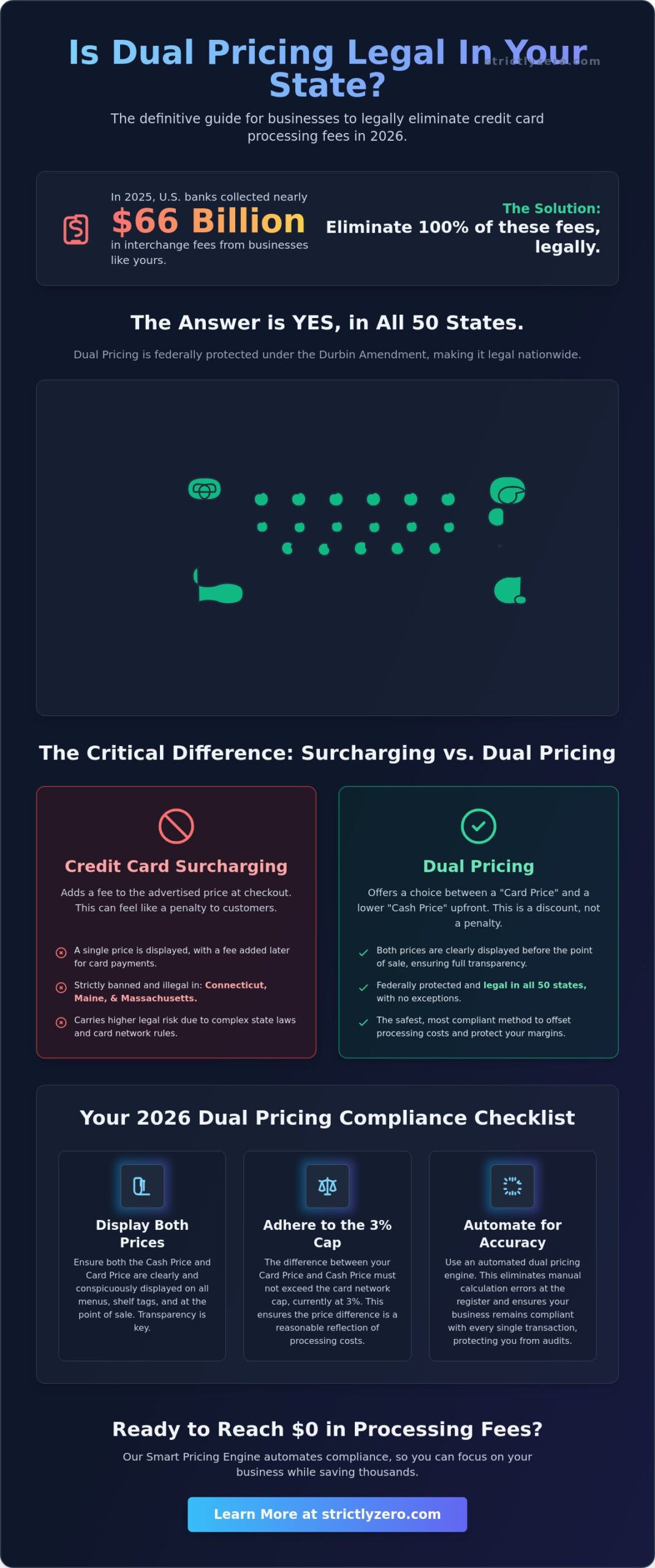
Dual Pricing vs. Surcharging: Navigating the Legal Gray Areas
Understanding the technical difference between these two models is the only way to answer “is dual pricing legal in my state” with absolute certainty. While they both aim to protect your margins, they operate under different legal frameworks. Surcharging involves adding a fee to a transaction at the checkout line. This practice is heavily regulated and requires you to register with card networks like Visa and Mastercard at least 30 days in advance. Dual pricing avoids this red tape entirely. Because you are simply displaying two separate prices for every item, you aren’t adding a “fee” at all. You’re offering a choice between a standard price and a discounted cash price.
This distinction is the reason dual pricing is legal everywhere. It provides total transparency for the customer from the moment they look at a price tag. If you choose a surcharge model, you’re limited by a 3% cap in 2026 and must provide specific signage at both the entrance and the point of sale. Dual pricing is simpler. By using a dedicated Surcharge & Dual Pricing Engine, you can automate these price displays and stay compliant without the administrative burden of network registration or the risk of state level penalties.
State-Specific Surcharge Restrictions in 2026
As of June 2026, Connecticut, Massachusetts, Maine, and Puerto Rico maintain clear bans on traditional credit card surcharging. If you operate in these areas, attempting to add a 3% fee at the register could lead to significant state fines. New York has also introduced strict “Total Price” disclosure requirements, making it illegal to list a price and then add a surcharge later. Dual pricing solves this compliance headache. By showing the full card price upfront, you satisfy New York’s transparency laws and bypass the surcharge bans in Massachusetts and Connecticut. Consulting the NFIB guide to surcharge laws confirms that offering a discount for cash remains a protected right for small businesses even in these “no-surcharge” states.
The Debit Card Compliance Factor
The biggest compliance trap for merchants in 2026 is surcharging debit cards. Federal law and card network rules strictly prohibit adding a surcharge to any debit or prepaid card transaction, regardless of whether the customer chooses “debit” or “credit” at the terminal. Violating this rule can result in your merchant account being blacklisted or facing massive audits. Dual pricing naturally avoids this violation. Since the “Card Price” is the standard price and the “Cash Price” is the incentive, you aren’t penalizing the debit card user. Instead, you’re simply not giving them the cash discount. This “Cash/Other” model is the safest way to handle the projected $6.3 trillion in card volume expected this year without accidentally breaking federal debit card rules.
2026 Compliance Checklist: How to Stay Legal
While you now know the answer to is dual pricing legal in my state, the burden of proof rests on your implementation. In 2026, card networks have increased their scrutiny of “junk fees,” making precise execution mandatory for every merchant. To protect your business from audits and fines, you must follow a strict five-step checklist that ensures total transparency. This isn’t just about avoiding a penalty; it’s about building trust with your customers by showing exactly how their payment choice impacts the final price.
- Step 1: Point-of-Entry Signage. You must alert customers before they even cross the threshold. A sign at the door or window must be clearly visible and state that all listed prices reflect a card price, while cash payments receive a discount.
- Step 2: Point-of-Sale Disclosure. Every item, menu entry, or shelf tag must display both the cash price and the card price. You cannot simply list a single price and mention a percentage difference at the end.
- Step 3: Receipt Transparency. The final receipt must clearly show the “Card Price” and the applied “Cash Discount” as separate line items if the customer pays with cash.
- Step 4: Card Network Notification. While dual pricing is a discount program, notifying your processor ensures your account is coded correctly. This prevents automated systems from flagging your transactions as unauthorized surcharging.
- Step 5: Employee Training. Your team must use compliant language. They should never refer to the price difference as a “fee” or “charge.” Training them to explain the “Cash Discount” model ensures customers feel rewarded for their choice rather than penalized.
Signage and Menu Requirements
Specific wording requirements for 2026 signage emphasize that the card price is the standard price of goods. Digital signage is increasingly preferred by card brands because it allows for instant updates, though physical stickers remain acceptable if they are legible and high-contrast. For a deeper look at setting up these displays, consult our Zero Fee Credit Card Processing: The 2026 Merchant Guide. Consistency across your physical and digital storefronts is the only way to avoid a network audit.
Receipt and Checkout Standards
A compliant receipt in 2026 must be explicit. A sample line item would show the “Subtotal (Card)” followed by a “Cash Discount” line that reduces the total for those paying with physical currency. This same level of transparency applies to your virtual gateway and e-commerce environments. Using terms like “Non-Cash Adjustment” is common but can be risky if not paired with a clear card price. To simplify these requirements, you can automate your compliance steps through our dedicated engine.
Eliminating Compliance Risk with Strictly’s Smart Pricing Engine
Managing the fine print of merchant compliance manually is like walking a tightrope without a net. Even if you understand that the answer to is dual pricing legal in my state is a firm yes, the technical execution is where most businesses stumble. A single mislabeled receipt or an accidental surcharge on a debit card can trigger a card network audit. Visa and Mastercard don’t usually send friendly reminders; they issue heavy fines and can even terminate your ability to accept cards entirely. Strictly’s Smart Pricing Engine was built to remove this administrative burden, allowing you to focus on your customers while we handle the legal heavy lifting.
Our technology provides a unified solution for your business, ensuring consistency across every sales channel. Whether you are managing ecommerce payment processing or taking payments at a physical counter, the engine applies the correct rules instantly. One of its most critical features is real-time debit card detection. Since surcharging debit is a federal violation, our system identifies the card type via its BIN (Bank Identification Number) and automatically removes the card price adjustment. This ensures you never accidentally penalize a debit user, keeping your business in total alignment with federal law and card network standards.
Automated Rules Engine
The legal landscape for merchant fees moves fast. Instead of spending your weekends researching is dual pricing legal in my state to see if a local court has issued a new ruling, our engine monitors legislation in all 50 states for you. When a regulation changes in California or a new disclosure requirement is passed in New York, your terminal software updates automatically. This real-time adaptability provides unmatched peace of mind for small business credit card processing. You won’t have to worry about printing new signs or reprogramming your hardware every time a card brand tweaks its operating manual.
Getting Started with Zero-Fee Processing
Transitioning to a more profitable pricing model shouldn’t be a weeks-long project. Our setup process is designed for speed, often taking less than 24 hours to get your system fully operational. If you’re curious about how much revenue you’re currently losing to interchange, you can use our cost of credit card processing tool to estimate your potential savings. Stop letting rising merchant fees eat your margins. Switch to Strictly and eliminate your processing fees today with a system that guarantees compliance in every state, every day.
Take Control of Your Profit Margins Today
The question of is dual pricing legal in my state has a clear answer that empowers you to stop losing money to interchange fees. By leveraging the federal protections of the Durbin Amendment, you can offer a transparent choice to your customers while protecting your bottom line. Success in 2026 requires more than just hanging a sign; it demands precise adherence to card network rules and accurate price displays across every channel you use.
You don’t have to navigate these shifting legal waters alone. Strictly provides the tools to automate your compliance, ensuring you never accidentally surcharge a debit card or miss a state level update. With Automated State-by-State Compliance, Real-Time Debit Card Detection, and No Hidden Setup Fees, we make the transition to zero-fee processing seamless and safe.
Start Your Zero-Fee Journey with Strictly Today and reclaim the revenue your business has earned. It’s time to build a more sustainable, profitable future for your company.
Frequently Asked Questions
Is dual pricing the same as a credit card surcharge?
No, they are legally distinct models. A surcharge adds a fee to the listed price at the end of the transaction. Dual pricing lists two separate prices for cash and card upfront. This distinction is the reason why merchants asking is dual pricing legal in my state find that it’s permitted nationwide, even where surcharging is restricted. It’s about offering a discount rather than imposing a penalty.
Which states have banned credit card surcharging in 2026?
As of June 2026, Connecticut, Massachusetts, Maine, and Puerto Rico maintain active bans on credit card surcharging. Other states like New York have complex disclosure laws that require showing the total price inclusive of any card fees. Dual pricing remains the safest alternative in these jurisdictions because it doesn’t involve adding a fee at checkout. It satisfies the transparency requirements that many state regulators now demand.
Can I use dual pricing for debit card transactions?
You cannot add a surcharge to a debit card, but dual pricing handles these payments differently. In a dual pricing model, the card price is the standard price. If a customer uses a debit card, they simply pay that standard price without receiving the cash discount. This approach avoids the federal violations associated with surcharging debit transactions while still protecting your business margins from high processing costs.
Do I need to register with Visa and Mastercard to use dual pricing?
No, you do not need to register with the card networks for a true dual pricing program. Surcharging requires a 30-day advance notification to the networks, but dual pricing is viewed as a discount program rather than a fee program. This makes it much easier to implement quickly without administrative delays or network paperwork. It’s a more streamlined way to reach $0 in processing fees.
What happens if I implement dual pricing incorrectly?
Incorrect implementation can lead to card network audits and significant monthly fines. If you fail to display both prices clearly or if you surcharge a debit card, Visa and Mastercard may flag your account. In extreme cases, they can terminate your merchant agreement entirely. Using an automated Surcharge & Dual Pricing Engine helps prevent these human errors and keeps your account in good standing.
Do I need special equipment to run a dual pricing program?
You don’t need to buy physical POS hardware, but your software must support dual price displays. The system needs to calculate the discount in real-time and print receipts with the required line items. Our Omni-Channel Payment Processing tools integrate these features into your existing digital environment or virtual terminal. This allows you to stay compliant without the need for expensive new equipment purchases.
How do I explain dual pricing to my customers without losing sales?
Focus on transparency and choice. Tell your customers that you’ve listed two prices to help keep costs low for everyone. Most shoppers understand that processing fees have risen, and they appreciate the option to save money by paying cash. When customers ask is dual pricing legal in my state, you can confidently explain it is a standard cash discount program designed to keep your prices competitive.
Is dual pricing legal for online e-commerce stores?
Yes, dual pricing is legal for online transactions across all 50 states. Your checkout page must clearly display the different totals for card and cash-equivalent payments before the customer clicks pay. Using a compliant virtual terminal or invoicing system ensures these digital disclosures meet all 2026 transparency standards. It’s a great way to manage costs for both domestic and international online sales. To further enhance your e-commerce efficiency, you can discover Silicon Valley Direct for professional fulfillment solutions that help protect your margins.