

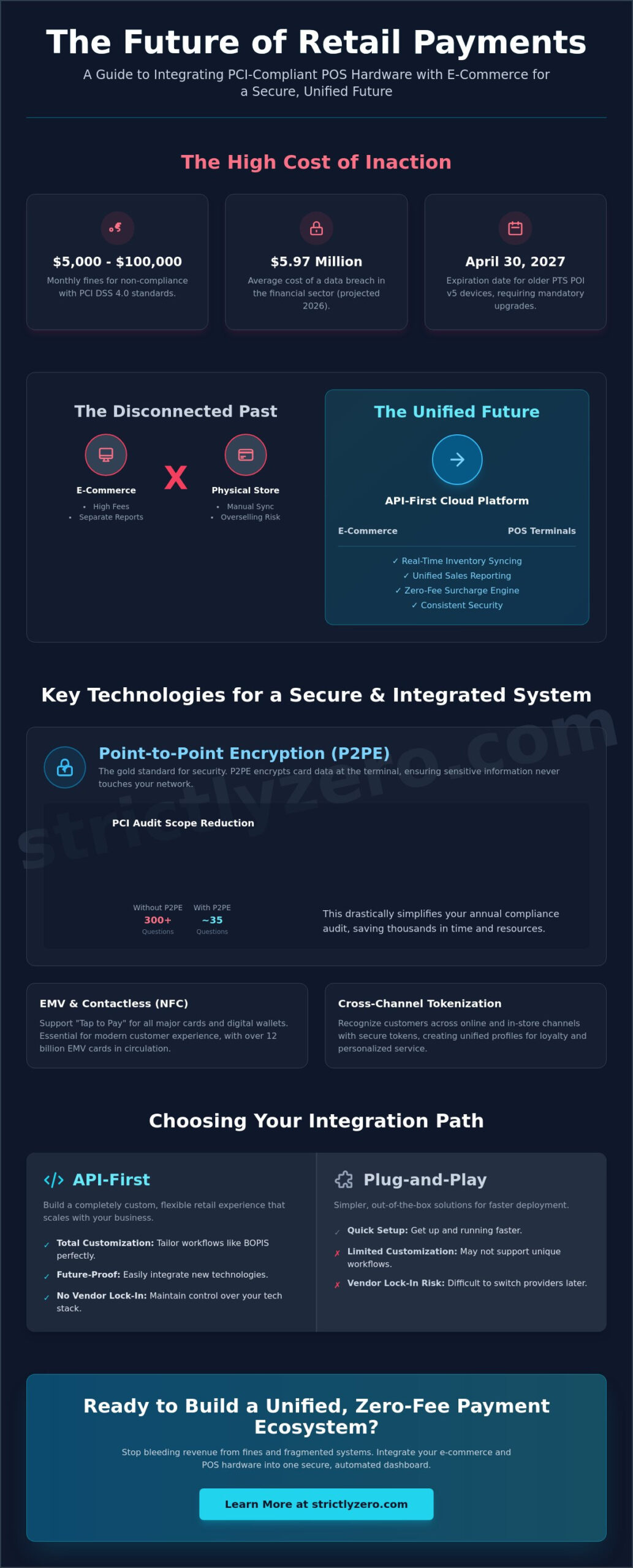
Did you know that staying on outdated security standards can trigger monthly fines between $5,000 and $100,000? You’ve probably felt the frustration of paying separate, high processing fees for your website and your physical storefront while wasting hours trying to reconcile inventory manually. It’s exhausting to keep up with the mandatory PCI DSS 4.0 requirements when your systems don’t talk to each other. With the average cost of a data breach in the financial sector reaching $5.97 million in 2026, the stakes for your infrastructure have never been higher.
This guide helps you identify the right pci compliant payment terminals pos hardware integrate with e-commerce platforms so you can stop bleeding revenue and start using a unified surcharge engine. You’ll discover how to move toward a zero-fee processing model while ensuring your hardware is future-proofed past the April 30, 2027, expiration date for older v5 devices. We’ll break down the shift to API-first cloud systems and show you how to manage every sale from one secure, automated dashboard.
Key Takeaways
- Learn how PCI DSS 4.0 standards for physical terminals act as your primary defense against escalating non-compliance fines and data breaches.
- Discover how to select pci compliant payment terminals pos hardware integrate with e-commerce platforms to achieve real-time inventory syncing and unified sales reporting.
- Compare API-first architectures against plug-and-play models to build a custom retail experience without getting trapped by vendor lock-in.
- Follow a step-by-step audit process to choose hardware that supports modern workflows like Buy Online, Pick Up In-Store (BOPIS).
- Leverage AI-driven fraud prevention and surcharge engines to create a secure, zero-fee payment environment that scales with your business.
The Role of PCI Compliant Hardware in Omni-Channel Retail
In 2026, the Payment Card Industry Data Security Standard (PCI DSS) 4.0 governs every transaction you process. Choosing pci compliant payment terminals pos hardware integrate with e-commerce platforms is no longer a luxury for mid-sized retailers; it’s a structural requirement. These devices serve as the physical gatekeeper for sensitive data. When you use hardware that doesn’t meet the latest PTS POI v6 or v7 standards, you risk monthly fines that scale up to $100,000 after six months of non-compliance.
To better understand how these security standards protect your business, watch this helpful video:
Beyond avoiding fines, compliant hardware acts as a shield against the $5.97 million average cost of a financial sector data breach. A unified system ensures that whether a customer taps their phone in-store or enters a card number online, the security protocols remain consistent. This harmony reduces the complexity of your annual audit by isolating card data from your broader business network. By using hardware that integrates directly with your processor’s cloud, you effectively shrink your compliance surface area.
P2PE: Why It is Non-Negotiable for Integrated Systems
Standard encryption often leaves gaps where data is vulnerable during transit between the terminal and your server. Point-to-Point Encryption (P2PE) solves this by encrypting cardholder data immediately within the hardware’s secure environment. It ensures that your POS software and local network never “see” the actual card numbers. Point-to-Point Encryption is the gold standard for integrated POS security because it can reduce the number of applicable PCI audit questions from over 300 down to around 35.
EMV and Contactless: Beyond the Chip
As of 2026, there are over 12 billion EMV cards in circulation. Modern terminals must support more than just the physical chip; they need to handle the latest EMV Contactless specifications to prevent fraud. Customers now expect “Tap to Pay” functionality for both iPhone and Android devices as a baseline experience. Using pci compliant payment terminals pos hardware integrate with e-commerce platforms that support NFC ensures you’re ready for the 2026 rollout of EMV-enabled EBT cards, which are replacing older, fraud-prone magnetic stripe versions across the U.S.
Essential Features for POS Terminals that Integrate with E-Commerce
Modern retail thrives on speed and synchronization. As of 2026, cloud-based POS solutions are the industry standard, with over 35% of retailers having transitioned to cloud architecture by 2023. To stay competitive, your pci compliant payment terminals pos hardware integrate with e-commerce platforms must offer real-time cloud-syncing. This ensures that when a customer buys the last pair of shoes in your physical store, your online inventory updates instantly. This prevents the administrative headache of overselling and manual reconciliation, which previously cost midsize companies up to $50,000 annually in lost labor and compliance overhead.
Connectivity is the backbone of this integration. Modern terminals should support a failover system including Wi-Fi, 4G, and 5G to ensure you never miss a sale during an internet outage. High-performance battery life is equally critical for mobile-first retail environments where clerks assist customers on the floor. These features are guided by the PCI Security Standards Council (PCI SSC), which ensures that even mobile connections maintain rigorous data encryption protocols. By choosing hardware that supports “Buy Online, Pick Up In-Store” (BOPIS) workflows, you bridge the gap between digital browsing and physical fulfillment.
Cross-Channel Tokenization Explained
Tokenization is the process of replacing sensitive card data with a unique, non-sensitive identifier called a token. When you use pci compliant payment terminals pos hardware integrate with e-commerce platforms, these tokens allow you to recognize a returning customer in-store even if they previously only shopped online. This creates a unified profile that powers loyalty programs and enhances AI-driven fraud prevention. Because the hardware handles the tokenization before data hits your network, your business stays out of the line of fire for data thieves.
Durability and Design: The Merchant Perspective
While security is paramount, the physical design of your hardware impacts the customer experience. You need sleek, modular devices that fit a modern aesthetic and offer upgrade paths. Hardware that is “future-proofed” helps you avoid the forced upgrades associated with the April 30, 2027, expiration of older v5 devices. Reliable ecommerce payment processing depends on this hardware to feed accurate data into your central dashboard, allowing for a truly unified commerce strategy.
The Integration Bridge: API-First vs. Plug-and-Play
Choosing pci compliant payment terminals pos hardware integrate with e-commerce platforms often involves a trade-off between immediate convenience and long-term business control. Many retailers fall for the “plug-and-play” promise offered by massive, all-in-one providers. While these systems get you up and running quickly, they often lead to restrictive vendor lock-in. This trap forces you to use proprietary hardware with limited features and pay non-negotiable processing rates that eat into your margins as you scale.
In 2026, the industry has shifted toward an API-first architecture. This “headless” approach separates your front-end customer experience from the back-end payment logic. It provides the flexibility to swap out physical devices or update your digital storefront without dismantling your entire security framework. Because the PCI Security Standards Council now emphasizes continuous monitoring under version 4.0, having an open API makes it significantly easier to validate security controls across your entire network. Strictly acts as the unified platform where your chosen hardware connects to this broader digital ecosystem.
The Universal Gateway Advantage
A high-performance payment gateway acts as the critical connective tissue between your physical terminals and your digital sales channels. By using a hardware-agnostic gateway, you can support devices from various manufacturers under a single merchant account. This centralization is vital for retailers aiming for a unified commerce model. It allows you to view every transaction from a mobile handheld terminal alongside your web shop sales on one integrated dashboard. This setup ensures your business is ready for the April 30, 2027, retirement of older hardware without requiring a total system overhaul.
Overcoming the “Hardware Silo” Problem
Fragmented payment processing is a silent drain on your revenue. Many merchants still operate with separate accounts for in-person and online sales, which typically leads to redundant monthly fees and complex tax reconciliation. Small businesses already face annual compliance costs between $1,000 and $10,000; maintaining two separate silos only serves to double that administrative burden. A unified omni-channel strategy routes all sales through a single engine. This API-first approach eliminates manual data entry by automatically syncing every transaction with your central financial ledger and inventory system.
Buying Guide: Choosing Your POS Hardware Setup
Selecting the right equipment requires a strategic look at your current digital footprint and physical space. You’ve already learned about the security standards, but the practical selection process starts with your existing software. First, audit your e-commerce platform. Whether you use Shopify, WooCommerce, or a custom Magento build, your pci compliant payment terminals pos hardware integrate with e-commerce platforms must support the same API protocols to ensure data flows correctly between your storefront and your back-office ledger.
Second, define your physical workflow. A high-volume boutique might require fixed countertop terminals with customer-facing displays, while a hybrid warehouse needs handheld devices for curbside pickup. Third, verify the specific PCI-PTS (PIN Transaction Security) certification. As of 2026, you should exclusively look for devices with v6 or v7 approval. Buying v5-approved hardware now is a mistake, as these devices reach their expiration date on April 30, 2027. Finally, calculate your ROI by looking past the initial sticker price of the hardware and focusing on long-term processing savings.
Hardware ROI and the Surcharge Model
The biggest barrier to upgrading hardware is often the upfront cost, which can range from $1,000 to $10,000 for small businesses. However, implementing a zero fee credit card processing model can offset these expenses in just a few months. By using the Strictly Surcharge & Dual Pricing Engine, your terminal automatically applies a small service fee to credit transactions. This automation ensures compliance with state laws and card brand rules at the point of sale. When you eliminate 100% of your processing fees, even the most advanced, high-end hardware pays for itself through immediate overhead reduction. Contact our team today to see how much you can save.
Support and Maintenance Checklist
Reliable hardware is only as good as the support behind it. In an omni-channel environment, a single terminal failure can disrupt your entire inventory sync. Prioritize hardware that offers Over-the-Air (OTA) updates, allowing security patches for PCI DSS 4.0 to be pushed remotely without manual intervention. Look for a replacement program that guarantees overnight shipping for failed units, as downtime costs can quickly exceed the $5.97 million average breach risk if your fallback methods aren’t secure. Ensure your processor provides 24/7 technical support to handle the complexities of integrated systems across all sales channels.
Future-Proofing with Strictly: The Unified Payment Ecosystem
Strictly serves as the central command center for your entire retail operation. While you select the physical devices that best fit your storefront, our platform provides the intelligence that allows those pci compliant payment terminals pos hardware integrate with e-commerce platforms to communicate with your digital shop. By acting as the unified software layer, we ensure that every transaction is screened by AI-driven fraud prevention in real-time. This proactive approach is vital in 2026, where the average cost of a financial sector data breach has reached $5.97 million.
Getting started is a matter of connecting your chosen hardware to our API-first environment. We provide the tools to bridge the gap between your physical shelves and your online cart, allowing you to manage sales, inventory, and refunds from one dashboard. This ecosystem eliminates the data silos that typically lead to manual reconciliation errors. When you use pci compliant payment terminals pos hardware integrate with e-commerce platforms through our gateway, you gain a future-proof system that adapts as security standards evolve toward the 2027 hardware expiration dates.
The Smart Pricing Engine at the POS
Our Smart Pricing Engine removes the complexity from card acceptance at the terminal. When a card is swiped or tapped, the software instantly identifies whether it’s a debit or credit card. This distinction is critical because surcharging is only permitted on credit transactions. Strictly automates state-by-state surcharge rules within the software layer, ensuring your business stays compliant with local laws. We provide full transparency to your customers through dual-pricing displays, showing both the cash and credit price clearly before the sale is finalized.
Scaling with Partners and ISOs
Developers and Independent Sales Organizations find immense value in our flexible, open architecture. By utilizing our robust API, partners can build custom integrations that connect diverse hardware setups to complex e-commerce environments. Our payment processing platform for ISOs is specifically designed to help merchants scale rapidly in 2026. Whether you’re a single-location boutique or a growing enterprise, our ecosystem provides the stability and security required for modern commerce. Scale your payments with Strictly today to achieve a secure, zero-fee payment environment.
Secure Your Future with Integrated Payments
Building a resilient retail business requires more than just picking a device; it requires a strategy that bridges the gap between your physical and digital storefronts. By selecting pci compliant payment terminals pos hardware integrate with e-commerce platforms, you’ve taken the first step toward meeting mandatory PCI DSS 4.0 standards. This proactive choice helps you avoid the $100,000 monthly non-compliance fines while preparing your infrastructure for the April 30, 2027, expiration of older v5 devices.
Success in 2026 depends on transparency and automation. Strictly provides the intelligence needed to manage this transition, offering an API-first platform that connects your hardware to a single, secure dashboard. Our Smart Pricing Engine automates compliance across state lines and credit brands, while ChurnIQ™ intelligence gives you the data needed to boost merchant retention. Don’t let fragmented systems or high processing fees slow your growth. It’s time to take control of your payment ecosystem.
Eliminate your processing fees and unify your sales with Strictly today and start building a zero-fee, omni-channel ecosystem that scales with your ambition.
Frequently Asked Questions
What makes a payment terminal PCI compliant?
A payment terminal is considered compliant when it meets the latest PCI PTS (PIN Transaction Security) standards, such as version 6 or 7. These certifications ensure the physical device has tamper-responsive sensors and secure encryption modules. For a business to remain fully compliant under PCI DSS 4.0, the terminal must also support Point-to-Point Encryption (P2PE). This prevents raw card data from ever entering your local network or server.
Can I use the same terminal for multiple e-commerce stores?
You can use a single terminal for multiple stores if your payment gateway supports multi-MID (Merchant Identification) routing. This setup allows you to toggle between different accounts or brands directly on the device screen. It requires pci compliant payment terminals pos hardware integrate with e-commerce platforms that use an API-first architecture. This centralized approach ensures that inventory and sales data for each brand remain distinct within your unified dashboard.
Do I need a special terminal to use a surcharge program?
You need a terminal with a software layer that supports automated surcharge and dual-pricing logic. The hardware must be able to distinguish between debit and credit cards in real-time to comply with card brand rules. Modern terminals display the cash price and the credit price side-by-side. This transparency is mandatory for zero-fee processing models and helps you avoid legal complications in various U.S. states.
How does POS hardware integrate with WooCommerce or Shopify?
Integration typically happens through an API bridge or a dedicated plugin that connects the hardware to your site’s backend. When a sale occurs in-store, the terminal sends a signal through the cloud to update your WooCommerce or Shopify inventory immediately. This prevents overselling and eliminates manual data entry. Selecting pci compliant payment terminals pos hardware integrate with e-commerce platforms ensures this data transfer remains encrypted and secure from end to end.
What is the difference between PCI-PTS and PCI-DSS?
PCI PTS applies specifically to the physical security of the terminal hardware, while PCI DSS covers your entire business environment. Think of PTS as the security of the vault and DSS as the security of the whole bank. You must use PTS-approved hardware to help satisfy the broader requirements of the PCI DSS 4.0 standard. Using the right hardware can reduce your annual audit from hundreds of questions to just a few dozen.
Is it better to buy or lease POS hardware for integration?
Buying is generally the more cost-effective choice for long-term integration because it eliminates monthly rental fees. Since older PCI PTS v5 devices expire on April 30, 2027, purchasing new v6 or v7 hardware ensures your investment lasts for several years. Leasing can lead to higher total costs over time and often locks you into proprietary processors. Owning your hardware gives you the freedom to choose the best software partners.
What happens if my POS terminal loses internet connection?
Most modern terminals automatically switch to a cellular failover like 4G or 5G if your Wi-Fi or Ethernet connection drops. This ensures you never miss a sale during a local outage. Some devices offer an “offline mode” that stores transactions locally for later processing, but this carries a higher risk of fraud. It’s safer to prioritize hardware with built-in SIM cards to maintain a continuous, secure connection to your cloud-based e-commerce platform.
How often do I need to update my POS hardware for compliance?
You should evaluate your hardware lifecycle every three to five years to align with PCI Security Standards Council updates. For example, the industry is currently transitioning away from v5-approved devices before their April 2027 retirement date. Beyond physical hardware, you must perform software updates via Over-the-Air (OTA) patches regularly. These updates ensure your terminals have the latest security fixes to combat emerging 2026 fraud trends.