

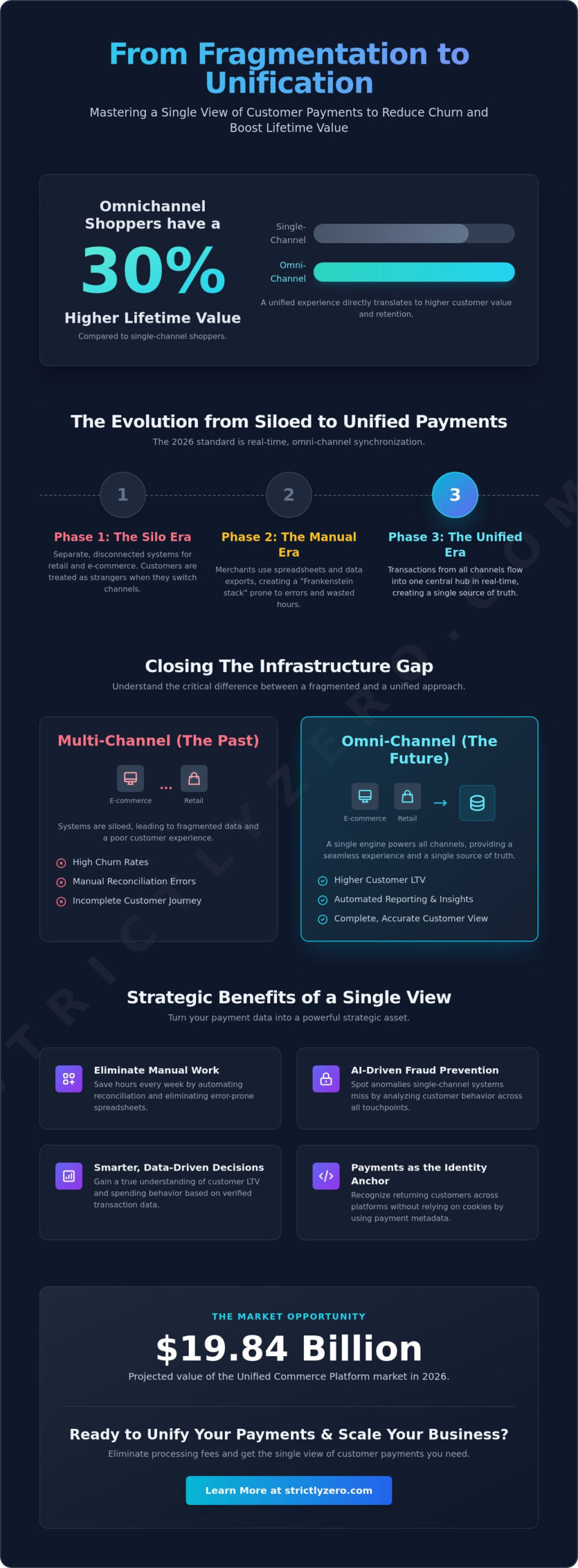
Did you know that omnichannel shoppers have a 30% higher lifetime value than those who only shop through one channel? It’s a massive opportunity for growth, yet many merchants are still trapped in a “Frankenstein stack” of disconnected systems. You’re likely exhausted from the daily grind of manual reconciliation between your online store and your physical locations. It’s frustrating when you can’t see the full story of your customer’s journey; it’s even worse when that lack of insight leads to high churn rates.
Transitioning to a single view of customer payments requires moving away from manual exports and toward automated architecture. You can’t achieve real-time visibility if your data is stuck in spreadsheets. The process begins with a comprehensive audit of your current touchpoints. You must identify every channel where transactions occur, from your e-commerce checkout to mobile apps and physical retail terminals. Once you’ve mapped these entry points, the next step is selecting an API-first payment processor to act as your central data hub. For businesses looking to incorporate digital assets into their ecosystem, you can explore Crypto Processing API options to ensure a truly unified infrastructure. This centralizes every bit of metadata into one accessible stream.
This guide will show you how to master a single view of customer payments to turn fragmented transaction data into a powerful source of truth. By consolidating this information, you can finally reduce churn and eliminate unnecessary processing costs through smarter, data-driven decisions. We’ll explore the transition from multi-channel silos to unified commerce, including how to leverage omni-channel payment processing and automated reporting to scale your business in 2026. You’ll learn how to replace manual spreadsheets with a unified dashboard that tracks every transaction, ensuring your data works as hard as you do.
Key Takeaways
- Understand why moving beyond fragmented data to a single view of customer payments is the essential first step for improving customer lifetime value and retention.
- Discover how consolidating transaction data eliminates manual reconciliation errors and saves your accounting team hours of tedious work every week.
- Learn to identify the infrastructure gap between siloed multi-channel systems and a unified omni-channel engine that powers e-commerce and retail simultaneously.
- Explore how AI-driven fraud prevention uses cross-channel behavior analysis to protect your revenue by spotting anomalies that single-channel systems miss.
- See how integrating unified data with a smart pricing engine can help you offset processing costs while providing a seamless checkout experience for every customer.
What is a Single View of Customer Payments?
A single view of customer payments is a unified record of every transaction a customer completes across every sales channel you operate. While a typical Customer Data Platform (CDP) might aggregate “soft” data like website clicks or email opens, a payment-centric view focuses on the most definitive action a customer takes: the purchase. This verified, bank-level data provides a level of accuracy that marketing analytics simply can’t match. It doesn’t rely on guesses or estimations. It’s the hard truth of your revenue.
To better understand how this concept transforms a business, watch this helpful case study:
In 2026, the Unified Commerce Platform market is projected to reach a value of $19.84 billion. This surge is driven by merchants who are tired of the reconciliation nightmare caused by siloed systems. When your online sales and physical store transactions don’t talk to each other, you lose the ability to see the full customer journey. A unified approach eliminates the need for manual data entry and cross-referencing spreadsheets; it creates a single source of truth that simplifies your accounting and improves your operational efficiency.
The Evolution from Siloed to Unified Payments
The way businesses handle transaction data has shifted dramatically. Most merchants have moved through three specific stages of maturity:
- Phase 1 (The Silo Era): Merchants used entirely separate accounts for retail and e-commerce. There was no connection between the two, meaning a customer was treated as a stranger if they switched channels.
- Phase 2 (The Manual Era): Businesses tried to bridge the gap using manual data exports. This led to “Frankenstein stacks” where spreadsheets were the only way to get a complete picture.
- Phase 3 (The Unified Era): The 2026 standard is real-time omni-channel synchronization. Every transaction, regardless of where it happens, flows into one central hub automatically.
Why Payments are the Ultimate Identity Anchor
As privacy standards like PCI DSS 4.0 become more stringent and third-party cookies disappear, merchants need a more reliable way to understand their audience. Payment metadata serves as the ultimate identity anchor. By utilizing card fingerprints, you can recognize returning customers across different platforms without relying on invasive tracking methods. This is particularly useful for linking guest checkouts to existing profiles. Because transaction history is based on actual financial commitments, it’s far more reliable than self-reported survey data. It allows you to calculate customer lifetime value with precision, ensuring your retention strategies are based on hard facts rather than guesses.
Strategic Benefits of Consolidating Transaction Data
Consolidating your financial data does more than just clean up your books. It turns your payment stream into a strategic asset. While many businesses get bogged down in marketing metrics like email open rates, a single view of customer payments provides the only data point that truly matters: actual spending behavior. By centralizing these records, you eliminate the human errors that plague manual reconciliation. You no longer have to spend hours cross-referencing CSV exports from your e-commerce site against your physical store’s daily totals. This accuracy is vital for calculating multi-channel attribution, ensuring you know exactly which touchpoints are driving revenue.
The evolution to unified commerce has made cross-channel intelligence a necessity for security. AI-driven fraud prevention becomes significantly more effective when it can analyze behavior across all platforms. If a card is used for a high-value online order and then appears at a physical terminal in a different state minutes later, a unified system flags the anomaly instantly. This precision protects your bottom line while empowering your customer support agents. When a customer calls with a question, your team can access their full purchase history across every channel in seconds, leading to faster resolutions and higher satisfaction.
Reducing Churn with Transactional Intelligence
Transactional data is a powerful predictor of customer loyalty. Brands with strong omnichannel engagement retain 89% of their customers, compared to just 33% for those with weak strategies. By monitoring a single view of customer payments, you can identify at-risk shoppers based on declining transaction frequency before they disappear entirely. This allows you to move beyond generic marketing and personalize offers based on a customer’s actual spending power. If a high-value retail shopper hasn’t visited in sixty days, a targeted, data-backed incentive can prevent them from churning to a competitor.
Operational Efficiency and Reporting
Efficiency gains from unified data are immediate and measurable. One-click reporting for multi-location businesses replaces the week-long headache of manual data aggregation with a single, real-time dashboard. This centralized approach also simplifies compliance with PCI DSS 4.0, which became mandatory for all merchants as of March 31, 2025. By securing sensitive data in a central hub rather than across disparate systems, you reduce your attack surface and streamline security audits. Ultimately, implementing unified data speeds up month-end closing by 40%. Merchants looking to optimize their financial operations often find that omni-channel payment processing provides the essential foundation for this level of growth.
Omni-Channel vs. Multi-Channel: The Infrastructure Gap
Many merchants mistake being “multi-channel” for being truly “omni-channel.” The difference lies in your underlying infrastructure. A multi-channel setup often leads to the Silo Trap, where your web store and physical storefront run on entirely separate payment rails. This fragmented approach makes it impossible to achieve a single view of customer payments. Instead of a clear picture, you get disconnected data sets that require hours of manual merging. This isn’t just an administrative headache; it’s a financial drain. When you use different vendors for different channels, you often end up double dipping on processing fees, paying multiple processor markups that could range from 0.1% to 2% for the same customer base.
True omni-channel commerce uses a single engine to power e-commerce, retail, and mobile sales simultaneously. This unified model is essential for growth in 2026, especially since retailers with high unified commerce maturity are currently demonstrating double the growth rates of those at a basic level. By leveraging integrated ecommerce payment processing, you bridge the gap between digital and physical touchpoints. It ensures every transaction, regardless of the device or location, feeds into one central reporting hub. This allows you to track the 73% of consumers who now shop on three or more channels before making a purchase, providing the seamless experience they expect.
The Virtual Terminal as a Unifying Bridge
A virtual terminal serves as a powerful tool for connecting disparate sales methods. It allows your team to process phone and mail orders within the same system used for your retail sales. You don’t need to invest in expensive, separate hardware silos for every type of transaction. Whether a customer is paying via a secure link in an invoice or over the phone, the data capture remains consistent. This consistency ensures your branding stays professional and your customer profiles stay updated, regardless of how the payment is initiated.
Tokenization: The Secret to Cross-Channel Recognition
Tokenization is the technical foundation of cross-channel recognition. It replaces sensitive cardholder data with a unique, secure token that can be used for future transactions without exposing the original card details. This process enables “vaulting,” which is what allows a customer to buy an item online and return it in-store seamlessly. As the click-and-collect market is projected to reach $177.9 billion in 2026, tokenization is no longer optional. When you maintain a single view of customer payments through secure tokens, you also improve recurring billing success. The system can track and update card information across the entire ecosystem, significantly reducing churn caused by expired or replaced cards.
How to Build a Single View of Payments Using APIs
Transitioning to a single view of customer payments requires moving away from manual exports and toward automated architecture. You can’t achieve real-time visibility if your data is stuck in spreadsheets. The process begins with a comprehensive audit of your current touchpoints. You must identify every channel where transactions occur, from your e-commerce checkout to mobile apps and physical retail terminals. Once you’ve mapped these entry points, the next step is selecting an API-first payment processor to act as your central data hub. This centralizes every bit of metadata into one accessible stream.
Success depends on how well you map customer identifiers across these platforms. By using email addresses and secure card tokens, you can link a “guest” transaction at a retail location to a registered profile in your online store. This data flow should be automated using secure webhooks that push information directly into your CRM or ERP. Finally, you should implement real-time dashboards. These provide immediate visibility into your business health, allowing you to spot trends or issues as they happen rather than waiting for a month-end report. If you’re ready to modernize your stack, connect with our payment experts to discuss an API-first integration.
The Power of an API-First Strategy
Closed legacy systems are the primary obstacle to achieving a unified customer view. These older platforms often trap data in proprietary formats that are difficult to extract or sync. Modern developers instead leverage advanced payment processing platform for ISOs tools to build custom, high-level views of transaction history. A key component of this real-time connectivity is the API webhook. An API webhook is an automated notification sent from your payment processor to your internal systems the moment a transaction event occurs, ensuring your records are always up to date without manual refreshing.
Cleaning and Standardizing Payment Data
Raw data is rarely perfect. You’ll need to handle discrepancies between authorized amounts and settled totals to ensure your financial reporting is accurate. This is especially important for businesses with tipping or shipping adjustments. You also need to standardize currency and tax data if you operate across different regions or jurisdictions. Maintaining strict data hygiene prevents the creation of duplicate customer records, which can skew your lifetime value metrics. By enforcing a single source of truth at the API level, you ensure that every department, from accounting to marketing, is looking at the same verified numbers.
Strictly: Unified Payments with $0 Processing Fees
Strictly isn’t just another processor; it’s a foundation for growth that creates a native single view of customer payments automatically. You don’t have to struggle with manual data exports or third-party integrations to see the big picture. The platform is built to consolidate every digital wallet transaction, credit card swipe, and online checkout into one stream of truth. In 2026, where digital wallet adoption is projected to exceed 5.2 billion users, having this level of cohesion is vital. Strictly leverages this unified data to power its Smart Pricing Engine, which facilitates zero fee credit card processing. By identifying exactly how a customer pays, the system applies surcharges or dual pricing intelligently, ensuring you don’t lose revenue to processing markups.
For enterprise-level merchants and partners, advanced tools like ClearSplit™ and ChurnIQ™ provide a competitive edge. ClearSplit™ simplifies revenue sharing and partner management, while ChurnIQ™ uses transactional intelligence to predict and prevent customer attrition before it happens. In a unified ecosystem, trust is the ultimate currency. When your data is transparent and your reporting is automated, you build stronger relationships with your customers and stakeholders. You aren’t just processing transactions; you’re managing a wealth of identity markers that drive long-term loyalty.
Eliminating Fees through Unified Compliance
Surcharging is legal in most U.S. states as of 2026, but the rules are incredibly strict. Merchants must cap fees (often at 3%), provide clear disclosure, and never surcharge debit cards. Strictly manages this complexity for you within a single dashboard. Our engine automatically distinguishes between debit and credit cards across all sales channels, ensuring you stay compliant with the Durbin Amendment and card network rules. This shift in credit card processing for small business allows you to bypass the typical 1.5% to 3.5% fees that eat into your margins. All compliance monitoring is handled within your single view of customer payments, so you can focus on scaling instead of auditing.
Getting Started with a Unified Platform
The journey from a fragmented “Frankenstein stack” to the Strictly ecosystem is designed for speed and scalability. For ISOs and developers, the platform offers the tools needed to provide unified solutions to a broad client base without the headache of legacy hardware silos. The migration process focuses on centralizing your data to finally unlock the 30% higher lifetime value associated with omnichannel shoppers. The future of commerce belongs to those who own their data and eliminate unnecessary costs. You can scale your business with Strictly’s unified platform today and experience the power of a truly integrated financial strategy.
Future-Proof Your Growth with Unified Payment Intelligence
The transition from fragmented data silos to a unified commerce model is the most significant shift for merchants in 2026. By moving beyond the limitations of a “Frankenstein stack,” you gain the clarity needed to identify loyal customers and protect your business from fraud. Establishing a single view of customer payments isn’t just a technical upgrade; it’s a financial necessity that allows you to reclaim your margins and stop overpaying for processing. You’ve seen how API-first infrastructure and tokenization provide the foundation for this visibility, turning every transaction into a valuable insight.
Strictly provides the tools you need to master this strategy while removing the burden of high costs. With our 100% compliant Smart Surcharge Engine, you can offset processing fees entirely. Our advanced features like ClearSplit™ for automated partner compensation and ChurnIQ™ for retention intelligence ensure your operations stay lean and your customers stay loyal. It’s time to stop guessing and start growing with a platform built for the modern merchant. Eliminate your processing fees and unify your data with Strictly today. The future of your business is unified, and we’re here to help you lead the way.
Frequently Asked Questions
What is the difference between a Single Customer View and a CRM?
A CRM tracks marketing interactions and contact details, while a single view focused on payments aggregates verified financial transactions across all sales channels. While a CRM might tell you a customer opened a specific email, a payment-centric view tells you exactly what they bought and when. It provides a higher level of data integrity because it relies on bank-verified records rather than self-reported information or marketing engagement metrics.
How does a single view of payments help with PCI DSS compliance?
A unified payment view streamlines compliance by centralizing sensitive data and reducing the number of systems that touch cardholder information. With PCI DSS 4.0 standards mandatory as of March 31, 2025, merchants must maintain continuous monitoring of security controls. By consolidating your data into a single, secure hub, you simplify the audit process and ensure that multi-factor authentication and encryption protocols are applied consistently across your entire infrastructure.
Can I achieve a single view if I use different processors for online and in-store?
It is technically possible but significantly more difficult to achieve a single view of customer payments when using disparate processors. You would typically need to build a custom data warehouse to merge mismatched data formats, which often leads to delays and reporting errors. Using a single omni-channel payment processor is the most efficient way to ensure your data is standardized and available in real-time without manual intervention.
Is a single view of payments only for large enterprise businesses?
No, unified data is just as critical for small and medium-sized businesses looking to scale their operations. Small merchants often suffer the most from manual reconciliation errors and high churn rates due to a lack of customer insight. Implementing an API-first strategy early on allows smaller businesses to compete with larger retailers by providing personalized experiences and better managing their cash flow through automated reporting and consolidated dashboards.
How does tokenization help in creating a single customer view?
Tokenization enables cross-channel recognition by replacing sensitive card numbers with a unique identifier that stays consistent across all your sales platforms. This allows you to track a customer’s journey from an online purchase to an in-store return without exposing their financial data. It’s the technical link that makes a single view of customer payments functional, allowing for seamless guest checkouts and more accurate lifetime value calculations.
What are the most common challenges when consolidating payment data?
The most common obstacles include legacy systems that don’t support modern APIs and the prevalence of data silos within an organization. Many merchants struggle with “Frankenstein stacks” where different departments use separate software that doesn’t communicate. Overcoming these challenges requires a shift toward an API-first infrastructure and a commitment to data hygiene to ensure that duplicate records don’t skew your reporting or customer profiles.
How can a single view of payments improve my surcharge program?
A unified view allows your surcharge engine to accurately distinguish between credit and debit cards across every channel you operate. Since regulations strictly prohibit surcharging debit cards, having a single source of truth ensures your program remains 100% compliant. This level of data visibility helps you apply the correct pricing model at the point of sale, whether the transaction happens through a virtual terminal or a physical retail location.
What role does an API play in payment data unification?
APIs act as the connective tissue that allows different software systems to share payment data in real-time. Instead of relying on slow batch uploads or manual CSV exports, APIs use webhooks to push transaction alerts instantly to your CRM or accounting software. This automation is what makes a single view of the customer possible, ensuring your dashboards always reflect the most current state of your business health.