

The 3% profit leak isn’t just a cost of doing business; it’s a choice you no longer have to make. Most merchants feel trapped between rising processing statements and the anxiety that passing those costs along will trigger bad reviews or legal headaches. You’ve likely heard conflicting advice about the surcharge vs cash discount program landscape, especially with state-level bans in Connecticut and Massachusetts still in full effect for 2026. It’s frustrating to watch your margins shrink while trying to decode complex card network rules and state-specific caps.
This guide promises to clear the confusion and help you reach $0 in processing fees without risking your reputation. You’ll learn exactly how to navigate the 3% Visa cap, why surcharging debit cards remains illegal nationwide, and how a sophisticated dual pricing engine keeps your checkout seamless. We’ll preview the latest compliance requirements from New York to California so you can stop paying for your customers’ rewards points and start reinvesting that capital back into your growth. Fee elimination is no longer a legal gamble; it’s a technology-driven transparency strategy.
Key Takeaways
- Differentiate between a surcharge vs cash discount program by understanding whether you’re adding a fee at checkout or offering a reduction from a standard credit price.
- Stay compliant with 2026 federal laws that strictly prohibit surcharging on debit and prepaid cards regardless of your business location or industry.
- Reduce customer “fee friction” by positioning your pricing strategy as a transparency measure that protects your margins without alienating loyal clients.
- Determine the best fit for your specific business model by analyzing how average transaction values and industry standards influence customer acceptance.
- Learn how a smart pricing engine automates card detection and state-level regulations to ensure your business stays 100% compliant while eliminating processing costs.
Defining the Core: Surcharge vs. Cash Discount Program
Understanding the fundamental mechanics of a surcharge vs cash discount program is the first step toward eliminating processing fees. While they both aim to protect your margins, they approach the transaction from opposite directions. One adds a fee to the sticker price at the moment of a credit sale, while the other offers a reward for using cash. This distinction isn’t just about semantics; it determines your legal compliance and how your customers perceive your brand value.
To get a broader perspective on the history of these fees, you can explore the evolution of Surcharge (payment systems) and how they’ve shifted from niche industry practices to mainstream retail strategies. Today, the choice you make impacts every line item on your monthly merchant statement and determines how you present your pricing to the world.
To better understand this concept, watch this helpful video:
What is a Surcharge Program?
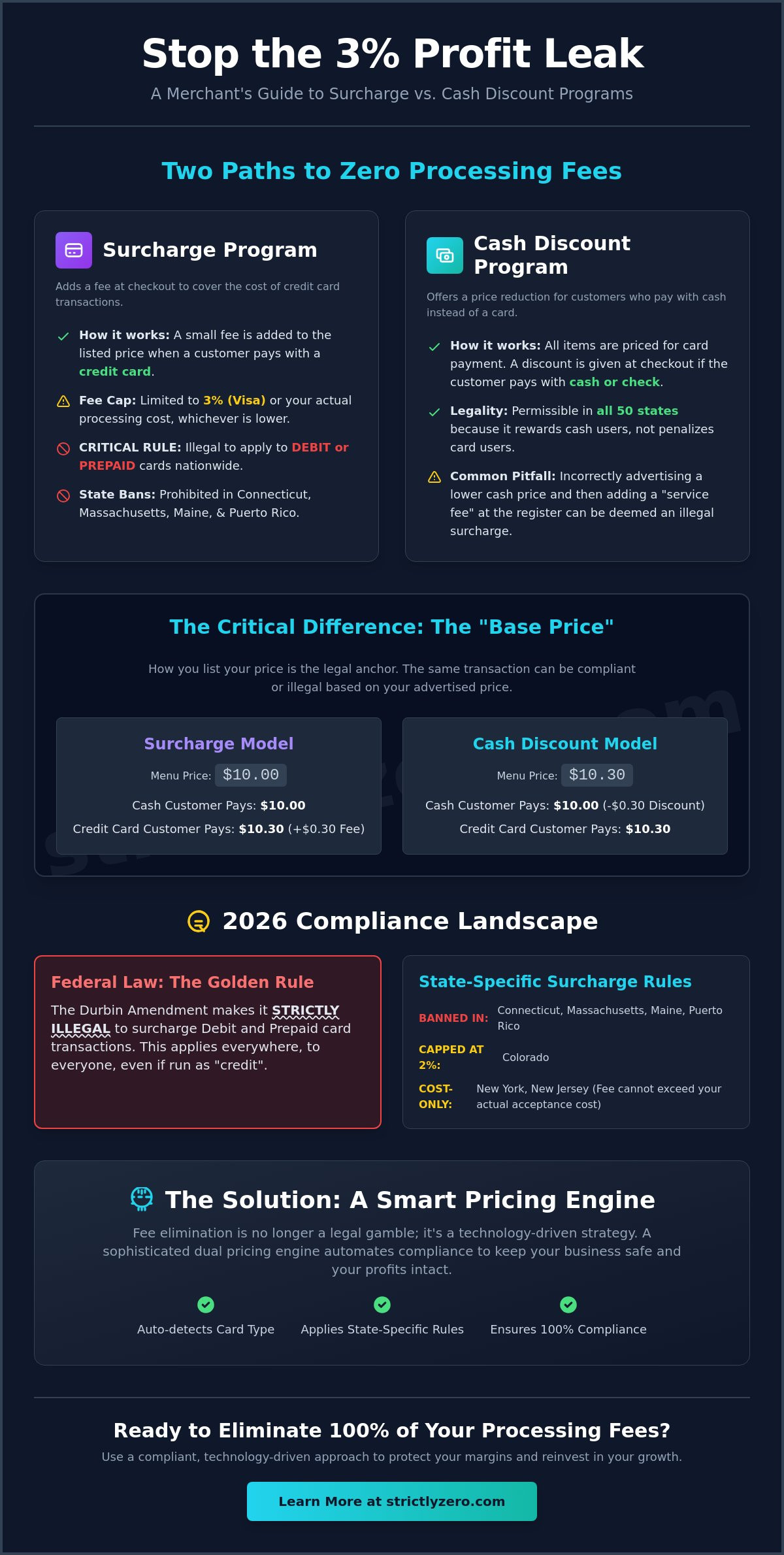
A surcharge is an additional fee tacked onto a credit card transaction to cover the merchant’s cost of acceptance. In 2026, Visa has set a strict cap of 3% or the actual cost of acceptance, whichever is lower. It’s critical to remember that surcharging only applies to credit cards. Federal law and card network rules strictly prohibit adding fees to debit or prepaid card transactions. You must also provide clear signage at the door and the register to let customers know about the fee before they pay.
What is a Cash Discount Program?
A true cash discount program works by listing all your products at the “credit price.” When a customer chooses to pay with cash or a check, you provide a discount. This is legally distinct because you aren’t penalizing the card user; you’re rewarding the cash user. Because of this logic, cash discounts are permissible in all 50 states. However, many businesses get into trouble by listing a lower price and then adding a service fee at the end. Regulators often view this as an illegal surcharge in restricted states like Connecticut or Massachusetts.
The “Base Price” problem is where most confusion starts. Your listed price is the legal anchor for your program. If your menu says a burger is $10, but the customer pays $10.30 with a card, that’s a surcharge. If the menu says $10.30 and the cash customer pays $10, that’s a cash discount. This distinction matters because state regulators and card networks are increasingly auditing how fees are presented. Choosing the wrong path can lead to “hidden fee” complaints and potential fines. In 2026, your merchant statement should clearly reflect these programs through a dedicated Surcharge & Dual Pricing Engine to ensure every penny is accounted for and compliant.
The 2026 Compliance Landscape: Legal Rules and State Bans
The legal landscape for a surcharge vs cash discount program isn’t just a suggestion; it’s a minefield of federal and state regulations. The Durbin Amendment remains the most critical federal hurdle. It ensures that debit card transactions are treated differently than credit cards. Surcharging a debit card is a violation of federal law and card network rules. It’s the quickest way to face heavy fines or lose your merchant account entirely. Even if a customer runs their debit card as “credit” at the terminal, you cannot legally apply a surcharge to that transaction.
As of June 2026, four jurisdictions—Connecticut, Maine, Massachusetts, and Puerto Rico—maintain total bans on credit card surcharges. If you operate in these areas, you must use a cash discount or dual pricing model to stay legal. Other states have implemented specific caps that override the standard card brand limits. Colorado limits surcharges to 2%, while New York and New Jersey require that fees don’t exceed your actual cost of acceptance. You can track the shifting state-by-state surcharge laws through the NCSL to ensure you aren’t falling behind new legislative sessions. Visa currently enforces a 3% cap on all surcharges. While Mastercard allows up to 4%, any merchant accepting both brands is effectively capped at the lower 3% limit.
Mandatory Disclosure and Signage
Transparency is your best defense against regulatory audits. You must place clear signage at your business entrance and at every point of sale. These disclosures must state the fee percentage and clarify that it does not apply to debit cards. On the final receipt, the surcharge must appear as a separate line item. For e-commerce, this disclosure must happen on the checkout page before the customer clicks “pay.” Vague language or hidden fees will trigger “junk fee” investigations under current consumer protection standards.
Automated Compliance vs. Manual Risk
Manual errors are the biggest risk for modern merchants. Relying on a cashier to distinguish between a credit card and a debit card is a recipe for disaster. Modern AI-driven engines now detect card types instantly at the bin level before the transaction is processed. This automation is particularly vital in California following the 2024 implementation of SB 478. While California’s law requires all-in pricing, surcharges are still permitted as long as they aren’t mandatory and you offer a fee-free alternative like cash or debit. To avoid these regulatory pitfalls, many businesses choose to automate their compliance through a dedicated pricing engine that handles state-specific logic in real-time.
Customer Psychology: Managing the “Fee Friction”
Surprise fees at the register are the fastest way to lose a repeat customer. When a shopper sees an unexpected charge on their final total, the psychological reaction is one of betrayal rather than business logic. This “fee friction” is the primary reason merchants hesitate to implement a surcharge vs cash discount program. However, the friction doesn’t come from the fee itself; it comes from the lack of transparency. If a customer feels “tricked” into paying more, they’ll likely leave a negative review. If they feel empowered with a choice, they often accept the cost as a fair trade for using a high-rewards credit card.
The most successful businesses in 2026 use an “inflation narrative” to frame these programs. Instead of raising every price on the menu or shelf by 10% to cover rising overhead, you can choose to keep your base prices stable for everyone. By offering a cash discount or applying a credit surcharge, you’re essentially saying that you refuse to make cash-paying customers subsidize the expensive airline miles of credit card users. This positioning shifts the focus from a “penalty” to a “protection of value.” You should use your mandatory signage as an educational tool. A well-placed decal doesn’t just satisfy state laws on credit card surcharges; it explains the “why” behind the policy before the customer even reaches the register.
The Script: How to Talk to Customers
Staff training is the bridge between a compliant program and a successful one. Your team shouldn’t apologize for the fee. Instead, they should focus on the choice available to the consumer. If a customer asks why there’s a charge, the response should be neutral and helpful. A simple, effective script for your staff might look like this: “To keep our shelf prices as low as possible for everyone, we offer a discount for cash payments. Credit card transactions include a small fee to cover the bank’s processing costs.” This framing places the “blame” on the processing cost, not the business, and highlights the benefit of the cash alternative.
Loyalty and Retention in a Zero-Fee Environment
Data from 2024 shows that while consumers might grumble about fees, they rarely change their shopping habits over a 3% difference if the value of the product is high. The rise of dual pricing, where both the cash and credit prices are clearly displayed on every tag, has significantly softened the blow to customer loyalty. It provides total clarity at the point of selection, removing the “reveal” at the checkout. For those running a credit card processing for small business model, this transparency is vital. When customers see both prices side-by-side, they’re more likely to perceive the lower price as a reward for their payment choice rather than the higher price as a punishment.
Selection Framework: Which Program Fits Your Business Model?
Choosing the right path between a surcharge vs cash discount program requires an honest look at your daily operations. A law firm doesn’t operate like a boutique retail store; their customers have different expectations regarding payment methods. Your decision matrix should focus on how your clients interact with your pricing and the sheer volume of your transactions. If your business relies on high-volume, low-margin sales, even a small processing fee can consume up to 50% of your net profit. Conversely, professional services with high ticket prices often find that a flat percentage fee is easier for clients to digest as a standard administrative cost.
Average Transaction Value (ATV) dictates how your customers react to fee structures. For a coffee shop with a $5 ATV, a 3% fee is only 15 cents. Most customers won’t blink at such a small amount. However, for a contractor with a $5,000 ATV, that same 3% becomes a $150 charge. In high-ticket scenarios, the “fee friction” is much higher. You must decide if your brand can sustain that friction or if a dual pricing model, which presents the card price as the standard, provides a smoother path to closing the sale. In 2026, many businesses are moving away from traditional cash discounts in favor of dual pricing to ensure absolute clarity at every touchpoint.
When to Choose Surcharging
Professional services, B2B wholesalers, and companies dealing with high-ticket invoices are the best candidates for surcharging. Since these businesses often use virtual terminals or invoicing software rather than physical price tags, implementing a surcharge is operationally simple; you don’t have to relabel inventory or update menus. In sectors like property development, Sonica for Real Estate supports firms by structuring private capital raises to complement their fee-saving strategies. It’s a clean pass-through of the cost of acceptance, provided you stay within the 3% Visa cap and avoid surcharging debit cards. This model works best when credit cards are a convenience for the buyer rather than the primary way they pay for everyday essentials.
When to Choose Dual Pricing
Dual pricing is rapidly becoming the gold standard for retail and hospitality environments. It displays both the cash price and the credit price on every item, menu, or shelf tag. This approach is the most compliant evolution of the cash discount model because it removes the “hidden” nature of the fee. Customers see exactly what they’ll pay regardless of their payment choice. It eliminates the need for complex math at the register and provides the transparency that 2026 consumers demand. To see how these models stack up in a side-by-side analysis, you can read our Surcharging vs. Dual Pricing Comparison.
To protect your margins without risking customer loyalty, you can request a custom fee analysis to see which engine fits your specific industry and state regulations.
Eliminate Fees with Strictly’s Smart Pricing Engine
The complexity of managing a surcharge vs cash discount program in 2026 makes manual processing a significant liability for your business. Between card brand caps and shifting state laws, you need a system that thinks faster than a cashier. Strictly’s Surcharge & Dual Pricing Engine provides this intelligence. It automatically identifies the card type at the point of sale, ensuring you never accidentally surcharge a debit card. This automation allows you to keep 100% of your revenue, effectively eliminating the processing fees that previously drained your bottom line.
Our omni-channel payment processing ensures this zero-fee experience follows your business everywhere. Whether you’re using our virtual terminal & invoicing for remote clients or processing transactions in-person, the logic remains consistent and compliant. This flexibility is supported by our AI-driven fraud prevention, which protects your cash flow from chargebacks while you focus on scaling operations. For independent sales organizations (ISOs), our platform offers the partner management tools necessary to scale a portfolio with confidence and precision.
The Technology Advantage
Getting Started with $0 Processing
Transitioning to a zero-fee model is a streamlined process with our onboarding team. We guide you from the initial application through to your first live transaction. Strictly provides the custom signage required by law and handles the terminal setup to ensure your engine is configured for your specific state regulations. You don’t have to guess about compliance because the system is built to enforce it automatically. If you’re ready to modernize your revenue model and protect your margins, you can scale your payments business with Strictly today.
Take Control of Your Profit Margins in 2026
Deciding between a surcharge vs cash discount program doesn’t have to be an operational burden. You now understand that while surcharges offer a direct pass-through of costs for credit transactions, dual pricing provides the transparency that modern retail and hospitality customers expect. By keeping the 3% Visa cap and state-specific regulations in mind, you can protect your revenue without alienating your loyal client base. The key is moving away from manual calculations and embracing automated systems that detect card types in real-time.
Strictly helps you achieve this with an omni-channel $0 fee processing solution that works in-person and online. Our Smart Pricing Engine handles the compliance hurdles for you, while ClearSplit™ partner management ensures your team stays aligned. You don’t have to let processing fees erode your hard-earned growth any longer. Our technology ensures you stay 100% compliant while providing a seamless checkout experience for every customer.
Eliminate your processing fees today with Strictly and start keeping 100% of your revenue. Your business deserves a payment strategy that prioritizes your bottom line and supports your long-term success.
Frequently Asked Questions
Is it legal to surcharge credit cards in all 50 states in 2026?
No, credit card surcharging is not legal in every state. As of June 2026, Connecticut, Maine, Massachusetts, and Puerto Rico still prohibit the practice. If you operate in these jurisdictions, you must use a cash discount or dual pricing model to stay compliant with state statutes. In other states, you must adhere to specific caps, such as Colorado’s 2% limit or New York’s cost-of-acceptance rule.
Can I apply a surcharge to debit card transactions if they are run as credit?
No, you cannot legally surcharge a debit card transaction under any circumstances. Even if a customer chooses “credit” at the terminal to bypass a PIN entry, the card remains a debit product. Federal law and card network rules strictly forbid adding fees to debit or prepaid cards. Violating this rule is the primary cause of merchant fines and account terminations in the industry today.
What is the maximum percentage I can charge as a surcharge?
The maximum surcharge is generally capped at 3% of the transaction amount. While Mastercard allows up to 4%, Visa maintains a strict 3% limit or your actual cost of acceptance, whichever is lower. Since most merchants accept both brands, the 3% cap becomes the effective legal ceiling for your program to avoid network violations and ensure your merchant account remains in good standing.
Do I need to notify Visa and Mastercard before I start surcharging?
Yes, you are required to notify the card networks at least 30 days before you begin a surcharge program. This notification process ensures that your business is registered and that your merchant account is properly configured for fee pass-through. Strictly handles this registration as part of our onboarding process to ensure your business remains compliant with the latest network requirements without manual paperwork.
What is the difference between a convenience fee and a surcharge?
A convenience fee is charged for using a non-standard payment channel, while a surcharge is based specifically on the card type used. For example, a theater might charge a convenience fee for online ticket sales but not for in-person purchases. Understanding the surcharge vs cash discount program nuances helps you choose the right fee structure for your specific business model and customer expectations.
How does a dual pricing program differ from a standard cash discount?
Dual pricing is a more transparent evolution of the cash discount model. Instead of just mentioning a discount at the register, dual pricing displays both the “Cash Price” and the “Card Price” on every item or menu listing. This clarity reduces customer confusion and is widely considered the most compliant way to offer a surcharge vs cash discount program in states with strict all-in pricing laws.
Will my customers leave if I implement a surcharge program?
Most merchants find that customer retention remains high when fees are communicated transparently before the sale. While some shoppers may initially question the change, providing a fee-free alternative like cash or debit usually resolves the friction. Positioning the program as a way to keep base prices stable helps customers understand the business necessity of offsetting rising processing costs without general price hikes.
Does Strictly provide the required signage for my storefront?
Yes, Strictly provides all the mandatory point-of-entry and point-of-sale signage required for legal compliance. We ensure your storefront decals and register displays use the specific wording required by card networks and state regulators. Our team also configures your virtual terminal and receipt templates to display fees as a separate, compliant line item so you don’t have to worry about manual disclosure errors.