

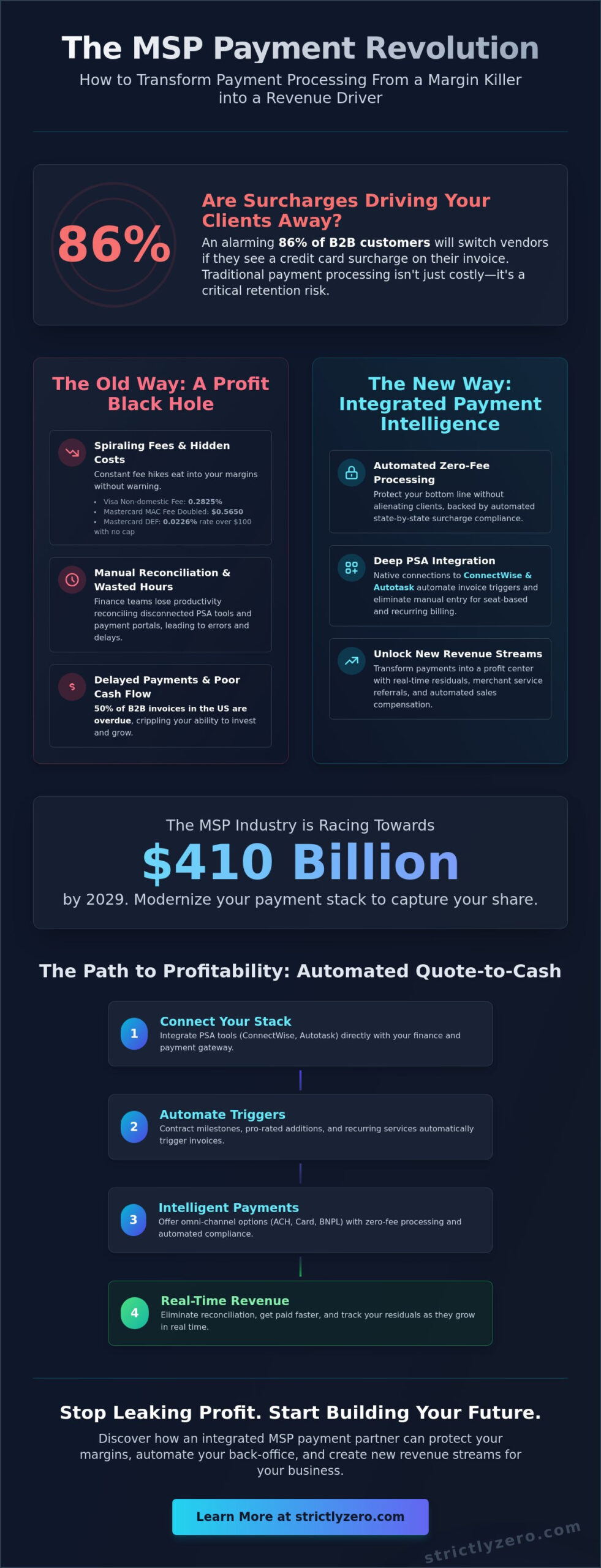
Did you know that 86% of B2B customers will switch vendors if they see a credit card surcharge on their invoice? You’ve likely felt the sting of the Visa non-domestic settlement fee jumping to 0.2825% this April, or noticed the Mastercard MAC fee doubling to $0.5650. It’s frustrating to watch your hard-earned margins disappear into a black hole of processing costs. Finding the right MSP payment solutions partner isn’t just about moving money anymore. It’s about surviving a 2026 market where Visa’s new Commercial Enhanced Data Program (CEDP) has replaced Level 2 interchange and added new participation fees to your overhead.
We’re going to show you how to flip the script and turn these costs into a scalable revenue driver. You’ll learn how to implement automated, zero-fee processing that protects your bottom line without alienating your clients. This guide explores the shift toward “quote-to-cash” automation, deep PSA integrations, and the specific strategies you need to scale your business toward the $410 billion industry projection by 2029. It’s time to stop manual reconciliation and start growing your residuals in real time.
Key Takeaways
- Learn how to transition from traditional merchant services to integrated payment intelligence that supports seat-based pricing and recurring billing.
- Discover the steps to connect your PSA tools directly to your finance stack to automate invoice triggers and eliminate manual reconciliation errors.
- Identify how the right MSP payment solutions partner can implement zero-fee processing while managing complex, state-by-state surcharge compliance automatically.
- Understand how to map your service items to your payment gateway to ensure seamless quote-to-cash workflows for every client contract.
- Explore ways to transform your payment processing into a secondary revenue stream through merchant service referrals and automated sales team compensation.
The Evolving Role of an MSP Payment Solutions Partner in 2026
The MSP industry is racing toward a $410 billion valuation by 2029. To capture this growth, you can’t rely on the same billing workflows used five years ago. In 2026, the definition of a payment processor has shifted from a simple utility to a strategic asset. A modern MSP payment solutions partner must bridge the gap between technical service delivery and financial efficiency. It’s no longer just about sending an invoice; it’s about creating an automated ecosystem that offsets costs and ensures compliance across state lines.
Traditional billing models are breaking under the weight of manual overhead. With 50% of B2B invoices in the US currently overdue, your cash flow depends on more than just getting paid. It requires real-time visibility and omni-channel options that allow clients to pay via ACH, credit card, or even “Buy Now, Pay Later” (BNPL) frameworks. Modern partners focus on payment intelligence, using data to predict churn and automate collections before they become a problem.
To better understand this concept, watch this helpful video:
Why Standard Processors are Margin Killers
Standard flat-rate processors ignore the nuances of the MSP model. They don’t understand seat-based pricing or the complexity of pro-rated mid-month additions. When you use a generic gateway, you’re often hit with hidden costs that eat into thin margins. For instance, the Mastercard Digital Enablement Fee cap removal in early 2026 means transactions over $100 now carry a 0.022600% rate without a ceiling. If your processor isn’t optimizing for these changes, you’re losing money on every high-value contract. Manual reconciliation between a disconnected portal and your PSA tool creates a secondary cost: the lost productivity of your finance team. It’s a double hit to your profitability.
The Rise of Partner-Centric Payment Platforms
The shift toward payment intelligence means your platform should act as a consultant, not just a middleman. API-first platforms allow you to build custom workflows that trigger invoices the moment a contract milestone is hit in ConnectWise or Autotask. A dedicated MSP payment solutions partner provides the infrastructure to automate these tasks while you focus on core IT services. This level of integration reduces the quote-to-cash cycle significantly.
True partnership also involves white-labeling. Since 86% of B2B customers might switch vendors over poor payment experiences, owning the branded interface is critical for retention. By choosing a partner-centric model, you gain access to features like:
- Automated Compliance: Handling the legal complexities of surcharging as regulations shift in 2026.
- Real-time Residuals: Instant visibility into the revenue your payment processing generates for your own firm.
- Data Quality: Leveraging the Visa Commercial Enhanced Data Program (CEDP) to qualify for lower interchange rates through line-item detail submission.
Essential Features of a Modern MSP Payment Solution
Scaling an MSP in 2026 requires more than a simple plug-in that sends an email. It requires a deep technical marriage between your Professional Services Automation (PSA) tool and your merchant account. When you select an MSP payment solutions partner, you’re looking for a system that doesn’t just record a transaction but understands your business model. This means native integration with Autotask or ConnectWise is mandatory. Unlike legacy platforms that require third-party plugins to bridge the gap, a modern partner builds the processing engine directly into your existing workflow.
This integration is vital for seat-based pricing. As your clients add or remove users, your payment system should automatically adjust recurring billing cycles without human intervention. This automation is the only way to maintain a lean back-office as you scale toward the $410 billion industry projected for 2029. It also allows you to implement automated, zero-fee processing that feels like a natural part of your service agreement.
A significant gap in current market solutions is the lack of real-time compliance automation. In early 2026, state-level regulations regarding surcharging have become increasingly complex. Since 78% of business cardholders already view surcharges negatively, and 86% of B2B customers say they would switch vendors over aggressive fee implementations, your solution needs a smart pricing engine. This engine must distinguish between a consumer credit card and a commercial card in milliseconds, applying the correct logic to stay compliant while protecting your margins from the 0.05% CEDP participation fee and other rising costs.
The Power of White-Label Payment Portals
Trust is the currency of the managed services world. If a client clicks a link in your invoice and lands on a generic, third-party processing page, it creates unnecessary friction. A white-labeled portal keeps your brand front and center. It allows clients to access their own billing history, manage stored payment methods, and view invoices without calling your support desk. This self-service capability reduces administrative tickets by as much as 30% for high-growth firms, allowing your team to focus on technical delivery rather than chasing payments.
Omni-Channel Flexibility for Field and Office
Your revenue doesn’t only come from recurring monthly contracts. Project-based work and emergency on-site visits require immediate payment options. A modern partner provides mobile payment links that field techs can send via text or email the moment a job is completed. For office staff, virtual terminals allow for secure over-the-phone renewals or deposit captures. Consolidating these diverse revenue streams into a single dashboard gives you real-time visibility into your merchant health and residual earnings, ensuring you never lose track of project-based profitability.
Finally, protect your high-ticket service contracts with AI-driven fraud prevention. These systems analyze transaction patterns to flag suspicious activity before it results in a costly chargeback. In a landscape where credit cards account for nearly 80% of merchant processing fees, having an automated shield against fraud is not just a feature; it’s a necessity for maintaining your bottom line.
Solving the Margin Squeeze: Zero-Fee Processing for MSPs
Most MSPs treat credit card fees as an inevitable tax on doing business. In 2023, U.S. merchants paid a staggering $126.35 billion just to accept credit cards. For a growing firm, those 2.5% to 3.5% fees represent a massive drain on liquidity. Choosing the right MSP payment solutions partner allows you to stop absorbing these costs and start treating your payment stack as a revenue-neutral utility. By implementing a zero-fee model, you reclaim that 3% margin, which can be reinvested into higher-tier talent or advanced R&D.
The math is simple but impactful. Consider a mid-sized MSP processing $750,000 annually through credit cards. At an average effective rate of 2.8%, that firm is losing $21,000 every year to interchange and processor markups. By shifting to a zero-fee structure, that $21,000 flows directly back into the business. This isn’t just about saving money; it’s about leveling the playing field against rising overhead costs like the Visa non-domestic settlement fee increase to 0.2825% that took effect in April 2026.
Surcharging vs. Dual Pricing: What’s Right for Your Clients?
While surcharging adds a fee at the point of sale, dual pricing presents two distinct prices to the client: one for credit and a discounted rate for ACH or cash. This distinction is vital for client retention. Since 86% of B2B customers say they’d likely switch vendors if a frequent partner implements surcharges poorly, the “cash discount” or dual pricing model is often the preferred path. It rewards the payment behavior you want, such as ACH, while keeping your credit card margins intact. A sophisticated partner uses automated debit card detection to ensure you never accidentally surcharge a debit transaction, which is a major compliance violation.
Automated Compliance in the 2026 Regulatory Landscape
The legal landscape for B2B payments has become a patchwork of state-by-state regulations. What’s legal in Texas might result in a heavy fine in another jurisdiction. The Strictly platform manages these shifting state laws in real-time, adjusting the pricing logic based on the merchant’s and the customer’s locations. This removes the manual burden of tracking legislative updates or filing complex PCI DSS paperwork. Automated surcharge engines prevent legal liability for MSPs by instantly adjusting transaction logic to match the specific merchant and customer location requirements. By offloading this risk to your MSP payment solutions partner, you ensure that your path to zero-fee processing remains fully compliant and audit-ready.
Communicating this change to your clients requires transparency. Focus on the value of choice. By offering a dual-pricing model, you’re giving them the option to pay the “standard” price via credit card or save money by switching to ACH. This approach reframes the conversation from “adding a fee” to “offering a discount,” which preserves the branded client experience you’ve worked hard to build.
Integration and Workflow: Connecting Your PSA and Finance Stack
Efficiency in 2026 isn’t just about fast internet; it’s about the speed of your quote-to-cash cycle. For most firms, the manual gap between a Professional Services Automation (PSA) tool and the bank account is where profit disappears. An MSP payment solutions partner should act as the glue between these systems. By automating the workflow, you solve the friction that keeps your accounts receivable from being current. You don’t have time to chase payments when you’re managing complex IT infrastructure.
A high-performance integration follows a four-step blueprint to ensure no revenue is left behind:
- Mapping Service Items: Align your ConnectWise or Autotask service codes directly with your payment gateway. This ensures that a “Managed Security” line item on an invoice is correctly categorized in your financial reporting.
- Automating Milestone Triggers: Set your system to fire off invoices the moment a project status changes or a contract milestone is reached in your PSA.
- Real-time Data Sync: Eliminate the need for “double-entry” accounting. When a payment is captured in the gateway, it should mark the invoice as paid in both your PSA and your accounting software like QuickBooks or Xero.
- Smart Dunning: Implement automated retries and notification sequences for failed recurring payments. This prevents service interruptions and keeps your cash flow healthy without manual follow-ups.
Maximizing Flexible Gateway Integration
While some providers lock you into a closed ecosystem, a flexible gateway architecture remains the industry benchmark for scalability. It allows you to leverage features like a secure Customer Vault, which stores sensitive payment data off-site to reduce your PCI scope while enabling seamless one-click renewals. This infrastructure serves as the ultimate payment processing platform for ISOs and MSPs who need a foundation that grows with their contract complexity. By using an open, API-first gateway, you aren’t limited by the “one-size-fits-all” constraints of basic billing plugins.
Reducing Churn with Payment Intelligence
Your payment data offers a wealth of predictive insights. Tools like ChurnIQ™ use this information to identify “at-risk” clients before they even think about canceling. If a client’s payment behavior changes or their card is nearing expiration, the system triggers an automated “save” sequence. This proactive approach is essential for maintaining merchant health and protecting your recurring revenue streams in a competitive market. To see how this integration can transform your back office, you should schedule a workflow audit with a specialist today.
Scaling Your MSP with the Strictly Partner Ecosystem
Scaling a managed service provider business requires looking beyond internal efficiencies. Once you’ve automated your billing and eliminated processing fees, the next step involves leveraging your MSP payment solutions partner to build new revenue streams. The Strictly Partner Ecosystem is designed to turn your financial stack into a growth engine. It isn’t just about processing your own invoices; it’s about providing your sales team with the tools they need to succeed and your business with the residuals it deserves.
Transitioning from a cost-center mindset to a profit-center mindset is the hallmark of a high-growth MSP in 2026. Your role as a trusted advisor allows you to offer more than just technical support. By referring your clients to a zero-fee processing model, you help them solve the same margin squeeze you’ve already conquered. This creates a secondary revenue stream for your firm through merchant service residuals. The onboarding process is frictionless, featuring dedicated account managers who understand the specific language of managed services. You won’t spend weeks explaining seat-based contracts to a support desk that usually handles retail shops.
ClearSplit™: Transparent Residual Management
Tracking commissions for a growing sales team shouldn’t involve a complex web of manual spreadsheets. ClearSplit™ eliminates that administrative burden by automating partner splits in real-time. Your team gets instant visibility into their earnings, which directly improves morale and retention. When your account managers see the immediate impact of a new contract or a merchant referral, they stay focused on high-value growth activities. This transparency is a key differentiator in a market where talent retention is as critical as client acquisition.
The Future of MSP Payments: AI and Beyond
The payment landscape continues to shift as AI-driven fraud detection becomes more sophisticated. These systems now analyze B2B transaction patterns to prevent high-ticket chargebacks before they happen. Additionally, the integration of POS lending within your payment portal allows your clients to fund large-scale IT projects or hardware refreshes with ease. This removes the “sticker shock” from major proposals and speeds up your project pipeline. It’s time to stop viewing payments as a back-office chore and start seeing them as a strategic advantage.
Ready to transform your financial operations? You should partner with Strictly to scale your payments business today and unlock the full potential of your financial ecosystem.
Future-Proof Your MSP Financials
The 2026 market doesn’t leave room for inefficient billing or margin-eating fees. By choosing the right MSP payment solutions partner, you move beyond basic merchant services and into a world of automated payment intelligence. You’ve seen how a compliant $0-fee processing engine can reclaim $20,000 or more in annual overhead, while deep PSA integrations eliminate the double-entry accounting that slows your team down. These aren’t just incremental gains; they’re the foundation of a scalable business model.
Scaling toward the $410 billion industry projection requires tools that do the heavy lifting for you. Whether it’s using ChurnIQ™ retention intelligence to protect your recurring revenue or managing sales commissions through ClearSplit™ automated residuals, your financial stack should be your biggest competitive advantage. Don’t let rising interchange rates or complex state regulations hold your business back. It’s time to transform your payment processing from a necessary expense into a scalable revenue driver that supports your long-term growth goals.
Scale your MSP and eliminate fees with Strictly and take control of your margins today. Your path to a more profitable 2026 starts with a single integration.
Frequently Asked Questions
Is surcharging legal for MSPs in all US states?
Surcharging is legal in 47 states as of May 2026, though specific restrictions still exist in jurisdictions like Connecticut and Massachusetts. Your MSP payment solutions partner must provide a smart pricing engine that detects the card type and customer location in real time. This automation ensures you remain compliant with state laws and card brand rules, such as the requirement to only surcharge credit transactions while leaving debit cards fee-free.
How does a payment solution integrate with my PSA like ConnectWise or Autotask?
Integration works through a secure API that maps your PSA service items directly to your payment gateway’s billing logic. When a contract milestone is reached or a seat-based invoice is generated, the system triggers the payment process automatically. This real-time sync eliminates the manual double-entry that leads to errors, helping you solve the 50% overdue invoice rate currently affecting many B2B businesses.
What is the difference between a payment gateway and a payment processor for MSPs?
The payment gateway is the software layer that captures and encrypts transaction data, while the processor is the financial institution that actually moves the funds. For an MSP, the gateway provides essential tools like the Customer Vault for secure tokenization. The processor handles the actual interchange fees, including the 0.05% CEDP participation fee, and settles the final amount into your business bank account.
Can I offer my clients a discount for paying via ACH instead of credit card?
Offering a discount for ACH is known as dual pricing and is a highly effective way to protect your margins. Since 86% of B2B customers might switch vendors if they feel a surcharge is implemented unfairly, dual pricing provides a “friendly” alternative. You present a standard price for credit cards and a discounted rate for ACH, which encourages the lower-cost payment method without alienating your client base.
How long does it take to switch to a new MSP payment solutions partner?
Most firms can complete the transition in 3 to 5 business days. The merchant account approval process typically takes 24 hours; then a dedicated account manager helps you map your PSA service codes to the new gateway. This frictionless onboarding ensures your monthly billing cycle continues without interruption while you move toward a more profitable, zero-fee processing model.
What are the PCI compliance requirements for an MSP in 2026?
MSPs must now adhere to PCI DSS 4.0 standards, which emphasize continuous security monitoring and multi-factor authentication. You can reduce your compliance scope by using a partner that offers hosted payment portals and tokenization. This keeps sensitive cardholder data out of your local network, allowing you to qualify for a simplified Self-Assessment Questionnaire rather than undergoing a costly, full-scale financial audit.
How does ChurnIQ™ help me keep more clients?
ChurnIQ™ uses payment intelligence to identify “at-risk” clients based on subtle changes in their transaction behavior. If a client who historically pays on day 1 suddenly waits until day 20, the system flags the account for your team to investigate. It also proactively manages credit card expirations, reaching out to clients before a failure occurs to prevent the accidental churn that often breaks recurring revenue streams.
What is ClearSplit™ and how does it handle my sales team’s commissions?
ClearSplit™ is an automated tool that manages partner residuals and sales commissions without the need for manual spreadsheets. It provides your team with a real-time dashboard where they can track their earnings from both service contracts and merchant referrals. By automating these splits, you improve team morale and ensure that your internal compensation remains transparent and accurate as your business scales.