

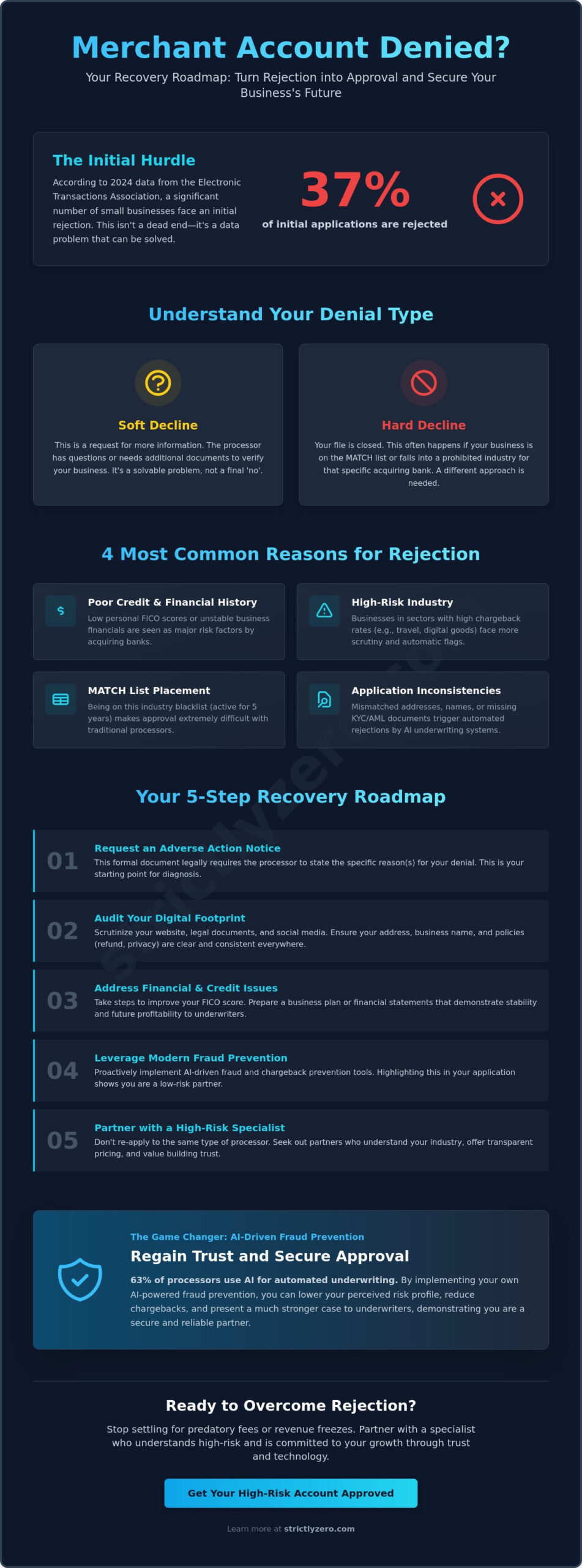
37% of small business merchant account applications are rejected on the first submission according to 2024 data from the Electronic Transactions Association. Rejection isn’t the end. Knowing what to do if merchant account is denied is the difference between a temporary revenue freeze and a scalable future. It’s frustrating to be labeled high-risk just because you’re in a specific niche or because your chargeback rate ticked toward the 1% threshold. You’ve likely felt the fear of being blacklisted on the MATCH list, where entries remain active for five years regardless of your current performance.
You don’t have to stay in the dark or settle for predatory 6% transaction fees. This guide will show you exactly what to do if merchant account is denied so you can diagnose the specific reason for your rejection and secure a processing partner that actually understands your business model. We’ll walk through a 2026 recovery checklist and explain how leveraging AI-driven fraud prevention can help you regain trust. If you are currently unsure what to do if merchant account is denied, this roadmap provides the exact steps to secure a reliable processing partner even if you are labeled high-risk.
Key Takeaways
- Identify the critical differences between a hard decline and a request for more information to determine your next move.
- Follow a precise 5-step roadmap on what to do if your merchant account is denied, including how to request an Adverse Action notice.
- Learn how AI-driven fraud prevention can lower your perceived risk and convince underwriters to approve your application.
- Audit your digital compliance and refund policies to remove the red flags that trigger automatic rejections.
- Discover how a processing partner focused on trust and dual pricing can help you scale even if you are labeled high-risk.
Understanding Why Merchant Account Applications Are Denied
A merchant account denial occurs when an acquiring bank decides that the financial risk of processing your transactions outweighs the potential profit. To understand the basics of this relationship, you should first clarify what is a merchant account within the context of the global financial system. Understanding the mechanics of this rejection is the first step in learning what to do if merchant account is denied. In 2026, these decisions happen in milliseconds based on real-time data feeds. Getting a “Hard Decline” means the processor has closed your file completely, while a request for more information is often a “Soft Decline.”
It’s vital to remember that a rejection isn’t a personal judgment on your character or the quality of your product. If you’re stressed about what to do if merchant account is denied, remember that this is a business hurdle rather than a personal failure. Underwriters look at data points, not intentions. With a 37% initial rejection rate for small businesses reported by the Electronic Transactions Association in 2024, you’re in good company. A rejection is simply a signal that your current data profile doesn’t match a specific bank’s risk appetite.
To better understand this concept, watch this helpful video:
The Role of the Acquiring Bank
Acquiring banks sit at the center of credit card processing services. They are legally responsible for every dollar processed through their system. If a merchant faces massive fraud, the bank is often left holding the bill. Because of the UK Payment Safeguarding Rules effective May 7, 2026, banks have become even more risk-averse. They perform a strict “Risk vs. Reward” calculation on every application, analyzing your average ticket size and monthly volume to ensure they aren’t exposed to settlement losses.
Automated Underwriting vs. Manual Review
Modern underwriting is driven by agentic AI, with 63% of merchants reporting that processors use these tools for instant flagging. Common triggers include mismatched business addresses or belonging to high-risk sectors. Knowing what to do if merchant account is denied requires cleaning up the data these algorithms analyze. If the AI can’t verify your digital footprint or finds inconsistencies in your terms of service, it will issue an automated rejection before a human ever sees your file. Trust is the primary currency in this environment, and proving your legitimacy through clean data is essential. If you’ve been flagged by an algorithm, your priority is identifying the specific data trigger that caused the system to doubt what to do if merchant account is denied and how to fix it.
The 4 Most Common Reasons for Merchant Account Rejection
Understanding what to do if your merchant account is denied starts with pinpointing the exact trigger behind the underwriter’s decision. While every bank has its own risk appetite, most rejections in 2026 stem from four specific areas. These range from simple clerical errors to complex industry classifications that flag your business before a human ever reviews your file. If you’ve been hit with a decline, it’s likely due to credit history, industry risk, a presence on the MATCH list, or inconsistencies in your Know Your Customer (KYC) documentation.
Application inconsistencies are often the “silent killer” of approvals. In an era of automated Anti-Money Laundering (AML) checks, even a small discrepancy between your business license address and your website’s contact page can trigger an instant rejection. Underwriters view these mismatches as potential fraud signals. Before reapplying, ensure every piece of data across your digital footprint is perfectly synchronized.
Credit and Financial Stability
Your personal FICO score remains a primary benchmark for credit card processing for small business. Banks view the business owner as the ultimate guarantor of the account. If your credit report shows recent bankruptcies or a history of late payments, the processor sees a high probability of financial instability. Underwriters will scrutinize your business bank statements to ensure you have consistent cash flow. Low cash reserves signal a high chargeback risk to banks because the merchant may lack the funds to cover disputed transactions. If you find yourself in this position, partnering with a processor that offers Trust as a Payment Processor can help bridge the gap through better risk assessment tools.
The MATCH List (Member Alert to Control High-Risk)
The MATCH list, formerly known as the Terminated Merchant File (TMF), is a database maintained by Mastercard. It acts as a global blacklist for the processing industry. If a previous processor terminated your account due to excessive chargebacks (typically exceeding the 1% threshold) or suspected fraud, you’ll be added to this list. Entries on the MATCH list remain active for five years before being automatically removed. Finding out if you’re on this list is a critical step in knowing what to do if your merchant account is denied. While it’s difficult to get off the list before the five-year mark, you can petition the adding bank if you can prove the entry was made in error or if the underlying issues have been legally resolved. For those currently on the list, seeking processors that specialize in high-risk recovery and use AI-driven fraud prevention is often the only path forward.
Your Recovery Roadmap: 5 Steps to Take After a Denial
If you’ve received a rejection, your immediate priority is gathering intelligence. Knowing what to do if your merchant account is denied requires moving past the initial shock and into a tactical investigative phase. You shouldn’t just spam more applications to different processors. That’s a quick way to look desperate to AI-driven underwriting systems that share data. Instead, follow this structured recovery roadmap to fix the underlying issues and present a cleaner profile to your next potential partner.
Step 1: Analyzing the Rejection Letter
Banks are legally required to provide an Adverse Action notice if they deny you based on credit information. However, these letters are often written in cryptic banker language. You need to determine if the issue was Policy or Data. A policy rejection means the bank simply doesn’t support your industry, regardless of your performance. A data rejection means something in your application, like a low FICO score or high chargeback history, didn’t meet their specific threshold. Ask your sales representative for the specific reason code. This clarity prevents you from making the same mistake twice.
Step 2: Website and Compliance Audit
In 2026, your website is your best underwriting tool. Underwriters will perform a deep dive into your digital presence to ensure you meet modern security and transparency standards. You must have clear, easily accessible pages for your Privacy Policy, Shipping Policy, and Contact Information. If your checkout process doesn’t clearly display your refund policy before the final click, you’ll likely face an automatic rejection. Ensure your site uses HTTPS and that all product descriptions are accurate. If you sell high-ticket items, your terms of service should be airtight to prevent friendly fraud.
Beyond the digital audit, you must address financial optics. If your personal credit score is a primary concern, securing a co-signer with a stronger profile can mitigate the bank’s risk. You should also seek a processing partner that prioritizes trust and understands high-risk business models. Finally, prepare a Merchant Cover Letter. This is your chance to explain past hurdles, like a one-time surge in chargebacks, and demonstrate how you’ve implemented new safeguards. Mentioning your use of AI-driven fraud prevention shows underwriters you’re proactive about protecting their settlement funds. This is a major priority for processors under the UK Payment Safeguarding Rules effective May 7, 2026.
How AI-Driven Fraud Prevention Can Secure Your Approval
Underwriters are inherently risk-averse, and their primary hesitation stems from the “Chargeback Fear.” By 2026, global chargeback costs are projected to hit $33.8 billion, a massive financial burden that banks are desperate to avoid. When you are researching what to do if your merchant account is denied, you must shift your strategy from simply asking for an account to proving your business is a safe bet. Integrating advanced technology into your payments stack transforms you from a “high-risk” liability into a transparent, low-risk partner.
Static underwriting, which relies on old credit scores and annual tax returns, is being replaced by dynamic trust monitoring. Modern processors look for merchants who use agentic AI to monitor transactions in real time. This technology identifies patterns of friendly fraud, which currently accounts for up to 75% of all chargebacks according to 2025 Visa data. By stopping these transactions at the gateway, you protect the processor’s settlement funds and maintain a clean processing history.
Mitigating Chargeback Risk with Tech
Real-time fraud alerts act as a digital shield, stopping suspicious transactions before they ever reach the settlement stage. This is critical because for every dollar lost to fraud, U.S. merchants lose an average of $4.61 in associated fees and overhead. Processors favor merchants who utilize these tools because they significantly lower the bank’s exposure to Mastercard’s 2026 Excessive Authorization Attempts Policy. This policy penalizes businesses that repeatedly retry declined cards, a behavior often associated with low-quality traffic. Aligning your business with the best credit card processing for small business rankings usually means adopting these AI-driven safeguards as a standard practice.
Data Transparency as a Sales Tool
Providing underwriters with “clean” data via API-first platforms is the most effective way to prove business legitimacy. When you use omni-channel payment processing, you provide a unified view of your sales across online, mobile, and in-person terminals. This consistency proves you aren’t a “fly-by-night” operation. In 2026, processors act as digital character witnesses, using your granular transaction data to vouch for your stability to the acquiring banks. This level of transparency is exactly what to do if your merchant account is denied due to lack of history. By showing exactly who your customers are and how they pay, you remove the guesswork from the underwriting process. Secure your business with AI-driven fraud prevention to ensure your next application is met with an approval rather than a rejection.
Why Strictly is the Solution for Merchants Seeking Trust
Finding a reliable partner is the most critical step when deciding what to do if your merchant account is denied. Most traditional processors operate on a binary system; they either want your business or they don’t. Strictly operates differently by offering “Trust as a Payment Processor.” We understand that being labeled high-risk is often a matter of industry classification rather than actual business performance. By leveraging our suite of partner management tools and AI-driven fraud prevention, we build a bridge between your business and the acquiring banks that previously said no.
Our Smart Pricing Engine is a game-changer for businesses in volatile sectors. Underwriters often flag high-risk merchants because their profit margins are thin and easily disrupted by 2026’s rising interchange fees. When you use a surcharge or dual pricing model, you stabilize those margins. Banks view this as a sign of financial maturity. It proves you have a strategy to handle the 3.5% to 6% transaction fees typically associated with high-risk processing without compromising your settlement funds. This financial resilience makes your application far more attractive to risk-averse underwriters.
The Zero-Fee Advantage for Risky Industries
The zero fee credit card processing model does more than just protect your bottom line. It proactively manages compliance across different jurisdictions. With the 2026 U.S. Credit Card Competition Act (CCCA) and varying state-level surcharging laws, staying compliant is a full-time job. Strictly’s engine automates these rules, ensuring your account remains stable and “audit-proof” in the eyes of the bank. This automation reduces the administrative burden on underwriters, making it much easier for them to approve your application even if you’ve faced previous rejections. We position your business as a compliant, low-maintenance partner for the bank.
Next Steps: Getting Approved with Strictly
We believe transparency is the fastest path to approval. If you’re still unsure what to do if your merchant account is denied, start by providing clean, API-first data. Our platform integrates directly with your existing tech stack, allowing us to present a unified view of your omni-channel payments to our banking partners. This level of detail removes the “black box” of high-risk processing and replaces it with verifiable trust. Whether you’re a startup needing a virtual terminal or an enterprise scaling through partner management tools, we provide the stability you need to grow. Get started with a Strictly merchant account today.
Secure Your Processing Future Today
A merchant account rejection doesn’t have to be the end of your business growth. By treating a denial as a diagnostic tool, you can identify whether your hurdles are policy-based or data-driven. Remember that fixing your digital compliance and leveraging AI-driven fraud prevention are the most effective ways to lower your risk profile in the eyes of 2026 underwriters. Knowing what to do if your merchant account is denied gives you the leverage to find a partner that values transparency over rigid, outdated risk categories.
Strictly helps you navigate these challenges with a Smart Pricing Engine that automates compliance and protects your margins through dual pricing. Our platform includes built-in AI-driven fraud prevention to ensure your account remains stable even in high-growth environments. Whether you’re an ISO or a merchant seeking a reliable virtual terminal, we prioritize the trust that banks demand. Eliminate processing fees and build merchant trust with Strictly today. You’ve built a great business; now it’s time to secure the payment processing it deserves.
Frequently Asked Questions
Can I apply for another merchant account immediately after being denied?
You can apply elsewhere immediately, but doing so without addressing the initial reason for rejection is a mistake. Automated underwriting systems in 2026 often share risk data across networks. If you submit multiple applications within a short window without fixing data discrepancies, you risk being flagged as a “shotgun applicant.” This signals desperation to banks and can lead to a cycle of automated declines before a human ever reviews your file.
Will a merchant account denial hurt my credit score?
The denial itself does not impact your credit score, but the application process might. Most processors perform a hard pull on your personal credit report, which can temporarily lower your FICO score by five to ten points. When you are researching what to do if merchant account is denied, prioritize processors that offer pre-qualification via soft credit pulls. This allows you to gauge your approval odds without damaging your credit standing during the recovery process.
What is the MATCH list and how long do I stay on it?
The MATCH list is a database maintained by Mastercard to track high-risk merchants who have had accounts terminated. Once you are placed on this list, you remain there for five years before the entry is automatically purged. To move forward, you must identify the specific reason code assigned to your entry, such as excessive chargebacks or suspected fraud. Knowing your code allows you to address the specific security or financial concerns of your next potential processor.
Why do major payment aggregators deny businesses without explanation?
Large payment aggregators use an “approve now, underwrite later” model that prioritizes fast onboarding over long-term stability. Their AI algorithms monitor your account in real time, and if they detect a sudden spike in volume or a change in your risk profile, they may freeze the account instantly. Because they handle thousands of merchants under a single umbrella, they often don’t provide the detailed diagnostic reports that traditional acquiring banks offer during a formal denial.
Is it possible to get a merchant account with a 500 credit score?
Yes, but you will likely face stricter terms like a rolling reserve. A reserve typically holds 5% to 20% of your transaction volume for a period of 90 to 180 days to protect the bank from potential losses. In 2026, many high-risk specialists prioritize your current business cash flow and 12 months of clean processing statements over a legacy FICO score, provided you can prove your business is currently stable.
How much more does a high-risk merchant account cost?
High-risk accounts typically carry transaction fees between 3.5% and 6%, which is significantly higher than the standard 2.9% for low-risk businesses. You may also face increased authorization fees. For example, Visa’s April 2026 fee changes increased certain international authorization attempt fees from $0.15 to $0.25. These higher costs reflect the increased monitoring and compliance overhead that banks must maintain to support businesses in volatile or highly regulated industries.
What industries are currently considered high-risk in 2026?
Industries like cryptocurrency, online gaming, CBD, and “Buy Now, Pay Later” (BNPL) services are currently under heavy scrutiny. New regulations, such as the UK’s Deferred Payment Credit rules effective July 15, 2026, have increased the compliance burden for these sectors. Any business with a high “Card-Not-Present” volume or recurring subscriptions is also flagged due to the 0.60% average global chargeback rate and the rising threat of first-party misuse disputes.
Can a surcharge program help me get approved for a merchant account?
Implementing a surcharge program is a strategic move when considering what to do if merchant account is denied because it signals financial stability to underwriters. By passing processing costs to the customer, you protect your net margins against rising interchange fees. Banks view this favorably as it reduces the likelihood of business failure. Demonstrating that you use an automated surcharge engine to maintain state-by-state compliance shows the bank that you are a sophisticated, low-risk operator.