

U.S. merchants handed over a staggering $187.20 billion in card processing fees in 2024, a figure that continues to sting as 2026 inflationary pressures mount. You’ve likely watched your sales climb only to see your take-home pay stay flat, squeezed by rising interchange rates and complex fee structures that are nearly impossible to audit. Understanding the financial benefits of zero fee processing is no longer just a luxury; it’s a necessity for any business owner who’s tired of seeing their hard-earned margins disappear before they even hit the bank.
It’s time to stop treating processing fees as an unavoidable cost of doing business. By eliminating these expenses, you can immediately reclaim a 3-4% increase in your net profit margins and create a predictable capital stream for future growth. This guide will show you how to implement these strategies effectively. We’ll explore the critical differences between surcharging and dual pricing, helping you choose the path that maximizes your revenue while keeping your customers happy.
Key Takeaways
- Identify how to transform a variable expense into a predictable capital stream to fund your next growth phase.
- Master the financial benefits of zero fee processing by implementing a dual pricing engine that offers transparency to every customer.
- Stop wasting hours on monthly audits by moving to a simplified, zero-cost model that removes interchange complexity.
- Learn why the “customer friction” fear is a myth and how providing payment choices can actually improve your brand’s reputation.
- Discover how to integrate a zero-fee model into your current workflows using a streamlined, five-minute setup process.
The Growing Burden: Why Processing Fees Are a Silent Profit Killer in 2026
For many merchants, the top line looks healthy, but the bottom line is gasping for air. The culprit isn’t just generic inflation; it’s the invisible friction of interchange fees that have quietly escalated over the last two years. While many providers still market “flat-rate” pricing as a simple solution, it’s often a veil for significant markups that outpace your actual sales growth. This deception makes it difficult to see how much you’re truly losing until you audit the year-end totals.
In 2026, the gap between gross revenue and what actually lands in your business account has widened significantly. Traditional processing models take a percentage of the total sale, but they don’t account for your rising overhead costs. When you finally realize the financial benefits of zero fee processing, you stop paying for the privilege of accepting your customers’ money. It’s the difference between barely breaking even and having the surplus needed to scale.
To better understand how these costs impact your business, watch this helpful video:
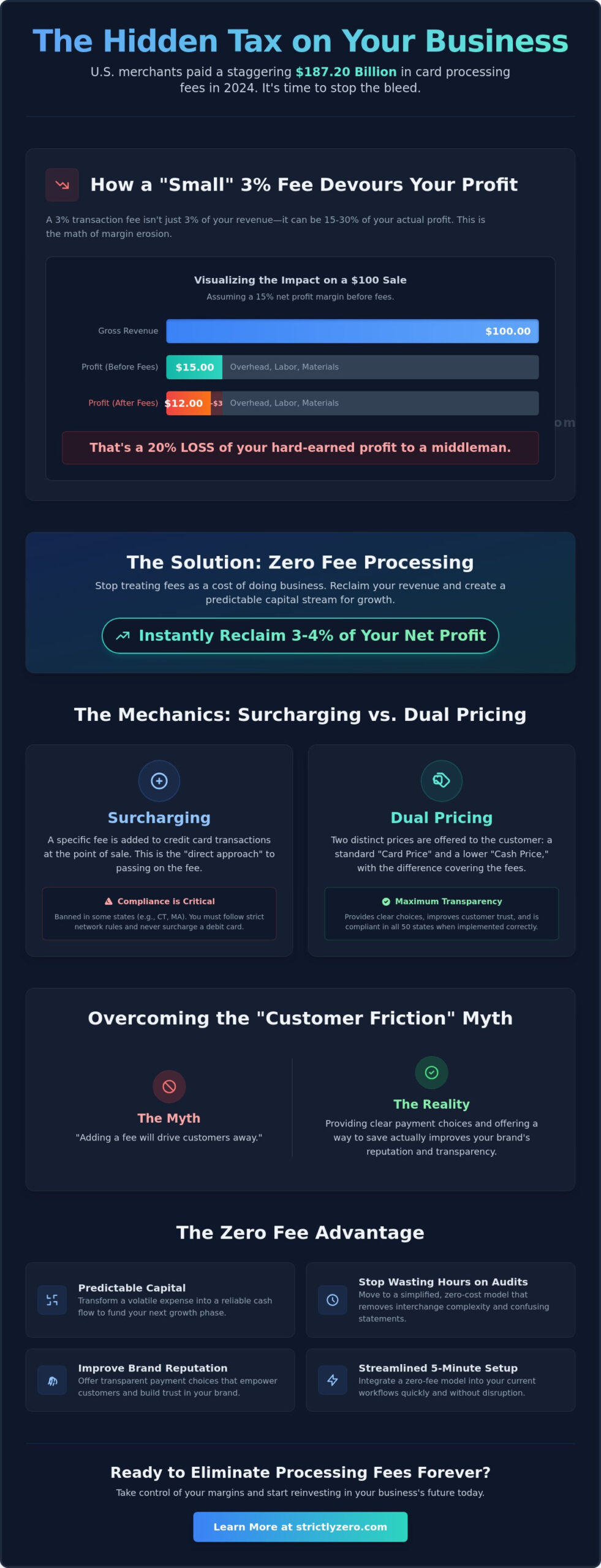
A 3% transaction fee sounds small on paper. However, for a business operating on a 10% to 20% net profit margin, that fee represents a massive chunk of your take-home pay. It’s not just 3% of a sale; it’s often 15% to 30% of your actual profit. This “fee fatigue” is pushing business owners to the brink in a high-inflation economy where every penny counts toward staying competitive.
The Math of Margin Erosion
Imagine a $100 sale. After labor, materials, and rent, you might keep $15. If a processor takes $3, your profit drops to $12. You’ve just lost 20% of your earnings to a middleman. In 2026, the “cost of doing business” excuse is a trap that keeps margins dangerously thin for local shops and service providers alike. Your Effective Rate is the total amount of processing fees paid divided by your total gross sales volume, representing the true percentage you lose to card networks each month.
Why 2026 is the Tipping Point
New regulations surrounding digital wallets and contactless payments have introduced fresh layers of complexity to standard processing costs. What was once an optional optimization has become essential for survival. Adopting the best credit card processing for small business means moving toward a model where your growth isn’t penalized by your success. In competitive markets, the financial benefits of zero fee processing provide the extra breathing room needed to reinvest in staff or inventory while your competitors struggle with shrinking margins.
The Mechanics of Zero-Fee: Surcharging vs. Dual Pricing
Understanding how to stop the bleed requires looking under the hood of your payment setup. There isn’t just one way to eliminate costs. Instead, you have two primary paths: surcharging and dual pricing. Both offer the financial benefits of zero fee processing, but they function differently regarding customer experience and legal compliance. A modern Surcharge & Dual Pricing Engine does the heavy lifting here. It identifies the card type instantly to ensure you don’t accidentally apply a fee to a debit card. Surcharging a debit card is a violation of network rules that can lead to heavy fines.
The term “cash discounting” is often mislabeled in the industry. In 2026, true cash discounting requires you to list the higher credit price on every item and offer a reduction for those paying with cash. If you’re simply adding a fee to the existing price at checkout, that’s surcharging. Mixing these up can lead to compliance headaches and unexpected audits. Modern systems now automate this distinction, ensuring your receipts and displays match the specific legal requirements of your model.
Surcharging: The Direct Approach
Surcharging is a method where a specific fee is added to credit card transactions at the point of sale. To stay compliant, you must follow strict surcharging laws and regulations which vary by state. For instance, while most states allow it, Connecticut and Massachusetts still ban the practice entirely. You also have to respect the card network caps. Mastercard limits surcharges to 4%, while Visa caps them at 3%. Some states have even lower limits, like Colorado’s 2% cap or the 1% limit in Illinois. You’re also required to notify the card brands 30 days before you start and display clear signage at your entrance. It’s a precise model, but it requires diligent oversight to avoid penalties.
Dual Pricing: The Transparency Leader
Dual pricing is the modern evolution of the “cash discount” model. Instead of adding a fee at the end, you display two distinct prices for every item: a cash price and a card price. This method is legal in all 50 states, making it a safer bet for businesses with locations in multiple regions. Many high-end service providers prefer this because it feels more like a choice for the customer rather than a penalty. By presenting the price difference upfront, you unlock the financial benefits of zero fee processing without the friction of a surprise fee at the end of the transaction. You can find more about the technical requirements in this guide to zero fee credit card processing. It’s often the smoothest way to protect your profit without surprising a client at the register.
If you’re unsure which model fits your specific industry, you might want to examine how a dedicated pricing engine handles these complex rules for you automatically.
Quantifying the Financial Benefits: From Savings to Reinvestment
Most business owners view processing fees as a defensive cost to be managed. To truly scale, you must flip this perspective. Eliminating these costs isn’t just about saving pennies; it’s a capital generation strategy. When you move from a traditional 3.5% effective rate to a zero-fee model, you aren’t just cutting an expense. You’re effectively giving your business a permanent, interest-free internal loan. The financial benefits of zero fee processing become clear when you look at the cumulative impact over years rather than months.
Beyond the immediate cash injection, you’ll see a massive boost in operational efficiency. Traditional merchant statements are intentionally complex, often requiring hours of auditing to decipher hidden markups or “mid-qualified” tier jumps. By removing the fees entirely, your monthly reconciliation becomes a five-minute task. This reclaimed time allows your leadership team to focus on revenue-generating activities rather than forensic accounting. Additionally, zero-fee programs often align with faster funding cycles, putting your money back into your hands within 24 to 48 hours.
Direct Margin Comparison
The following table illustrates the impact of transitioning from a standard 3.2% industry average fee to a zero-fee model. These figures demonstrate how much capital stays within your business for reinvestment.
| Annual Revenue | Traditional Fees (3.2%) | Annual Savings | 5-Year Cumulative Impact |
|---|---|---|---|
| $500,000 | $16,000 | $16,000 | $80,000 |
| $1,000,000 | $32,000 | $32,000 | $160,000 |
| $5,000,000 | $160,000 | $160,000 | $800,000 |
Strategic Capital Reallocation
Overcoming the Customer Friction Myth
The fear that customers will flee at the sight of a service fee is one of the biggest hurdles for business owners. However, by 2026, consumer behavior has shifted dramatically. From ride-sharing apps like Uber to food delivery services like DoorDash, shoppers now encounter service fees and convenience surcharges in almost every digital and physical interaction. They don’t just tolerate these costs; they expect them in exchange for convenience and transparency. When you implement a dual pricing model, you aren’t penalizing the customer. You’re empowering them with a choice between a discounted cash price and a standard card price.
The financial benefits of zero fee processing are only sustainable if your customer base remains loyal. The key lies in framing. Instead of presenting the change as a new “tax,” successful merchants frame it as a way to keep base prices low for everyone. Without this model, you’d be forced to raise prices across the board to cover rising interchange rates, effectively making your cash-paying customers subsidize those using high-reward credit cards. Most consumers find the dual-price approach fairer once they understand that it protects the business from invisible middleman costs.
The Automated Compliance Advantage
The real magic happens behind the scenes with a Surcharge & Dual Pricing Engine. This technology eliminates the risk of human error by automatically identifying the card type the moment it’s swiped or entered. Because surcharging a debit card is a major compliance violation that can lead to network fines, the system uses “Debit Suppression” to ensure fees are only applied where legally allowed. It also tracks state-by-state legal variations in real-time, adjusting the logic for locations in places like Colorado or Illinois where caps are lower than the national average. Beyond compliance, our AI-driven fraud prevention acts as a secondary financial benefit by stopping chargebacks before they happen, further protecting your newly expanded margins.
Customer Loyalty in the Zero-Fee Era
Transparency actually builds more trust than hidden processing costs ever could. In service-based industries especially, clients appreciate knowing exactly where their money is going. Modern POS systems display both prices clearly on the screen and the receipt, removing the “surprise” factor that often leads to friction. Data shows that for most small businesses, the impact on conversion rates is negligible, while the impact on net profit is transformative. You’re no longer losing a chunk of every sale to a bank, allowing you to maintain the high level of service that keeps customers coming back.
Ready to see how this works in your store? Explore our Surcharge & Dual Pricing Engine to automate your compliance today.
Implementation: Transitioning to a Zero-Fee Model with Strictly
Transitioning to a zero-fee model doesn’t have to be a technical headache. With Strictly, the promise is a five-minute setup that takes you from a legacy processor to active zero-fee processing. This speed is vital for businesses that can’t afford downtime. The financial benefits of zero fee processing start the moment your new engine goes live, turning every transaction into a full-value deposit for your bank account.
Integration is seamless. Whether you’re connecting via your existing payment gateway or a custom API, the Strictly engine plugs into your current workflows without requiring a complete hardware swap. Once active, you gain access to a “Saved Fees” dashboard. This real-time reporting provides a clear view of exactly how much capital you’ve reclaimed, making it easy to track the expansion of your net profit margins. For ISOs and partners, our partner management tools are a game-changer for winning merchant loyalty by offering a solution that solves their biggest pain point.
The Strictly Onboarding Process
We’ve streamlined the move to zero fees into three distinct steps to ensure nothing gets missed. Our goal is to make the switch as invisible as possible to your daily operations while making the savings highly visible on your bottom line.
- Step 1: We start with a deep-dive statement analysis. We look for hidden “junk” fees and non-qualified surcharges that your current processor might be hiding in the fine print.
- Step 2: Implementation is hardware-agnostic. You can use our Virtual Terminal or generate secure Payment Links to accept payments anywhere, integrating directly with your Omni-Channel Payment Processing setup.
- Step 3: We provide staff training materials. This ensures your team can confidently explain the dual pricing model to customers, maintaining transparency and trust at the point of sale.
Advanced Tools for Growth
Retention is just as important as acquisition. We use ChurnIQ™ to monitor account health and ensure your merchant retention stays high. For our partners, ClearSplit™ automates the distribution of residuals from zero-fee accounts, removing the manual labor from your back-office operations. This ecosystem ensures that the financial benefits of zero fee processing are maximized for both the merchant and the partner. When you stop paying for the privilege of getting paid, you unlock the capital needed to scale your business to the next level.
Calculate your potential savings with Strictly today.
Secure Your Business Growth for 2026 and Beyond
The shift toward zero-fee processing isn’t just a trend; it’s a fundamental change in how profitable businesses operate in a high-inflation economy. You’ve seen how transforming a major expense into a predictable stream of internal capital can fundamentally alter your company’s valuation. You’ve also learned how modern technology simplifies compliance and keeps your customers happy through transparency and choice. Realizing the full financial benefits of zero fee processing means you no longer have to sacrifice your hard-earned margins to card networks.
With our Smart Pricing Engine handling automated compliance and AI-driven fraud prevention protecting every sale, you can focus on scaling your operations instead of auditing statements. Partners also benefit from the transparency of ClearSplit™ for residual management. It’s time to take control of your revenue and stop letting interchange rates dictate your growth potential. Eliminate your processing fees today with Strictly and start reinvesting in the future of your business. Your bottom line will thank you.
Frequently Asked Questions
Is zero-fee credit card processing legal in all 50 states in 2026?
Dual pricing is legal in all 50 states, while credit card surcharging is prohibited in Connecticut and Massachusetts as of 2026. If your business operates in a state with surcharging restrictions, implementing a dual pricing model allows you to access the financial benefits of zero fee processing legally by showing distinct prices for cash and card payments.
Will my customers stop buying from me if I add a surcharge?
Most consumers in 2026 are already accustomed to service fees from ride-sharing apps, delivery services, and hotels. Data indicates that when the model is framed as a way to keep base prices low, customer friction is minimal. Offering a choice through dual pricing is often the most well-received method because it presents a clear discount for cash users.
What is the difference between surcharging and dual pricing?
Surcharging involves adding a specific fee to a credit card transaction at the final stage of checkout. Dual pricing is a more transparent approach where you display two separate prices for every item: a cash price and a card price. Dual pricing is generally easier to implement across multiple states because it’s not subject to the same strict caps as surcharging.
Does zero-fee processing work for online e-commerce stores?
Yes, zero-fee models are highly effective for e-commerce through the use of a Virtual Terminal & Invoicing. You can send secure payment links that automatically apply the correct pricing logic based on whether the customer uses a credit card or another method. This ensures your margins remain protected even in a digital-first sales environment.
Can I still accept debit cards with a zero-fee program?
You can continue to accept all major debit cards, but you cannot legally apply a surcharge to them under current federal rules. Our Surcharge & Dual Pricing Engine uses debit suppression technology to identify these cards instantly. This ensures that only credit transactions receive the fee, keeping your business compliant with all card network regulations.
How much can a typical small business save annually with this model?
Small businesses using a zero-fee model report average annual savings of approximately $7,500 based on industry research. For larger merchants, the financial benefits of zero fee processing often translate into tens of thousands of dollars in reclaimed profit. This represents an immediate 3% to 4% increase in net profit margins on your card-based sales volume.
What technical equipment do I need to start zero-fee processing?
You don’t need to purchase proprietary physical hardware to begin. Strictly provides hardware-agnostic solutions that integrate with your existing workflows via a Virtual Terminal or custom API. This allows you to activate zero-fee processing across all your sales channels without a significant upfront investment in new counter equipment.
How does Strictly ensure my business remains compliant with Visa and Mastercard rules?
Strictly uses an automated Surcharge & Dual Pricing Engine to manage all network requirements, including the 30-day notification period and proper receipt disclosure. By combining this with AI-driven fraud prevention and real-time state law tracking, the system prevents illegal surcharging on debit cards and keeps your fees within legal caps automatically.