

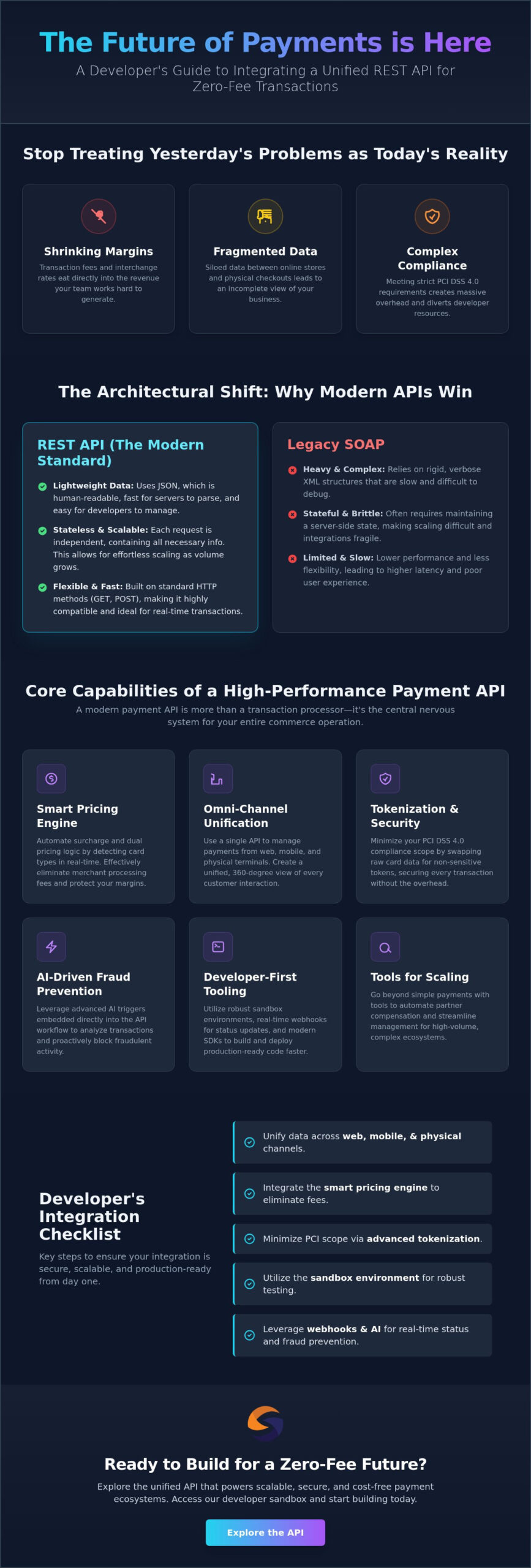
Most developers treat transaction fees as an unchangeable law of the internet, but in 2026, those shrinking margins have become a choice rather than a necessity. You’ve likely spent hours wrestling with fragmented data between your online store and physical checkout points, all while trying to keep up with the strict requirements of PCI DSS 4.0. Selecting a modern REST API for payment processing shouldn’t just be about moving strings of data from point A to point B. It’s about building a system that works harder for the business than it does for the credit card networks.
It’s frustrating to watch complex compliance tasks and interchange rates eat into the revenue your team works so hard to generate. This guide promises to show you how to integrate a unified API that automates surcharge and dual pricing logic to effectively eliminate merchant fees. We’ll preview how to streamline your tech stack with a single integration for omni-channel payments, leverage AI-driven fraud prevention, and utilize a robust sandbox testing environment to ensure your code is production-ready from day one.
Key Takeaways
- Understand why transitioning to a REST API for payment processing is the foundation for unifying data across web, mobile, and physical checkout points.
- Master the integration of a smart pricing engine that detects card types in real-time to automate surcharge and dual pricing logic.
- Learn how to minimize your PCI compliance scope through tokenization while utilizing robust sandbox environments for secure testing.
- Discover how to use real-time webhooks and AI-driven fraud prevention to automate transaction status updates and protect business margins.
- Explore tools for scaling that automate partner compensation and streamline management for complex, high-volume payment ecosystems.
What is a REST API for Payment Processing?
REST stands for Representational State Transfer. It’s a set of architectural principles that allow different software systems to talk to each other using standard HTTP methods like GET, POST, and DELETE. To understand the technical foundation of these systems, it helps to start by defining What is an API? in its simplest form. For fintech, a REST API for payment processing acts as a secure, invisible bridge. It translates your customer’s card data into a format the banking network understands, ensuring funds move safely from one account to another.
Modern web applications have largely abandoned legacy SOAP protocols in favor of REST. While SOAP relied on complex XML structures that were often rigid and difficult to debug, REST uses JSON (JavaScript Object Notation) for its data exchange. JSON is lightweight and human-readable. This makes it much faster for servers to parse and easier for developers to manage. This speed is critical for real-time transactions where every millisecond affects the checkout conversion rate.
To better understand how these architectural concepts work in practice, watch this helpful breakdown:
The Architecture of a Modern Payment Request
When you initiate a transaction, the API creates a “Charge” or “PaymentIntent” object. This object tracks the lifecycle of the money, from initial authorization to final settlement. One critical feature of a robust REST API for payment processing is the use of idempotency keys. These keys ensure that if a network glitch causes a request to be sent twice, the customer is only charged once. Because REST is stateless, each request contains all the information needed to process the transaction. This allows your payment infrastructure to scale effortlessly as your transaction volume grows.
Key Benefits of API-First Payment Platforms
Integrating an API-first platform offers several advantages over traditional hosted checkout pages that force users away from your site. First, you gain total control over the user interface. You can design a checkout flow that matches your brand perfectly without redirects. Second, deployment is rapid. Modern SDKs allow developers to build and test integrations in a fraction of the time required by legacy systems. Finally, these APIs provide seamless connectivity. They sync with your existing ERP and CRM systems, ensuring your financial data remains unified across all business channels. For those in specialized healthcare niches, you can learn more about Sophya to see how dedicated management software leverages these integrations for psychology clinics.
Core Capabilities of a High-Performance Payment API
A modern REST API for payment processing does more than just move money. It serves as the central nervous system for your entire commerce operation. The biggest challenge developers face today is fragmented data. If your online sales live in one database and your physical POS transactions live in another, you’re flying blind. High-performance APIs solve this by providing true omni-channel support. This means you use a single set of endpoints to manage data from your website, mobile app, and in-person terminals, creating a unified view of every customer interaction.
Beyond data unification, these platforms must handle the heavy lifting of global commerce. This includes multi-currency support to reach international markets and real-time processing speeds that meet the expectations of 2026 consumers. By consolidating these functions, you reduce the technical debt associated with maintaining multiple third-party integrations. It’s about building a stack that is resilient enough to handle peak traffic without sacrificing the speed of individual requests.
Tokenization and Security Standards
Security is the non-negotiable foundation of any financial integration. Instead of handling sensitive card details directly, a secure API uses advanced tokenization to swap raw card numbers for unique, non-sensitive strings. This process is essential for meeting PCI DSS security standards, specifically the 4.0 requirements that became mandatory in 2025, without the massive overhead of securing your own servers for cardholder data. Modern systems go a step further by embedding AI-driven fraud prevention directly into the workflow. These triggers analyze transaction patterns in real-time to block suspicious activity before it hits your ledger, protecting both your revenue and your reputation.
Webhooks and Event-Driven Architecture
The days of polling an API for status updates are over. Modern infrastructure relies on an event-driven architecture powered by real-time webhooks. When a transaction moves through its lifecycle, your server receives an instant notification for events like ‘payment.succeeded’ or ‘refund.created’. This is particularly vital for handling asynchronous payment methods such as ACH or SEPA, where confirmation might take days rather than seconds. To keep this communication secure, always implement signature verification to ensure the data is coming from your trusted processor. If you’re looking to simplify this complexity, you might consider how omni-channel payment processing can unify these disparate events into a single, manageable stream. This approach ensures your system remains responsive and scalable, regardless of how many payment rails you choose to support.
Eliminating Processing Costs: Surcharge & Dual Pricing via API
While most developers focus on how to move money, the most successful ones in 2026 are focusing on how to save it. The “Zero Fee” revolution isn’t just a marketing slogan; it’s a technical shift in how a REST API for payment processing handles transaction logic. Instead of the merchant absorbing the 2.5% to 4% interchange costs, the API calculates and applies these fees to the cardholder in real-time. This ensures that the business receives 100% of the sticker price on every credit card transaction.
Implementing this requires more than just a simple addition to the total. You must align your integration with the W3C Payment Request API standard to ensure a consistent and transparent user experience. By leveraging a specialized pricing engine, your checkout flow can dynamically adjust based on the payment method provided. This level of automation removes the manual guesswork from fee management and allows the technical stack to directly contribute to the company’s profit margins.
The Logic Behind the Smart Pricing Engine
A high-performance API identifies the card type through a BIN (Bank Identification Number) lookup the moment the customer enters the first few digits. This is a critical step because federal and card network regulations, such as those from Visa and Mastercard, prohibit surcharging on debit and prepaid cards. The API response must be instantaneous, providing the compliant surcharge amount before the final authorization occurs. This transparency is vital; the customer sees exactly what they’re paying for, and the API ensures the receipt data matches the authorized amount perfectly. This real-time differentiation is what separates a basic payment gateway from a sophisticated REST API for payment processing.
API-Driven Compliance Management
Compliance is a moving target. As of 2026, states like Connecticut, Massachusetts, and Maine still prohibit surcharging, while others like New York and Colorado have specific disclosure requirements and caps on fee percentages. Manually coding these rules into your application is a recipe for legal trouble. A modern API handles this logic through geo-IP lookups and pre-validated rule sets that update automatically as laws change. This significantly reduces the legal burden on your development team. For a deeper dive into the regulatory landscape, you can consult this zero fee credit card processing guide. By offloading compliance to the API, you can focus on building features rather than tracking legislative sessions in fifty different jurisdictions.
Dual pricing takes this a step further by offering two distinct price points: one for cash or debit and another for credit. Your API integration should support this by allowing you to send two separate amount fields to the checkout UI. This model is often preferred because it frames the credit price as the standard and the cash price as a discount, which is widely considered the most compliant way to offset processing costs across all fifty states.
Developer’s Checklist: Integrating for Security and Scalability
Integrating a REST API for payment processing requires a disciplined approach to ensure both security and financial accuracy. Your first step is obtaining API keys and configuring your sandbox environment. This isolated space is where you’ll build and break things without affecting live transactions. Once the environment is ready, implement tokenization immediately. By ensuring raw card data never touches your servers, you drastically reduce your PCI DSS 4.0 compliance burden and protect your business from the liability of a data breach. To further streamline your regulatory journey, you can learn more about InfoSecurix and their specialized compliance services.
With the security foundation in place, focus on the logic of the transaction. Build your request payloads to include the necessary fields for your surcharge or dual pricing logic. As we established in the previous section, your code must handle the real-time calculation of fees based on the card type identified by the API. Finally, set up webhook listeners for transaction reconciliation. These endpoints should handle asynchronous events, ensuring your database stays in sync with the actual status of the funds even if a user closes their browser before a redirect completes.
Testing and Sandbox Best Practices
Don’t just test the “happy path” where every transaction succeeds. Use specific test card numbers to simulate “Insufficient Funds,” “Expired Card,” or “Fraud” responses. This allows you to build robust error handling that guides the user through a failed checkout without frustration. You should also simulate network latency and timeout scenarios to ensure your system remains resilient during connectivity drops. Versioning is another critical factor. Always specify the API version in your request headers to prevent unexpected schema updates from breaking your production integration.
Scaling for High Volume
Success brings its own set of technical challenges. High-volume merchants must implement rate limiting and retry logic with exponential backoff to handle temporary provider outages or traffic spikes gracefully. Monitor your API health through specialized developer dashboards to catch increases in error rates before they impact your conversion numbers. For large-scale operations, utilize bulk endpoints for reconciliation and reporting to avoid hitting individual request limits. If you’re building for a complex enterprise environment, you can simplify these workflows by using Partner Management Tools to automate compensation and reporting across your entire network.
The final stage of your checklist is conducting end-to-end testing with varied card profiles. This confirms that your surcharge logic correctly identifies debit versus credit cards and applies the appropriate state-level compliance rules. Once you’ve verified that the data flows correctly from the initial POST request to the final webhook confirmation, you’re ready to flip the switch to production.
Scaling with Strictly: The Unified API for Zero-Fee Payments
Choosing the right REST API for payment processing is a decision that dictates how fast a business can scale. While many gateways offer basic connectivity, Strictly provides a unified infrastructure designed for high-growth environments and complex partner ecosystems. Developers and enterprise ISOs prefer this platform because it moves beyond simple transaction handling. It integrates business logic directly into the code, allowing you to manage multiple merchant accounts, automate fee-offsetting strategies, and protect margins through a single, cohesive integration. This approach eliminates the need for a patchwork of third-party tools that often create data silos and technical friction.
A standout feature for those building complex platforms is the ClearSplit™ module. This tool automates partner and developer compensation by splitting payments at the point of transaction. You don’t have to worry about manual residuals or monthly reconciliations; the API handles the math and the payouts according to your predefined logic. Additionally, the platform provides access to ChurnIQ™ data. By pulling these insights via the API, you can monitor merchant health and retention metrics in real-time, allowing your team to intervene before a merchant considers leaving. It’s about using financial data to drive long-term business strategy.
The future of payments is already embedded in the Strictly roadmap. As we move through 2026, the API continues to evolve with native endpoints for AI-driven fraud prevention and POS lending. These features allow you to offer sophisticated financial services to your users without the overhead of building them from scratch. By leveraging these pre-built modules, you can focus on your core product while the API handles the heavy lifting of risk assessment and credit logic.
Partner Tools for Developers and ISOs
Building a SaaS platform requires more than just a checkout button. You need a robust payment processing platform for ISOs that understands the nuances of residuals and multi-level reporting. With Strictly’s infrastructure, you can white-label the experience and provide your merchants with a seamless onboarding flow. The ClearSplit™ module is particularly valuable here, as it ensures every stakeholder is paid accurately and on time, which is essential for maintaining trust as you scale your network of partners and agents.
Next Steps for Integration
Ready to start building? Your first step is to access the 2026 developer documentation, which provides detailed endpoint mapping and code snippets for every feature mentioned in this guide. If your business has unique requirements for fee-offsetting or complex payout structures, you should schedule a technical consultation with our engineering team. We’ll help you architect a solution that maximizes your revenue while minimizing your technical debt. Don’t let legacy processing fees hold back your growth. It’s time to Scale your business with Strictly’s API and experience the power of a truly modern REST API for payment processing.
Future-Proof Your Payment Infrastructure Today
By now, you understand that a modern payment stack is about much more than just moving data between servers. We’ve explored how a unified API architecture eliminates the friction between online and offline channels. You’ve also seen the specific technical logic required to automate state-by-state compliance and effectively wipe out merchant fees. Integrating a high-performance REST API for payment processing is no longer just a routine technical task; it’s a strategic move to protect your business margins from the rising costs of interchange.
With a Smart Pricing Engine handling automated surcharge compliance and AI-driven fraud prevention securing every request, your team can focus on building features instead of managing financial risk. Tools like ClearSplit™ ensure that partner and developer compensation happens automatically, removing the burden of manual reconciliation. The technical foundation for a zero-fee future is ready for you to build upon. Take the first step toward a more profitable and secure payment ecosystem by exploring our documentation.
Start Building with Strictly’s Zero-Fee API and transform how your application handles every transaction. The future of commerce is unified, automated, and fee-free. We can’t wait to see what you build next.
Frequently Asked Questions
What is the difference between a payment gateway API and a payment processor API?
A payment gateway API acts as the digital doorway that collects card data, while a payment processor API handles the actual movement of funds and settlement with the banks. Strictly functions as a direct payment processor, which reduces the number of intermediaries in your tech stack. This direct connection leads to faster settlement times and more transparent reporting compared to using a standalone gateway that must still connect to a separate processor.
Is it legal to automate credit card surcharging through an API?
Automating credit card surcharging through an API is legal in most of the United States, provided you follow specific card network and state-level regulations. You must never apply a surcharge to debit or prepaid cards, and you must stay within the fee caps set by networks like Visa and Mastercard. Our surcharge and dual pricing engine automatically identifies the card type and applies the correct logic based on the customer’s location to keep your business compliant.
How does a REST API help with PCI DSS compliance?
A REST API for payment processing simplifies PCI DSS compliance by utilizing tokenization to keep sensitive cardholder data off your local servers. When a customer enters their card information, it’s sent directly to the processor’s secure vault in exchange for a non-sensitive token. Since your system only stores and transmits this token, you can often qualify for a much simpler compliance validation level while significantly reducing your data breach liability.
Can I use one API for both online and in-person (POS) payments?
You can use a single API to manage both online and in-person payments through an omni-channel architecture. This unified approach allows you to track a customer’s purchasing habits across your website and physical locations within a single dashboard. By consolidating your data streams, you eliminate the need for manual reconciliation between different payment platforms and gain a clearer view of your total transaction volume across every sales channel.
What is idempotency in payment APIs and why is it critical?
Idempotency is a property that ensures an API request is processed only once, even if the request is sent multiple times due to network errors. By including a unique idempotency key in your header, you tell the server to ignore any subsequent requests with that same key. This is a critical safety mechanism in financial software because it prevents accidental double-charging, which protects your customers and reduces your dispute rate during high-traffic periods.
How do webhooks improve the efficiency of a payment integration?
Webhooks improve efficiency by pushing real-time notifications to your server the moment a transaction status changes. Instead of your system constantly asking the API for updates, a process known as polling, the API sends a POST request to your endpoint for events like “payment.succeeded” or “refund.created.” This event-driven model reduces server load and ensures that your application can trigger immediate actions like sending confirmation emails or updating inventory.
Does the Strictly API support dual pricing for international customers?
Yes, the Strictly API supports dual pricing and surcharge logic for international customers while handling multiple currencies. Our engine detects the card’s origin and the transaction currency to apply the appropriate fee-offsetting rules automatically. This allows you to maintain consistent margins globally without manually calculating exchange rates or local fee regulations for every individual checkout session, regardless of where your customer is located.
How long does it typically take to integrate a REST API for payments?
Integrating a REST API for payment processing typically takes a few days for a basic setup and up to several weeks for complex, enterprise-level implementations. The timeline depends on your specific requirements for custom checkout UIs, multi-platform syncing, and the depth of your automated reporting needs. Using our robust sandbox environment and well-documented SDKs can significantly accelerate this process for your development team by allowing for rapid testing and iteration.