
What if the 2.3% average processing fee your business paid last year was actually optional? For most merchants, the steady climb of interchange rates feels like a hidden tax that eats away at your hard-earned margins. You’ve likely spent far too many hours squinting at opaque monthly statements, trying to figure out why your costs keep rising despite your sales staying steady. It’s time to settle the debate between interchange plus pricing vs surcharge program to see which path actually protects your bottom line in 2026.
You deserve a processing strategy that offers both total transparency and compliance peace of mind. In this guide, you’ll discover the critical differences between transparent interchange-plus models and fee-eliminating surcharge programs that can lead you toward $0 processing costs. We will break down how to navigate the latest regulatory shifts, including the 3% surcharge cap and new state-specific rules like the Illinois Interchange Fee Prohibition Act. By the end, you’ll know exactly how to leverage smart technology to eliminate fees without risking a compliance headache.
Key Takeaways
- Learn how to decode the “wholesale” cost of credit card processing to ensure you aren’t overpaying for basic transaction access.
- Evaluate the trade-offs of interchange plus pricing vs surcharge program structures to find the right balance between customer experience and profit margins.
- Master the 2026 compliance landscape to avoid legal pitfalls in states with strict “actual cost” caps or outright surcharge bans.
- Explore how AI-driven tools automate debit card detection to prevent illegal surcharges and keep your merchant account in good standing.
- Determine if your business model is ready for a “zero-fee” transition that shifts the burden of rising interchange rates away from your bottom line.
What Are Interchange Plus Pricing and Surcharge Programs?
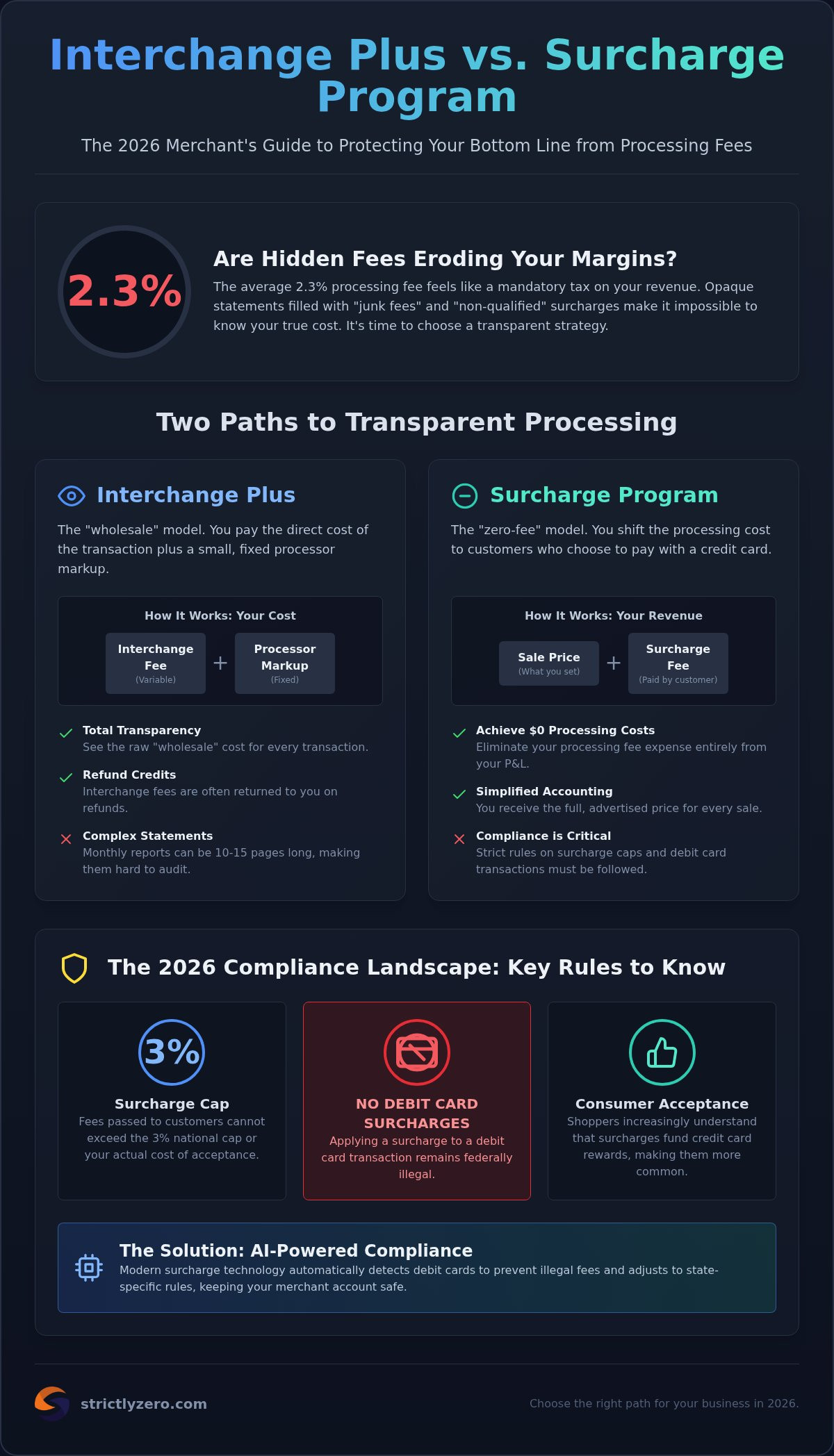
Choosing between an interchange plus pricing vs surcharge program isn’t just about picking a fee structure; it’s about deciding who should carry the cost of a credit card transaction. Interchange plus is often called the “wholesale” model. It passes the actual cost of the card network fees directly to you, plus a small, transparent markup for the processor. On the other hand, a surcharge program shifts that cost to the customer by adding a small fee to the final total. Both models are gaining massive traction in 2026 because they aim to kill the confusing “junk fees” found in old school tiered pricing. Business owners are tired of seeing “non-qualified” surcharges on their statements that don’t seem to correlate with their actual sales volume.
The foundation of every transaction is the Interchange fee, which is the non-negotiable rate set by card networks like Visa and Mastercard. As of April 2026, these rates have been updated to reflect new small merchant programs and digital enablement fees. By moving away from flat-rate or tiered pricing, you gain the ability to see exactly what you’re paying for or, in the case of a surcharge program, eliminate the expense entirely. This shift represents a move toward radical transparency that traditional processors have avoided for decades.
To better understand the fundamentals of transparent pricing, watch this helpful video:
The Core Mechanics of Merchant Fees
Card networks like Visa and Mastercard set the base rates for every type of card, from basic debit to high-end rewards credit cards. In an interchange-plus model, the “plus” represents the processor’s profit. It’s usually a small percentage and a few cents per transaction. This keeps your costs predictable because the markup stays the same even when the card brands adjust their rates. In a surcharge model, you’re practicing “fee-shifting.” You set a fixed surcharge, currently capped at 3% for most merchants in 2026, which covers the cost of the transaction so your business receives the full sticker price of the sale.
Why Business Owners Are Comparing These Now
Inflation and margin pressure have reached a breaking point for many industries in 2026. When your raw material costs go up, you can’t afford to lose another 2.5% to 3.5% on every swipe. At the same time, consumer acceptance of credit card surcharges has grown. Shoppers now understand that rewards points aren’t free; they’re funded by merchant fees. Modern technology has also made compliance much easier. You don’t have to manually calculate different rates for different states anymore. AI-driven engines now handle the heavy lifting, ensuring you never accidentally surcharge a debit card, which remains illegal under federal law.
Interchange Plus Pricing: The Transparency Advantage
Interchange plus pricing is often hailed as the most honest way to pay for merchant services. Unlike flat-rate models that hide everything behind a single percentage, this structure pulls back the curtain. You see the raw Credit Card Processing Fees set by the banks alongside the specific markup your processor takes. For businesses analyzing an interchange plus pricing vs surcharge program, this level of detail is the primary selling point. It ensures you aren’t paying a “premium” just for the sake of simplicity. You pay exactly what the card networks charge, plus a fixed margin that doesn’t change based on the card type used.
One often overlooked benefit of this model is the treatment of refunds. When you issue a return, the card networks typically return the original interchange fee to the processor. In a true interchange-plus model, those “Interchange Credits” should flow back to your bank account. Many other pricing structures pocket that money, which can cost high-volume retailers thousands of dollars annually. However, this transparency comes with a practical hurdle. Your monthly statements won’t be a single page. They are often 10 or 15 pages long, listing hundreds of different card types, from basic debit to high-tier rewards cards. Auditing these documents requires time and a sharp eye for detail to ensure no hidden markups have crept into the “plus” side of the equation.
Who Benefits Most from Interchange Plus?
This model is the gold standard for B2B companies with large transaction sizes and slim margins. If you’re selling $10,000 worth of industrial equipment, a fraction of a percent can represent hundreds of dollars in profit. It’s also the go-to for government agencies or non-profits that may face legal restrictions on passing fees directly to the public. If your customers are extremely price-sensitive and might flee at the sight of a 3% surcharge, keeping the costs internal via interchange-plus is usually the safer bet for customer retention.
The 2026 Outlook for Interchange Rates
The landscape changed again on April 18, 2026, when the latest Visa and Mastercard schedules went live. For instance, standard retail rates for consumer credit now range from 1.51% to 2.30% plus a $0.10 per-transaction fee. Interchange is the non-negotiable base cost set by card brands that every processor must pay. If your business qualifies for the Small Merchant Fee Program, you might see rates as low as 1.29%. Keeping track of these fluctuating numbers is vital for anyone weighing an interchange plus pricing vs surcharge program. You can dive deeper into these specifics in our Credit Card Processing for Small Business: The 2026 Essential Guide. If the complexity of these statements feels overwhelming, consulting with a payment expert can help you decide if transparency or total fee-elimination is the better move for your specific volume.
The Surcharge Program: Achieving Zero-Fee Processing
While interchange plus offers transparency, a surcharge program aims for total fee elimination. In this model, your business no longer views processing as a cost of doing business. Instead, the cost of credit card processing is passed directly to the customer at the point of sale. For a merchant, the “$0 processing” reality means you only pay a flat monthly platform fee rather than a percentage of every swipe. When comparing an interchange plus pricing vs surcharge program, the choice often comes down to whether you want to manage your costs better or remove them from your ledger entirely. This shift can save a high-volume retail business thousands of dollars every month, but it requires a sophisticated technological backbone to remain legal.
The biggest hurdle to surcharging has always been the complexity of card types. Federal law and card network rules strictly prohibit surcharging debit and prepaid cards. If you accidentally apply a fee to a debit transaction, you risk heavy fines or losing your merchant account. This is where a Smart Pricing Engine becomes essential. This technology automatically detects the card type in real-time. If a customer swipes a credit card, the surcharge is applied; if they use a debit card, the system bypasses the fee instantly. This automation removes the human error that often leads to compliance failures.
The Legality and Compliance of Surcharging in 2026
Staying compliant in 2026 requires more than just a sign on the door. As of July 2026, credit card surcharging is still explicitly prohibited in Connecticut, Massachusetts, and Maine. Additionally, the Illinois Interchange Fee Prohibition Act, which took effect on July 1, 2026, now prevents merchants from charging interchange fees on the tax and gratuity portions of a transaction. Because regulations change so quickly, using an automated state-by-state compliance engine is no longer optional. According to guidelines from the Consumer Financial Protection Bureau, clear and conspicuous disclosure is mandatory. You must notify customers of the surcharge at the entrance of your business and again at the point of sale, ensuring they have the option to use cash or debit to avoid the fee.
Customer Perception and Communication
Many business owners worry that surcharges will drive customers away. However, by 2026, consumer acceptance of “convenience fees” has reached an all-time high. The key is transparent communication. When staff are trained to explain that the surcharge allows the business to keep prices lower for everyone, most customers are happy to comply or switch to a debit card. Some merchants prefer a “Dual Pricing” model, where they list a cash price alongside a card price, making the choice feel like a discount for cash users rather than a penalty for credit users. You can find more strategies for this transition in our Zero Fee Credit Card Processing: The 2026 Merchant Guide to $0 Fees. Balancing an interchange plus pricing vs surcharge program requires looking at your specific customer base to see which approach fits your brand’s voice best.
Interchange Plus vs. Surcharge Program: Side-by-Side
Comparing interchange plus pricing vs surcharge program reveals a fundamental difference in how you handle overhead. Interchange plus is built on a “cost-up” logic. You pay the wholesale rate plus a fixed markup, which keeps your processor’s profit margin transparent but leaves you vulnerable to biannual rate hikes from card brands. A surcharge program uses “fee-shifting” logic. It moves the processing cost to the cardholder, effectively insulating your margins from the rising costs of rewards cards and network updates. While interchange plus statements are notoriously long and difficult to audit, surcharge statements are often much cleaner because the merchant isn’t paying the transaction percentages.
Compliance requirements also differ significantly between these two models. With interchange plus, your primary focus is standard PCI compliance and ensuring your markup stays competitive. Surcharge programs require a much tighter technological grip. You must adhere to the 3% practical surcharge cap effective in 2026 and follow strict disclosure rules. Customer impact is the final piece of the puzzle. Interchange plus is invisible to the shopper, while surcharging is visible. However, many modern businesses use dual pricing to frame the surcharge as a “cash discount,” which drastically reduces friction at the register.
The Decision Matrix: Which One Should You Choose?
For businesses that handle large-scale transactions, such as contractors or healthcare providers, offering flexible consumer financing through Zip-Loan can be a strategic way to facilitate sales without adding the friction of a surcharge.
If you’re unsure which model fits your current sales volume, get a custom savings comparison to see the real-world impact on your bottom line.
The Hybrid Approach: When to Use Both
You don’t always have to choose just one. Many omni-channel businesses now use a hybrid approach to maximize their savings and customer satisfaction. For example, a wholesaler might use interchange plus for their B2B clients who pay via large corporate invoices while using a surcharge program for B2C walk-in customers at their retail storefront. Modern payment platforms allow you to toggle these settings across different sales channels. This flexibility ensures you’re providing a professional experience for high-ticket clients while still protecting your retail margins from the high costs of consumer credit cards.
Eliminate Fees with Strictly’s Smart Surcharge Program
Strictly has redefined how businesses look at their monthly overhead. While the debate over interchange plus pricing vs surcharge program often centers on transparency, Strictly focuses on the ultimate outcome: profit preservation. By providing a unified platform, we enable merchants to eliminate processing costs across every sales channel. Whether you’re swiping a card in a retail shop, sending an invoice through a virtual terminal, or taking a payment on a mobile device, our technology ensures you keep 100% of your sticker price. In many cases, when deciding between interchange plus pricing vs surcharge program, the ease of automation often becomes the deciding factor for busy owners.
Our platform goes beyond simple fee-shifting. We integrate AI-driven fraud prevention to protect your revenue from chargebacks and malicious activity. For those managing complex business structures, our partner management tools and ClearSplit™ technology ensure that compensation is handled accurately and automatically. This omni-channel advantage means you don’t have to juggle different providers for your online and in-person sales. Everything is consolidated into one secure, high-performance ecosystem that scales with your growth.
Built-in Compliance for Peace of Mind
Strictly takes the guesswork out of the legal landscape. Our system is pre-programmed with the latest 2026 regulations, including the 3% surcharge cap and specific state restrictions in places like Maine and New York. We provide the automated signage and receipt disclosures required by card brands and the Illinois Interchange Fee Prohibition Act. Strictly’s Smart Pricing Engine serves as a real-time compliance tool for merchants by instantly distinguishing between card types and applying the correct pricing logic. This ensures you never accidentally surcharge a debit card, keeping your account in good standing without manual effort.
Getting Started with Zero-Fee Processing
Moving to a zero-fee model shouldn’t be a hurdle. Our onboarding process is designed for speed, allowing you to transition from traditional models to a surcharge engine in days, not weeks. We also empower ISOs and partners to offer these same powerful tools to their own client bases, backed by our robust support and technology. It’s time to stop letting processing fees dictate your growth potential. Estimate your savings with our processing cost calculator to see how much your bottom line could improve by switching to a compliant, automated program today.
Take Control of Your Processing Margins in 2026
Deciding between an interchange plus pricing vs surcharge program is no longer just a matter of preference; it’s a strategic move for your bottom line. You’ve seen how transparency in interchange-plus can reveal hidden costs, while a compliant surcharge program can eliminate those fees entirely. In an era of rising card brand rates and shifting state laws, the right choice depends on your specific customer base and your tolerance for monthly administrative tasks. Technology has finally caught up to regulation, making it possible to protect your margins without the risk of manual errors.
Strictly provides the automated tools you need to stay ahead of these changes. Our platform offers compliant surcharge and dual pricing programs that are designed to work in all 50 states. With built-in automated debit card detection and full omni-channel support, you can stop worrying about compliance and start focusing on growth. Whether you’re processing in-person or online, you deserve a partner that prioritizes your profit.
Ready to transform your merchant statement? Eliminate your processing fees today with Strictly’s Smart Surcharge Program. The path to $0 processing is simple, secure, and ready for your business to start today.
Frequently Asked Questions
What is the difference between interchange plus and a surcharge program?
The primary difference between an interchange plus pricing vs surcharge program is who carries the financial burden of the transaction. Interchange plus is a transparent model where the merchant pays the wholesale cost from the banks plus a fixed processor markup. A surcharge program shifts that cost to the cardholder by adding a small fee to credit card purchases, which can lead to $0 processing costs for the business.
Is it legal to surcharge credit card transactions in 2026?
Yes, surcharging is legal in 47 states as of July 2026. It remains explicitly prohibited in Connecticut, Massachusetts, and Maine. Merchants must also navigate specific state regulations, such as the Illinois Interchange Fee Prohibition Act that started on July 1, 2026, which bans fees on the tax and gratuity portions of a sale.
Can I add a surcharge to debit card payments?
No, you cannot surcharge debit or prepaid cards under any circumstances. Federal law and card network rules are very strict on this point. Even if a customer runs their debit card as “credit” without a PIN, it’s still a debit transaction and cannot legally carry a surcharge fee.
How much can a business save by switching to a surcharge program?
Most businesses eliminate nearly all of their monthly processing fees by making the switch. Since the average processing fee was 2.3% in 2025, a business doing $100,000 in monthly credit sales could potentially save over $2,000 per month. You typically only pay a flat platform fee instead of a percentage of every swipe.
Does interchange plus pricing include the merchant service fee?
Yes, the “plus” in interchange plus represents the merchant service fee or processor markup. This model is highly valued because it separates the non-negotiable bank rates from the profit your processor makes. It’s much easier to audit than old tiered systems, though the statements can still be quite long.
Will a surcharge program drive away my customers?
Consumer acceptance of convenience fees has grown significantly by 2026. Most shoppers understand the cost of rewards programs and are willing to pay a small fee or switch to debit or cash. Using a dual pricing strategy helps by framing the choice as a cash discount rather than a credit penalty.
What is the maximum compliant surcharge rate in 2026?
The practical maximum surcharge rate is 3%. While Mastercard technically allows up to 4%, Visa limits surcharges to 3%. Because most merchants accept both brands, you must follow the more restrictive 3% cap to remain compliant with all network rules and avoid potential fines.
How does a smart pricing engine detect debit cards automatically?
A smart pricing engine uses the card’s Bank Identification Number (BIN) to identify the card type in real-time. Before the transaction is finalized, the system checks the BIN against a global database to see if the card is credit or debit. If it’s a debit card, the software instantly removes the surcharge to ensure your business stays compliant.