

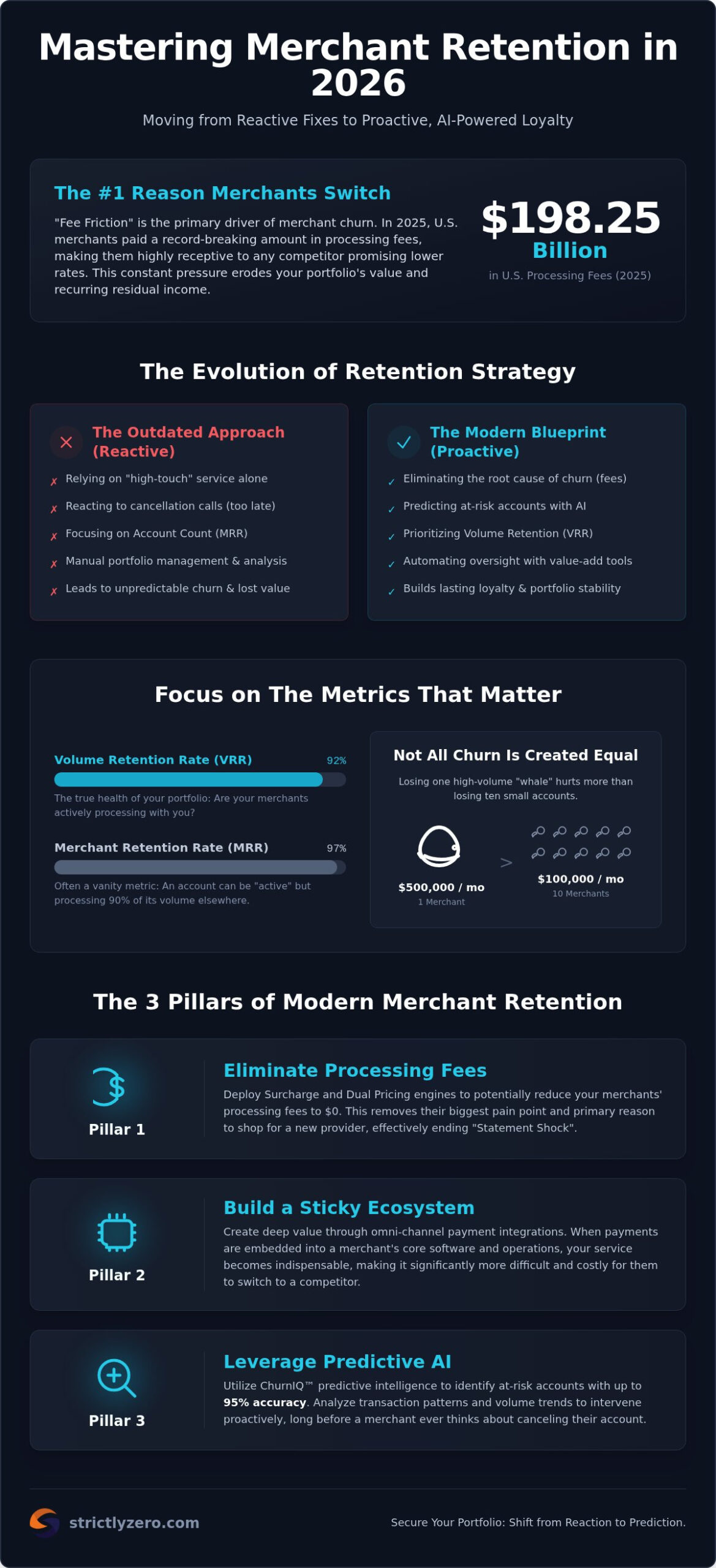
With U.S. merchants paying a staggering $198.25 billion in processing fees in 2025, it’s no wonder your clients are looking for the exit the moment a competitor promises a lower rate. You likely feel the pressure of watching hard-won accounts vanish due to fee-related friction or complex new regulations like the Illinois Interchange Fee Prohibition Act. It is a constant battle to maintain your portfolio when manual management takes up your team’s valuable time and churn remains unpredictable.
This guide will show you how to master merchant account retention strategies that move beyond simple price matching to create lasting loyalty. You’ll discover how to leverage ChurnIQ™ predictive intelligence to identify at-risk accounts with up to 95% accuracy before they leave. We will also explore how surcharge and dual pricing engines can help your merchants reach $0 in processing fees, effectively removing their biggest reason to switch. By the end of this article, you’ll have a roadmap for automating your partner management and increasing your portfolio’s lifetime value in 2026.
Key Takeaways
- Understand why merchant churn is a direct threat to your residual income and how to calculate Merchant Retention Rate (MRR) for a clearer view of your portfolio’s health.
- Discover why modern merchant account retention strategies must prioritize volume retention over account quantity to protect your most valuable revenue streams.
- Learn how to eliminate “Statement Shock” by implementing surcharge and dual pricing engines that can bring merchant processing fees down to zero.
- Explore how omni-channel payment integrations create a “sticky” ecosystem that makes it significantly harder for merchants to switch to a competitor.
- Leverage ChurnIQ™ predictive AI to analyze transaction patterns and intervene with at-risk accounts before they have a chance to cancel.
Understanding the High Cost of Merchant Churn in 2026
In the payment processing industry, merchant churn isn’t just a lost contract. It’s the permanent evaporation of a recurring residual stream. While general customer retention focuses on maintaining a user base, merchant account retention strategies are specifically designed to protect the long-term valuation of an ISO’s portfolio. When a merchant cancels, the financial impact ripples through your business, affecting your monthly cash flow and the overall exit value of your company. You aren’t just losing a client; you’re losing the compounding interest of your hard work.
The market in 2026 is more aggressive than ever. “Big Tech” processors and embedded payment platforms are actively poaching accounts with promises of simplified flat rates or deep software integrations. These competitors often target the primary driver of merchant dissatisfaction: Fee Friction. This occurs when a merchant feels that the cost of processing transactions is eating too deep into their margins, especially after U.S. merchants paid a record $198.25 billion in fees in 2025. Without a proactive strategy, your merchants will eventually view your service as a commodity that can be replaced by the lowest bidder.
The Hidden Costs of Attrition for ISOs
Every time a merchant leaves, your portfolio valuation takes a hit. Most portfolios are valued on a multiple of their monthly residuals. Losing a single high-volume account doesn’t just subtract that month’s profit; it removes thousands of dollars in potential equity. There is also a significant time-cost involved. When your sales team spends their entire week replacing lost volume just to stay flat, they aren’t actually growing the business. Diversifying your risk through specialized ecommerce payment processing can help stabilize your portfolio, but it won’t stop the bleeding if your core retention model is flawed.
Why Traditional Support is No Longer Enough
Many ISOs believe that high-touch customer service will keep merchants loyal. It won’t. In 2026, “being nice” cannot compete with a rival who offers a 1% lower effective rate. Merchants are business owners first. Their primary “Switching Trigger” is the moment they open a monthly statement and see a high fee they didn’t expect or can no longer justify. If you are only reacting to cancellation calls, you’ve already lost. Effective merchant account retention strategies require moving from reactive troubleshooting to providing proactive value-add services that eliminate the cost of processing entirely.
Key Metrics to Measure Payment Processing Loyalty
You can’t improve what you don’t measure. In the merchant services world, counting the number of active Merchant IDs (MIDs) is often a vanity metric that hides the true health of your portfolio. If you want effective merchant account retention strategies, you have to look at the money moving through those accounts rather than just the number of entries in your CRM. Traditional SaaS metrics don’t always translate to payments because a merchant can keep an account “open” while moving 90% of their volume to a competitor.
To get a clear picture of loyalty, start by calculating your Volume Retention Rate (VRR). This is the percentage of processing volume retained from your existing merchant base month over month, excluding new sales. While Merchant Retention Rate (MRR) tells you if accounts are closing, VRR tells you if they’re actually using your services. In 2026, the Residual Stability Index has become the gold standard for ISO portfolio health. It measures the consistency of your net residuals against market volatility and margin compression, helping you see if your revenue is truly secure or just temporarily inflated by a few high-risk accounts.
Losing one “whale” merchant doing $500,000 in monthly volume hurts significantly more than losing ten small boutiques doing $10,000 each. This is why your “At-Risk” score should be weighted by volume. By using data to predict who is looking at the exit, you can prioritize your retention efforts where they’ll have the biggest financial impact. Monitoring these metrics manually is a recipe for burnout, which is why many top-performing ISOs partner with Strictly to automate their portfolio oversight and focus on high-value accounts.
Analyzing Processing Volume Trends
A 10% dip in monthly volume is rarely an accident. It is often the first red flag that a merchant is “split-processing” to test a new provider’s speed or rates. You must distinguish between seasonal dips, like a retail shop’s post-holiday slump, and genuine churn signals. In 2026, processing attrition is defined as the gradual migration of transaction volume to secondary gateways or embedded software platforms before a complete account closure occurs. Catching this trend early allows you to intervene before the merchant fully commits to a switch.
Customer Lifetime Value (CLV) in the Zero-Fee Era
Implementing zero fee credit card processing is one of the most effective ways to dramatically increase CLV. When a merchant pays nothing to accept cards, the primary reason for leaving, high fees, is completely removed from the equation. This transparency builds deep long-term loyalty that traditional pricing models can’t match. By focusing on winning retention strategies that prioritize the merchant’s bottom line, you can justify investments in better hardware or omni-channel software. These value-adds make your service “sticky” and ensure the merchant remains a profitable part of your portfolio for years to come.
Eliminating the #1 Reason Merchants Leave: Processing Fees
Most retention advice suggests offering personal discounts to keep a disgruntled customer. While this might work for a month or two, it is a race to the bottom that kills your margins. In the payment industry, the primary reason for churn is “Statement Shock.” This occurs when a merchant opens their monthly report and sees the impact of rising swipe fees. With U.S. merchants paying a record $198.25 billion in credit and debit card fees in 2025, that shock is more frequent and painful than ever before. If you want your merchant account retention strategies to actually stick, you have to address the cost of processing at its source.
The average effective swipe fee for Visa and Mastercard hit 2.36% in 2025. For a business owner, that is a massive line item that feels like a tax on their growth. By introducing a surcharge or dual pricing model, you aren’t just offering a small discount; you’re providing a permanent solution that can bring their processing costs down to $0. When a merchant pays nothing to accept cards, they become “un-poachable.” No competitor can win a price war against a $0 bill. This shift moves you from being a vendor they tolerate to a partner that protects their bottom line.
The Psychology of the $0 Processing Bill
Merchants are significantly more loyal when they no longer view processing as an operational expense. Surcharging shifts the cost perception from the merchant to the individual transaction. It’s a psychological win because the business owner stops seeing their hard-earned revenue disappear every month. To make this work, you need a system that handles the complexities of state laws and card brand rules. Strictly’s Surcharge & Dual Pricing Engine acts as a smart pricing tool that automates compliance, ensuring your merchants stay on the right side of regulations while they enjoy their savings.
Dual Pricing as a Retention Powerhouse
While surcharging adds a fee to credit transactions, dual pricing offers a “cash price” and a “card price.” Providing these options increases merchant trust because it gives them a sense of control over their business model. Some industries prefer the transparency of dual pricing, while others lean toward traditional surcharging. Offering both ensures you can tailor the experience to the merchant’s specific needs. You can find more implementation details in our 2026 merchant guide to $0 fees, which covers how these models function in the current market.
Compliance is the final piece of the retention puzzle. As of July 1, 2026, the Illinois Interchange Fee Prohibition Act (IFPA) has changed the landscape by prohibiting interchange fees on tax and gratuity. With similar bills introduced in Colorado, Delaware, and Rhode Island, merchants are looking for processors who can navigate these legal shifts. Providing a compliant, automated engine proves you are an expert, not just a middleman, making it much harder for the merchant to consider leaving for a less informed competitor.
Advanced Retention Tactics for ISOs and Payment Partners
Moving beyond fee elimination requires a structural shift in how you manage your portfolio. In 2026, the most successful ISOs use merchant account retention strategies that prioritize operational integration over simple price matching. If your service is just a pipe for money, you’re replaceable. If your service is the engine that runs their business, you’re essential. This transition starts with a proactive five step approach to merchant care.
- Step 1: Audit the technology stack. Identify friction points where your merchant is still using manual processes or outdated hardware.
- Step 2: Implement omni-channel solutions. Connect their in-person sales with their online storefront to create a unified data stream.
- Step 4: Automate residual reporting. Use transparent systems to ensure your sales partners stay motivated to keep their accounts active.
- Step 5: Schedule Quarterly Optimization Calls. Replace standard “Support Calls” with strategic reviews that show the merchant how to save more or sell faster.
By shifting from a reactive support model to a proactive optimization model, you change the power dynamic. You aren’t just a cost center on their balance sheet; you’re a consultant helping them grow. This level of involvement makes it much harder for a competitor to walk in and steal the account with a slightly lower rate.
Stickiness Through Omni-Channel Integration
The more integrated your payment solutions are, the less likely a merchant is to leave. Data from 2026 shows that merchants using embedded payment platforms have 2x to 4x higher retention rates because switching providers would require reconfiguring their entire daily workflow. Providing virtual terminals and payment links for service-based merchants creates this same level of “stickiness.” When you provide the ultimate payment processing platform for ISOs, you give your clients a suite of tools they can’t easily replicate elsewhere.
Empowering Partners with ClearSplit™
Merchant churn is often preceded by “Agent Churn.” If your sales agents feel their compensation is opaque or delayed, they’re more likely to move their entire book of business to a different processor. ClearSplit™ solves this by providing automated partner compensation and real-time residual data. When your partners can see exactly what they’re earning and how their retention efforts pay off, they’re far more likely to defend your portfolio against competitors. If you want to stabilize your residuals and protect your accounts, you should modernize your partner management with tools that build trust through transparency.
Leveraging ChurnIQ™ and Strictly for Long-Term Loyalty
While manual audits and quarterly calls are effective, the most sophisticated merchant account retention strategies in 2026 rely on predictive intelligence. You can’t always wait for a merchant to tell you they’re unhappy. Often, the first sign of trouble isn’t a phone call; it’s a subtle shift in transaction data that the human eye might miss. This is where ChurnIQ™ provides a decisive advantage for ISOs and payment partners by turning raw data into actionable insights.
ChurnIQ™ is Strictly’s proprietary retention intelligence tool designed to move you from a reactive stance to a proactive one. By using AI to analyze transaction patterns, the system flags at-risk accounts before the merchant even considers a competitor. This intelligence allows your team to intervene at the exact moment loyalty begins to waver, saving the residual stream before the account is lost. When you combine this with a “Trust as a Processor” model, you provide the stability and platform reliability that modern businesses demand.
Predictive Analytics: The Future of Retention
One of the biggest challenges for any portfolio manager is identifying “silent churners.” These are merchants who stop processing volume or slowly migrate their transactions elsewhere without officially canceling their account. ChurnIQ™ identifies these patterns in real-time, allowing you to automate the intervention process for your sales teams. AI-driven fraud prevention also acts as a critical retention tool by shielding merchant revenue from chargebacks and theft, ensuring they stay profitable and satisfied with your service. Instead of chasing lost accounts, your team can focus on strengthening relationships that the data shows are at risk.
Why Partners Scale Faster with Strictly
Strictly provides more than just a gateway; it offers a support infrastructure that allows ISOs and MSPs to focus on growth. Our API-first, unified omni-channel platform ensures that your merchants have a seamless experience whether they are selling in-person, online, or through a virtual terminal. As state-level regulations like the Illinois IFPA continue to emerge, Strictly’s compliance-first approach removes the legal headache for both you and your merchants. This commitment to innovation and security is why partners who prioritize long-term merchant account retention strategies choose to build their portfolios here.
By leveraging the right mix of predictive AI and zero-fee pricing models, you can stop the cycle of attrition and start building a more resilient business. It’s time to move beyond the limitations of traditional processing and give your merchants a reason to stay for the long haul. Partner with Strictly to Scale Your Business and take control of your portfolio’s future today.
Secure Your Residual Future and Stop Merchant Attrition
In the 2026 payment landscape, merchant account retention strategies must evolve from basic support to proactive business optimization. You’ve seen how fee friction drives merchants away and how predictive tools like ChurnIQ™ provide a necessary edge to identify at-risk accounts before they cancel. By implementing surcharge and dual pricing models, you remove the biggest obstacle to loyalty and make your portfolio “un-poachable” by competitors.
Success requires the right infrastructure. Strictly gives you the tools to automate partner management with ClearSplit™ and protect your margins with compliant $0 fee programs. It’s time to stop watching your hard-earned residuals evaporate and start building a sticky, high-value ecosystem that thrives on transparency and technology. You have the roadmap; now it’s time to take the lead in your market.
Reduce Churn and Scale Your Portfolio with Strictly
Frequently Asked Questions
What is the most common reason merchants switch processors?
High processing fees and a lack of pricing transparency are the primary reasons merchants switch to a competitor. When a business owner sees their monthly statement and realizes they’re part of the record $198.25 billion paid in U.S. fees in 2025, they start shopping for lower rates. If you don’t offer a way to mitigate these rising costs, they’ll eventually find a provider who promises a smaller bill.
How does a surcharge program help with merchant retention?
A surcharge program helps retention by removing the merchant’s largest expense: processing fees. By shifting the cost of credit transactions to the customer, you can bring a merchant’s processing bill down to zero. It’s nearly impossible for a competitor to win an account when the merchant is already paying nothing for your services. This model effectively “locks in” the merchant by eliminating their biggest pain point.
What is a healthy churn rate for a merchant services portfolio in 2026?
A healthy churn rate depends heavily on the specific industry you’re serving. In 2026, professional services typically see annual churn below 10%, while restaurants can range from 25% to 45%. High-risk e-commerce accounts often experience churn as high as 50%. Knowing these benchmarks helps you tailor your merchant account retention strategies to the specific risks and needs of your individual portfolio segments.
Can AI really predict when a merchant is about to leave?
Yes, predictive AI can identify at-risk merchants with high accuracy by spotting subtle shifts in processing behavior. Tools like ChurnIQ™ analyze transaction data to find “silent churners” who are testing other processors before they officially cancel. This allows your team to intervene early, often with a 95% success rate in predicting which accounts are most likely to leave based on their historical transaction patterns.
How does omni-channel processing increase merchant loyalty?
Omni-channel processing increases loyalty by deeply embedding your tools into a merchant’s daily business operations. When a client uses your virtual terminal, payment links, and in-person systems, the technical cost of switching becomes a major barrier. Merchants using integrated platforms are two to four times more likely to stay because your service is essential to their entire workflow across every sales channel.
What role does PCI DSS compliance play in retention?
PCI DSS compliance and regulatory expertise build the trust necessary for long-term retention. Merchants want to know their processor can handle complex legal shifts, such as the Illinois Interchange Fee Prohibition Act (IFPA) effective July 1, 2026. If you manage their compliance and security headaches automatically, they’re much less likely to risk moving to a less experienced provider who might leave them vulnerable to fines.
How does Strictly’s ChurnIQ™ tool identify at-risk merchants?
ChurnIQ™ identifies at-risk merchants by monitoring real-time transaction patterns for red flags like volume dips or split-processing. The tool uses predictive analytics to flag accounts that show signs of dissatisfaction before a cancellation request is ever made. This intelligence gives ISOs a chance to address issues proactively and protect their recurring residuals from disappearing by engaging with the merchant at the right time.
Is dual pricing or surcharging better for retaining high-volume clients?
Both models are effective merchant account retention strategies, but the choice depends on the merchant’s specific business type. Dual pricing is often better for high-volume retailers who want to offer a clear “cash price” versus a “card price” to maintain transparency. Surcharging is frequently preferred by service-based businesses that want to shift the direct cost of credit card processing away from their bottom line entirely.