

What if the security standards you dread are actually the secret to unlocking a zero-fee payment model? For most business owners, pci dss compliance for merchants feels like an expensive maze of technical jargon and shifting deadlines. You’re likely worried about the complexity of PCI DSS 4.0 standards or the looming threat of a data breach. It’s frustrating to spend hours on Self-Assessment Questionnaires (SAQs) when you just want to focus on growing your brand.
We understand that security should be a foundation for growth, not a barrier to entry. This 2026 guide provides a clear path to validation and shows you how to significantly reduce your security scope. You’ll learn how to master the latest requirements while protecting your business from heavy fines. We’ll explore how modern tools like virtual terminals and AI-driven fraud prevention can automate your protection. By the end, you’ll have a roadmap to secure, omni-channel processing that keeps your data safe and your margins high.
Key Takeaways
- Understand why PCI DSS 4.0 is the non-negotiable baseline for every US merchant operating in 2026.
- Learn how to correctly identify your required Self-Assessment Questionnaire (SAQ) to avoid false validation and unnecessary legal liability.
- Discover how pci dss compliance for merchants can be simplified by mapping data flows and implementing modern multi-factor authentication.
- Explore how using a Smart Pricing Engine and virtual terminals can drastically reduce your security scope while enabling zero-fee processing.
- Master the 12 core requirements of the new standards to build a secure foundation that protects your business from expensive data breaches.
What is PCI DSS Compliance for Merchants in 2026?
PCI DSS is more than just a technical checklist. It’s a comprehensive security framework that dictates how businesses must handle sensitive financial information. The Payment Card Industry Data Security Standard ensures that any company accepting, processing, or storing credit card data maintains a fortress-like environment. For small business owners, pci dss compliance for merchants is a commitment to protecting customer trust while keeping the doors open for modern digital payments.
By 2026, the transition to PCI DSS 4.0 is complete, making it the mandatory standard for every US merchant. The PCI Security Standards Council (PCI SSC) designed this version to be more flexible but also more rigorous regarding authentication and monitoring. It’s vital to remember that compliance isn’t a suggestion from a government agency. It’s a legal contract with your acquiring bank. When you signed your merchant agreement, you promised to uphold these specific security measures to keep the global payment ecosystem safe.
To better understand this concept, watch this helpful video:
The True Cost of Non-Compliance
Ignoring these standards is a gamble with high stakes. Merchant banks often levy monthly non-compliance fees that eat into your margins before you’ve even made a sale. These fees are just the tip of the iceberg. If a breach occurs, you’ll face forensic audit costs that can reach tens of thousands of dollars. A single security incident can trigger an exhaustive deep dive into your systems that you must pay for out of pocket. For a small business, these costs, combined with potential legal liabilities and the permanent stain on your brand’s reputation, can be terminal. Customers don’t return to businesses that lose their financial data.
Who Needs to Comply?
A common myth is that low-volume merchants are exempt. That’s false. Whether you process one transaction a year or a million, you’re in scope. However, there’s a difference between “Compliance,” which is following the rules daily, and “Validation,” which is the periodic act of proving it through paperwork. In 2026, omni-channel merchants face the toughest road. Selling online, in-person, and through mobile apps often creates a fragmented system. This fragmentation increases your “PCI scope,” making it harder to track where data lives and how it’s protected across different platforms. Managing this complexity requires a unified approach to security that doesn’t slow down your operations.
The 12 Requirements of PCI DSS 4.0: A Simplified Breakdown
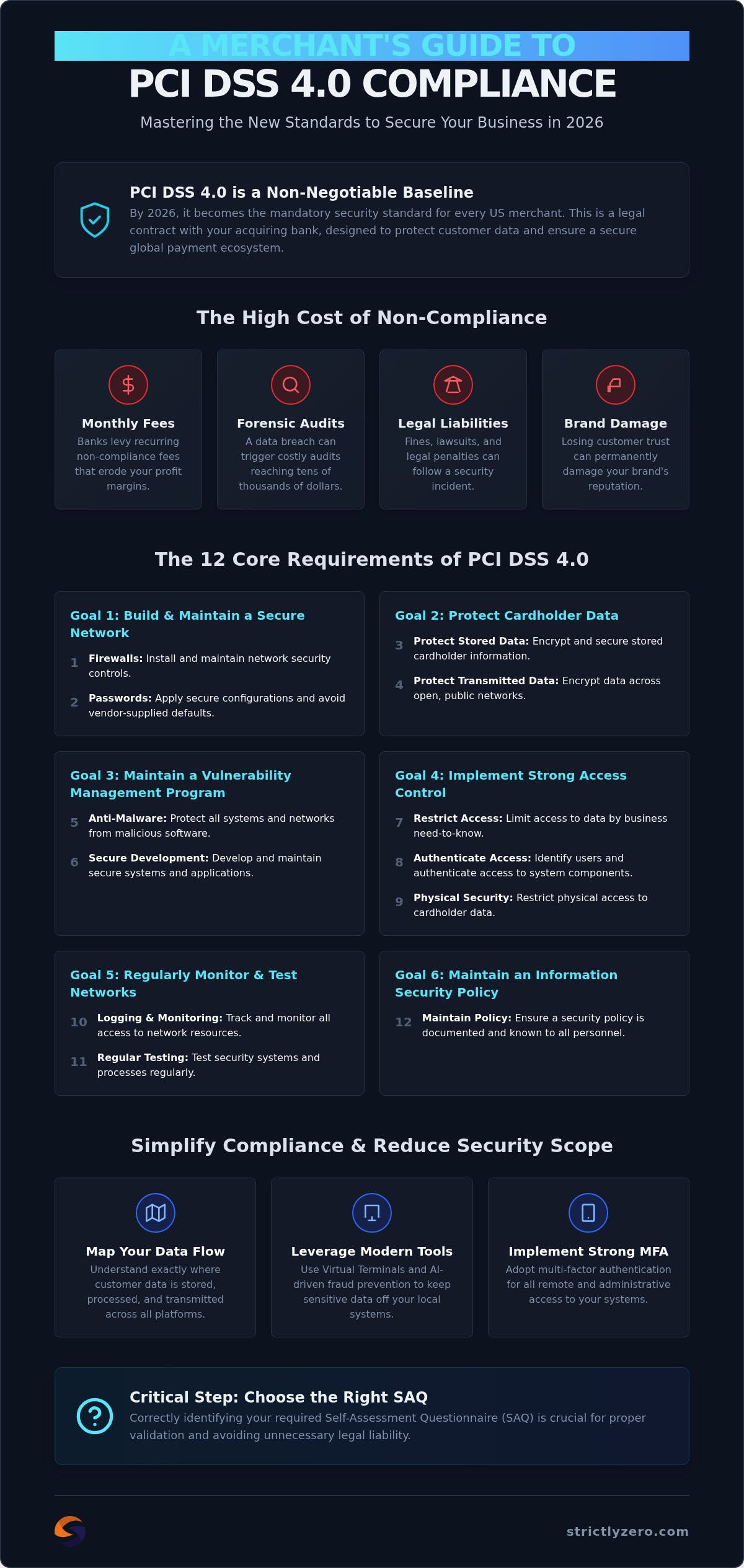
The transition to PCI DSS 4.0 shifted the focus from simple checklists to continuous security. For business owners, pci dss compliance for merchants is now built on 12 specific requirements that ensure cardholder data remains invisible to unauthorized parties. These requirements are grouped into six logical goals. First, you must build and maintain a secure network by installing firewalls (Requirement 1) and avoiding vendor-supplied defaults for system passwords (Requirement 2). You can find technical documentation and templates through the Official PCI SSC Merchant Resources to help your team stay current.
Finally, your business must regularly monitor and test networks. This involves tracking all access to network resources (Requirement 10) and regularly testing security systems (Requirement 11). The final piece is maintaining an information security policy (Requirement 12) that addresses security for all personnel. Compliance isn’t a one-time event; it’s a daily operational habit.
Focusing on Cardholder Data Environment (CDE)
The CDE refers to the people, processes, and technologies that store, process, or transmit cardholder data or sensitive authentication data. Scope is the boundary where PCI rules apply. If your point-of-sale system is on the same Wi-Fi as your guest network, your entire business is likely in scope. To simplify pci dss compliance for merchants, you should aim to shrink this environment. Using a provider that offers omni-channel payment processing through secure hosted fields allows you to keep data off your servers, significantly reducing the complexity of your annual security review.
Determining Your Merchant Level
Your compliance path depends on your transaction volume over a 12-month period. Level 1 merchants process over 6 million transactions and must undergo an intensive internal audit resulting in a Report on Compliance (ROC). Levels 2 through 4 represent the small to mid-market tiers. Level 2 merchants process 1 to 6 million transactions, while Level 3 covers 20,000 to 1 million e-commerce transactions. Level 4 includes everyone else. It’s important to check with your specific card brands, as Visa and Mastercard sometimes have slightly different criteria for these tiers.
Choosing the Right Self-Assessment Questionnaire (SAQ)
Selecting the correct paperwork is often the most confusing part of pci dss compliance for merchants. The Self-Assessment Questionnaire (SAQ) serves as your primary tool for validating that you’ve met the 12 requirements discussed earlier. It isn’t just a “check the box” exercise. Selecting the wrong form can result in false validation. This means you might think you’re protected, but your merchant bank sees you as a high-risk liability. Your specific integration type determines which form you need. If you’re manually entering card numbers into a web browser, your requirements are different than if you’re using a physical card reader. Modern payment gateways now automate much of the data collection for these forms, making the process significantly less painful.
Common SAQ Types for Small Businesses
The PCI Council provides several versions of the SAQ, each tailored to how you handle data. Understanding these helps you avoid unnecessary technical hurdles.
- SAQ A: This is the preferred option for e-commerce. It’s for merchants who completely outsource card processing to a third party. Your servers never see, touch, or store card data.
- SAQ A-EP: Use this if you have a partially outsourced e-commerce site where you control the website but the payment is handled by a provider.
- SAQ B-IP: This applies to brick-and-mortar stores using standalone, IP-connected point-of-sale (POS) terminals with no electronic card data storage.
- SAQ D: Known as the catch-all form, this is for any merchant who doesn’t fit the other categories. It’s the most intensive and carries the highest scope.
Reducing Scope with Virtual Terminals
One of the most effective ways to avoid the dreaded SAQ D is to change how you collect payments. Using a virtual gateway keeps sensitive information entirely off your local network. When you use a virtual terminal or invoicing system, the data is encrypted at the point of entry and sent directly to the processor. This means your office computers and Wi-Fi networks stay out of the Cardholder Data Environment. For service-based businesses, payment links offer a similar security benefit. By sending a secure link to a customer, you’re letting them handle the data entry in a pre-secured environment. Hosted payment fields remain the gold standard for pci dss compliance for merchants because they provide a seamless checkout experience while ensuring your server never handles raw card data. This reduction in overhead allows you to focus on your business instead of complex security audits.
Merchant Action Plan: Steps to Achieve Compliance in 2026
Achieving pci dss compliance for merchants in 2026 requires a shift from passive observation to active management. The first step is mapping the flow of cardholder data through your entire business. You must document every point where a card number is entered, stored, or transmitted. This includes everything from your online checkout page to the back-office computer used for bookkeeping. Once you’ve mapped the flow, the second step is implementing 2026-standard Multi-Factor Authentication (MFA). Under the newest standards, MFA is required for all personnel with access to the cardholder data environment, not just remote workers.
The third step involves technical validation. You must conduct quarterly vulnerability scans using an Approved Scanning Vendor (ASV). An ASV is a company qualified by the PCI SSC to validate external scans and ensure your network’s perimeter is secure. Fourth, don’t overlook the human element. Train your employees on security basics like spotting phishing attempts and social engineering. Most breaches start with a single compromised password or a deceptive email. Finally, wrap up your year by completing your annual SAQ and Attestation of Compliance (AOC). This document is your proof to banks and partners that you’ve done the work to stay secure.
People and Process Requirements
Technology and Testing
Technology moves fast, but hackers move faster. Patching outdated software is the most effective way to prevent 2026 data breaches. When a developer releases a security update, you should apply it immediately. Testing these systems is equally vital. There’s a big difference between an internal scan, which checks your local network for weaknesses, and an ASV external scan, which looks at your business from a hacker’s perspective on the internet. Both are necessary to maintain a truly secure environment. To simplify this process and ensure your business stays ahead of regulatory changes, consider partnering with a processor that offers omni-channel payment processing with built-in security features.
Strictly: Secure, Compliant, and Zero-Fee Processing
Strictly changes the conversation around pci dss compliance for merchants by turning a regulatory burden into a strategic advantage. Instead of just checking boxes, our platform automates the most complex security tasks. We simplify credit card processing for small business by ensuring that your data environment stays as small as possible. This is achieved through secure hosted fields and virtual terminals that keep sensitive data off your local systems. For developers, our API-first approach provides the flexibility to build secure checkout experiences without sacrificing speed or user experience.
The core of our platform is the Smart Pricing Engine. This tool doesn’t just manage costs; it manages risk. It ensures that your payment workflows remain compliant with both PCI standards and evolving state-by-state regulations. Whether you’re processing a transaction online, through a mobile device, or in-person, our omni-channel support provides a unified security layer. You don’t have to manage different security protocols for different sales channels. Everything is centralized, monitored, and protected under one roof.
Compliant Surcharging in 2026
Running a surcharge program involves more than just adding a fee to a transaction. You must navigate a complex web of card brand rules and state laws that change frequently. Strictly’s platform ensures your program meets these high standards automatically. Our zero fee credit card processing model is designed to offset the rising costs of security and compliance audits. One critical feature is automated debit card detection. Since surcharging debit cards is a major compliance violation, our engine identifies the card type in real-time and applies the correct pricing. This protects you from fines and keeps your merchant account in good standing.
Advanced Fraud Prevention
Security isn’t just about following rules; it’s about staying ahead of threats. We provide Trust as a Payment Processor by leveraging AI-driven fraud prevention tools. These systems analyze transaction patterns to stop fraudulent activity before it reaches your bank. Combined with end-to-end encryption, your business becomes a difficult target for hackers. This proactive stance ensures that your reputation remains intact while your margins grow. Ready to secure your business? Partner with Strictly to eliminate fees and stay compliant today. We handle the technical complexities so you can focus on scaling your brand safely.
Secure Your Business and Scale with Confidence
Mastering pci dss compliance for merchants is no longer just about avoiding fines; it’s about building a resilient foundation for modern commerce. We’ve explored how the transition to version 4.0 requires stricter authentication and why shrinking your data environment is the most effective way to reduce audit stress. By mapping your data flows and choosing the right validation path, you turn a complex regulatory hurdle into a streamlined operational habit. Security doesn’t have to be a drain on your resources when you have the right technology in place.
Strictly provides the tools you need to stay ahead of these requirements while significantly improving your bottom line. Our API-first omni-channel platform features a Smart Pricing Engine that ensures state-by-state surcharge compliance. With AI-driven fraud prevention included, you can focus on growth while we handle the heavy lifting of security. Eliminate your processing fees and stay PCI compliant with Strictly today. Protecting your customers’ data is the first step toward a more profitable and secure future. You’ve got the blueprint; now it’s time to take the lead.
Frequently Asked Questions
Do I really need to be PCI compliant if I only process a few transactions a month?
Yes, pci dss compliance for merchants applies to every business that accepts credit cards, regardless of transaction volume. Even if you only process one sale a month, you’re legally and contractually obligated to protect that data. While your validation requirements might be simpler than a global retailer’s, the core security standards remain the same to ensure the entire payment ecosystem stays protected.
What is the difference between PCI compliance and PCI validation?
Compliance is the ongoing state of following security standards, while validation is the periodic act of proving it to your bank. You might be compliant by having a secure firewall, but you aren’t validated until you submit your annual Self-Assessment Questionnaire (SAQ). Think of compliance as the daily work and validation as the annual report card that keeps your merchant account active and avoids non-compliance fees.
How much does it typically cost for a small merchant to become PCI compliant?
The cost of pci dss compliance for merchants depends heavily on your business model and how much data you handle. Costs often include vulnerability scans, security software updates, and potential merchant bank fees. While we don’t provide specific price ranges, merchants using outsourced payment fields generally pay much less than those managing their own servers and complex network architectures because their security scope is smaller.
Can my business be fined if I use a compliant processor but haven’t filled out my SAQ?
Yes, your bank can still levy non-compliance fees even if your payment processor is fully secure. Compliance is a shared responsibility. While your processor handles the data they receive, you’re responsible for the environment where you collect that data. Failing to submit your annual SAQ and Attestation of Compliance (AOC) tells the bank you haven’t verified your side of the security chain.
What is an ASV scan and does every merchant need one?
An ASV scan is an external vulnerability test performed by a company authorized by the PCI Council. Not every merchant needs one. Generally, if you have systems directly connected to the internet that handle transactions, you’ll likely need quarterly scans. Merchants who completely outsource their payment pages often avoid this requirement, which is a major benefit of using hosted fields and virtual terminals.
How does PCI DSS 4.0 change things for merchants compared to previous versions?
PCI DSS 4.0 shifts the focus from a rigid checklist to a more flexible, risk-based approach. It introduces stricter multi-factor authentication (MFA) requirements for anyone accessing the cardholder data environment. It also demands more frequent reviews of user access and more detailed documentation of your security policies. This version is designed to evolve with modern threats rather than just reacting to old ones.
If I use a virtual terminal, is my computer now in scope for PCI compliance?
Yes, the computer you use to access a virtual terminal is considered in scope for compliance. However, the scope is significantly narrower than if you were storing raw card data on your hard drive. You must ensure the computer is patched, uses strong passwords, and is free of malware. Using a dedicated device for payments is a common strategy to keep this scope manageable and secure.
Does PCI compliance protect me from all types of credit card fraud?
No, PCI compliance is designed to secure card data, not to stop every instance of fraud. It prevents hackers from stealing card numbers from your system, but it doesn’t stop a criminal from using a stolen card on your website. To truly protect your revenue, you should combine compliance with AI-driven fraud prevention tools that analyze transaction patterns and flag suspicious behavior in real time.