

In January 2026, a staggering 74% of new retail merchant accounts opted for a dual pricing model rather than traditional fee structures. This massive shift isn’t just a trend; it’s a survival strategy for businesses tired of watching high monthly processing statements erode their bottom line. If you feel like you’re constantly choosing between losing profit to fees or losing customers to surprise charges, you aren’t alone.
Understanding the nuances of dual pricing vs surcharge is the key to eliminating your credit card processing fees legally and transparently. While both methods aim to reduce your costs, the legal landscape and customer reactions vary wildly between them. You deserve a solution that reaches $0 in fees without the fear of state-level fines or register-side backlash. This guide breaks down the critical differences in compliance, explains why federal debit card laws change the math, and shows you exactly how to maintain 100% legal compliance while keeping your customers happy.
Key Takeaways
- Learn the legal distinctions between dual pricing vs surcharge models and which specific states ban surcharging in 2026.
- Understand why surcharging debit cards is a federal violation and how to avoid the “debit card trap” that leads to heavy fines.
- Discover why dual pricing is the only 50-state compliant strategy for businesses looking to reach $0 in processing fees.
- Identify the exact steps needed to audit your merchant statements and transition to a more transparent pricing structure.
- See how a Smart Pricing Engine automates state-by-state compliance and real-time debit detection to protect your business.
Understanding the Basics: What are Surcharging and Dual Pricing?
In 2026, the average credit card interchange fee sits around 1.97% for Visa, but total processing costs often climb as high as 3.5% once markups are added. For many small businesses, this overhead is no longer a cost of doing business they can easily absorb. It’s a direct threat to their margins. This financial pressure has sparked a massive migration toward fee-shifting models. When evaluating dual pricing vs surcharge options, you’re essentially choosing how you want to reach that zero-fee goal. Both models aim to offset that 3% to 4% processing hit, but they do it in fundamentally different ways.
Surcharging is the practice of adding a specific line-item fee to a transaction when a customer pays with a credit card. It’s historically been a common way to recover costs, as detailed in the history of Surcharge (payment systems). On the other hand, dual pricing involves presenting two distinct prices for every single item in your store or on your menu: one for card payments and a lower one for cash. While both can eliminate your processing bill, the legal and psychological outcomes are poles apart.
How Surcharging Works in Practice
Surcharging functions as a checkout fee applied at the final moment of the sale. Keep in mind that federal law and card network rules strictly limit this to credit cards. You cannot legally surcharge a debit card, even if the customer chooses to run it as “credit” at the terminal. Additionally, card brands have tightened the reins recently. As of 2026, Visa enforces a strict 3% cap on surcharges. Since most merchants accept both Visa and Mastercard, that 3% becomes the effective ceiling for your business, regardless of what your actual processing costs might be.
The Mechanics of Dual Pricing
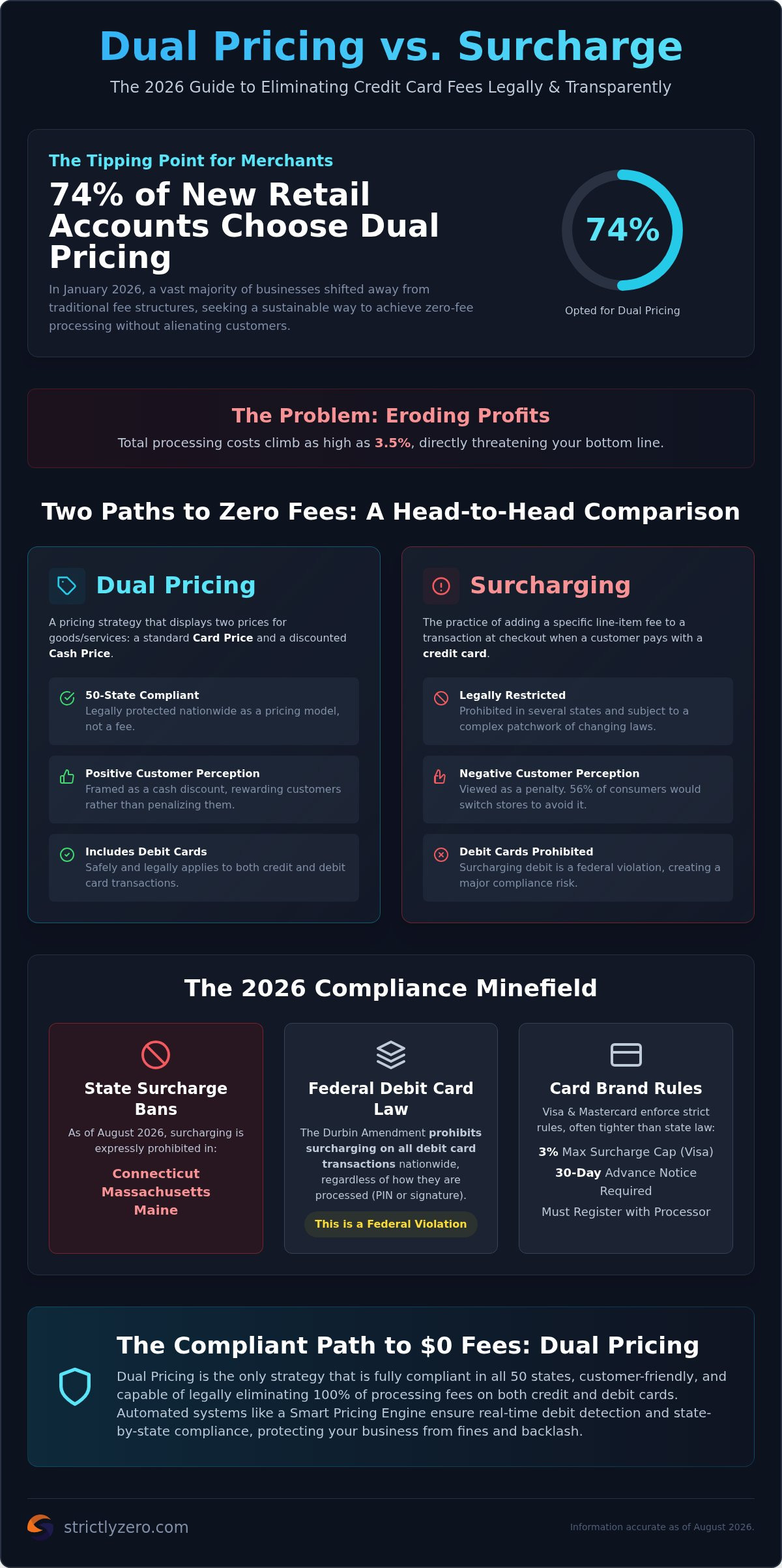
Dual pricing is often viewed as a pricing strategy rather than a fee. Instead of surprising a customer at the end of a transaction, you provide total transparency from the start. Digital signage, shelf labels, and menus clearly list a Card Price and a Cash Price. This shift in framing is powerful. While 56% of consumers say they’d likely switch merchants to avoid a surcharge penalty, dual pricing frames the lower cost as a cash discount. This psychological nuance explains why 74% of new retail merchant accounts in early 2026 chose the dual pricing model over traditional surcharging.
The 2026 Legal Landscape: Compliance and State Rules
Jurisdiction in the payment space is a complex web of federal mandates and a patchwork of state laws on credit card surcharges. While federal law, specifically the Durbin Amendment, prohibits surcharging on debit cards nationwide, individual states decide if you can surcharge credit cards at all. As of August 2026, if your business operates in Connecticut, Massachusetts, or Maine, surcharging is expressly prohibited. This is where the debate of dual pricing vs surcharge becomes a matter of legal necessity rather than just preference. Dual pricing remains legally protected in all 50 states because it’s classified as a pricing strategy, not a penalty. This makes it the safest route for any business with a multi-state footprint.
Beyond state statutes, merchants must maintain strict PCI DSS compliance. When you pass on fees, your point-of-sale system must handle sensitive data securely, and your receipts must clearly reflect the breakdown of the transaction. Failure to meet these standards can lead to audits that are far more expensive than the processing fees you’re trying to eliminate. Compliance isn’t just about the law; it’s about protecting your merchant account from being flagged by the card brands themselves.
Card Brand Rules You Can’t Ignore
Visa and Mastercard have their own set of requirements that are often stricter than state statutes. You can’t just flip a switch and start surcharging tomorrow. Both networks require at least 30 days of advance notice before you begin any surcharge program. You also must register your intent with your payment processor. Perhaps the most critical rule for 2026 is the hard 3% cap. While some outdated guides still mention a 4% limit, Visa reduced the cap to 3% in April 2023. If you overcharge a customer by even a fraction of a percent, you risk heavy fines or the total loss of your processing privileges.
State-Specific Surcharge Nuances
New York has implemented one of the most specific transparency laws in the country. In NY, you cannot simply list a price and say “+3% for credit.” You must display the highest possible price, which is the card price, to ensure customers aren’t surprised at the register. Other states like Colorado have capped surcharges at 2%, even if your actual processing costs are higher. Because these regulations are a moving target that changes with every legislative session, many merchants now use a Surcharge & Dual Pricing Engine to automate compliance and stay ahead of shifting laws. Managing these rules manually is no longer a viable option for businesses that value their legal standing.
The Critical Differences: Dual Pricing vs. Surcharge
While both models aim for the same result, the operational reality of dual pricing vs surcharge differs significantly. Surcharging is a reactive “add-on” triggered at the end of a sale. Dual pricing is a proactive structure where your prices already account for the payment method. This distinction changes everything from how you reconcile your monthly statements to how your customers feel when they walk out the door. In a surcharge model, you must track every individual fee to ensure it doesn’t exceed your actual cost of processing. Dual pricing often results in a much cleaner statement because the processing overhead is neutralized before the transaction even hits your ledger.
Legality and ease of implementation also vary. Surcharging requires you to navigate a patchwork of state laws and card brand rules, including the strict 3% cap on Visa transactions. Dual pricing is simpler to implement across multiple locations because it’s a standard pricing strategy protected in all 50 states. It removes the guesswork of whether your current checkout process is compliant with the latest 2026 regulations in New York or Colorado.
The Debit Card Compliance Challenge
Surcharging credit cards is legal in most states, but surcharging debit cards is a federal violation under the Durbin Amendment. This is the “Debit Card Trap.” Many merchants mistakenly think that if a customer runs a debit card as “credit” at the terminal, a surcharge is allowed. It isn’t. To stay compliant, your point-of-sale system must use automated “BIN Detection” to identify the card type instantly. If your hardware lacks this technology, you risk “accidental” surcharges. These mistakes lead to card brand fines or the total loss of your processing privileges. Dual pricing avoids this trap entirely by offering a discount for cash, which is legal for all card types.
Impact on Customer Behavior and Churn
Customer perception is where these two models truly diverge. Data from August 2026 shows that 56% of consumers are likely to switch to a competitor just to avoid a surcharge. Additionally, 32% of merchants who use surcharges report that customers cancel their purchase once they see the fee at the register. Transparency matters because 68% of consumers now check their receipts for hidden fees. Dual pricing builds trust by showing the cash price upfront, making the customer feel rewarded for their choice rather than penalized. For more on how these strategies fit into modern business, read about the Best Credit Card Processing for Small Business in 2026: The Zero-Fee Revolution. By choosing transparency over hidden fees, you protect your brand’s reputation while still reaching that $0 fee goal.
Implementation Strategy: Moving to a Zero-Fee Model
Transitioning to a zero-fee model requires more than just a software update; it’s a fundamental change in how your business handles revenue. The first step is always a deep dive into your current merchant statements. Total credit card processing fees typically range from 1.5% to 3.5% per transaction. By identifying exactly where your money is going, you can calculate the potential savings of switching your model. When deciding on dual pricing vs surcharge structures, look closely at your location. If you’re in a state with strict transparency laws like New York, your implementation will look different than a business in Texas.
Choosing between dual pricing vs surcharge models shouldn’t be a guessing game. Once you’ve selected your path, transparency becomes your primary goal. For surcharging, card networks require a 30-day advance notice before you can legally begin. You must also update your digital disclosures and physical signage to meet the 3% Visa cap requirements. Finally, partner with a processor that offers an automated compliance engine. This removes the manual burden of checking every card type and state regulation. To simplify your transition, you can get started with a Smart Pricing Engine that handles the legal heavy lifting for you.
Staff Training and Customer Communication
Your staff is the front line of this transition. If a customer asks why there are two prices on a tag, the answer shouldn’t be “because processing is expensive.” Instead, train them to highlight the benefit of the cash price. Framing the change as a “Cash Discount” rather than a “Credit Penalty” is crucial for maintaining high retention rates. Use clear scripts that focus on choice and transparency. This approach aligns with the best practices found in our guide on Zero Fee Credit Card Processing: The 2026 Merchant Guide to $0 Fees.
Omni-Channel Implementation
Consistency is key across all sales channels. If you offer a dual pricing model in-store, your website and virtual terminal must reflect the same logic. This prevents customer confusion and ensures your accounting stays clean. Modern systems allow virtual terminals to handle dual pricing for over-the-phone orders by automatically applying the correct rate based on the card type detected. For a deeper look at managing these systems across different platforms, check out our Ecommerce Payment Processing: The Ultimate Omni-Channel Guide.
The Strictly Advantage: Automated Zero-Fee Compliance
Choosing between dual pricing vs surcharge models is only half the battle. The real challenge lies in the day-to-day execution of these programs without falling out of compliance with state laws or card brand rules. Strictly acts as the essential trust layer for your business, handling the complex math and shifting legal requirements so you don’t have to. By utilizing a dedicated Surcharge & Dual Pricing Engine, you can achieve a true $0 processing fee outcome as a standard result. This allows you to reinvest thousands of dollars back into your business growth rather than losing that capital to monthly statement overhead.
Whether you operate a single storefront or a complex omni-channel enterprise, the platform provides total flexibility. You can implement these pricing strategies across your website, mobile apps, and in-person terminals simultaneously. This ensures that your pricing logic remains consistent regardless of how your customers choose to pay. By automating the entire process, you eliminate the risk of human error at the register, which is often the primary cause of merchant account flags and consumer complaints.
Smart Pricing Engine: Compliance on Autopilot
The Smart Pricing Engine is designed to make state-level compliance effortless. You never have to check a legal map again because the system updates in real-time to reflect the latest 2026 statutes in states like New York, Connecticut, and Massachusetts. For merchants who choose surcharging, the engine automatically caps fees at 3% to stay strictly within the current Visa and Mastercard limits. Strictly detects card types in milliseconds to ensure legal compliance, instantly identifying debit cards to prevent illegal surcharging before the transaction is even authorized. This automated debit detection is your best defense against the “debit card trap” and the heavy fines that come with it.
Partner Solutions with ClearSplit™ and ChurnIQ™
Strictly also addresses a major gap in the industry by providing specialized Partner Management Tools for ISOs and MSPs. Through ClearSplit™, partners can easily manage and simplify residuals even in a zero-fee environment, ensuring everyone is compensated fairly and transparently. To protect the long-term health of these programs, ChurnIQ™ provides advanced monitoring of merchant health after they switch to a dual pricing model. This data-driven approach allows partners to see exactly how customers are responding to pricing changes in real-time. By combining AI-driven fraud prevention with these robust partner tools, Strictly offers a comprehensive ecosystem that makes zero-fee processing sustainable for both merchants and their service providers.
Take Control of Your Processing Costs in 2026
The shift toward fee-free processing is no longer a luxury for small businesses; it’s a necessity for protecting your margins. By understanding the core differences between dual pricing vs surcharge models, you can choose a path that keeps your business compliant while ensuring your customers feel valued. While surcharging offers a quick fix for credit transactions, dual pricing provides a transparent, 50-state compliant strategy that avoids the common pitfalls of federal debit laws. You don’t have to navigate these complex regulations alone.
Strictly provides the trust and technology needed to automate your transition. With AI-Driven Fraud Prevention and Automated Debit Card Detection, you can stop worrying about card brand fines or state-level audits. Our system is fully compliant in all 50 states, giving you the peace of mind to focus on growth instead of math. Eliminate your processing fees today with Strictly’s Smart Pricing Engine. Your path to $0 in fees is just a few clicks away, and your bottom line will thank you.
Frequently Asked Questions
Is dual pricing legal in all 50 states in 2026?
Yes, dual pricing is legal in all 50 states as of August 2026. Because it’s classified as a pricing strategy rather than a penalty fee, it avoids the specific state prohibitions that affect surcharging. This makes it the most reliable model for merchants who operate across state lines and want to offer a consistent, compliant experience without legal risk.
Can I surcharge a debit card if the customer runs it as credit?
No, you cannot surcharge a debit card under any circumstances, even if the customer chooses the “credit” option at the terminal. Federal law through the Durbin Amendment and card network rules strictly prohibit this practice. Surcharging a debit or prepaid card is a major violation that can lead to significant fines or the total loss of your merchant account privileges.
What is the maximum percentage I can charge for a credit card surcharge?
The maximum surcharge you can apply is 3% for Visa and Mastercard transactions in 2026. While some outdated industry guides still mention a 4% cap, Visa officially reduced this limit to 3% in 2023. If you accept both card brands, you must adhere to this 3% ceiling to stay compliant with the networks’ global rules.
Do I need to put up signs if I use a dual pricing model?
Yes, you must clearly display both the cash price and the card price to maintain transparency and legal standing. This usually involves using digital signage, updated shelf labels, or menus that show the two distinct amounts for every item. Providing this information upfront helps build customer trust and ensures you’re meeting the transparency requirements of the model.
What is the difference between a cash discount and dual pricing?
Dual pricing shows two specific, fixed prices for every item, while a cash discount typically applies a percentage reduction at the moment of checkout. When comparing dual pricing vs surcharge options, many merchants choose dual pricing because it offers the highest level of transparency. It’s much easier for customers to understand two clear prices than a percentage calculation at the register.
How do I notify Visa and Mastercard that I am starting a surcharge program?
You must provide your payment processor and the card networks with at least 30 days’ advance notice before you begin any surcharge program. Most processors have a specific registration portal or formal notification process to handle this requirement. Failing to provide this notice is a compliance breach that can result in your program being shut down immediately.
Are there any states where surcharging is still illegal?
Yes, as of August 2026, credit card surcharges are expressly prohibited in Connecticut, Massachusetts, and Maine, as well as Puerto Rico. If your business operates in one of these jurisdictions, you cannot legally add a surcharge to a transaction. In these states, a dual pricing model is the only compliant path to reaching a $0 fee outcome.
Does dual pricing apply to online e-commerce transactions?
Yes, dual pricing is highly effective for online e-commerce transactions and virtual terminals used for over-the-phone orders. Your checkout page or digital invoice simply displays the two totals based on the payment method the user selects. This ensures your online customers receive the same transparent pricing as those visiting your physical storefront, maintaining consistency across your entire omni-channel operation.