

The global payment processor market is projected to reach $71.8 billion in 2026, yet many newcomers find themselves locked out by opaque commission structures and industry gatekeepers. If you are wondering how to become a payment processing agent without getting burned by shady partnerships, you aren’t alone. The barrier to entry often feels higher than ever because the technology is moving faster than the traditional training models can keep up with.
It’s frustrating to face a maze of complex industry jargon and high barriers to entry while trying to build a stable career. You want a path where your residuals grow every month, but the fear of non-compliant processors or complex state surcharge laws can feel paralyzing. This guide promises to give you the exact roadmap to becoming a high-earning agent by leveraging modern zero-fee technology and strategic partnerships that prioritize transparency and automated compliance.
We will walk through the clear steps for registration, explain how to build a merchant portfolio using AI-driven fraud prevention, and identify the most profitable products to sell in 2026. You’ll learn how to use tools like a dual pricing engine to help your clients eliminate fees while you maximize your own earning potential.
Key Takeaways
- Shift your focus from competing on basic transaction rates to providing high-tech business solutions like omni-channel processing and AI-driven fraud prevention.
- Follow a proven five-step roadmap on how to become a payment processing agent that prioritizes registration with compliant, tech-forward partners.
- Learn how to use a “Zero-Fee” surcharge model and a Smart Pricing Engine to help merchants eliminate processing costs while increasing your own residuals.
- Discover how to scale your portfolio using automated tools like ClearSplit for partner compensation and ChurnIQ for merchant retention intelligence.
- Master the nuances of 2026 regulatory changes, including state-specific surcharge laws and new ACH fraud monitoring rules, to remain a trusted merchant consultant.
The Role of a Payment Processing Agent in 2026
In 2026, the payment processing agent serves as the critical bridge between local business owners and the complex global financial infrastructure. You aren’t just a salesperson; you’re a technology consultant helping merchants access the Payment Service Provider (PSP) ecosystem. While the industry used to focus on shaving a few pennies off transaction rates, the modern agent provides high-level business solutions like AI-driven fraud prevention and omni-channel payment processing.
Understanding how to become a payment processing agent requires a shift in mindset. You’re entering an industry that remains remarkably recession-proof. Regardless of economic shifts, businesses must accept payments to survive. This makes credit card processing for small business one of the most stable sectors for building long-term wealth. Agents earn their income through residuals, taking a small percentage of every transaction processed by their merchants. As your portfolio grows, these small slices of daily commerce turn into a significant, recurring revenue stream.
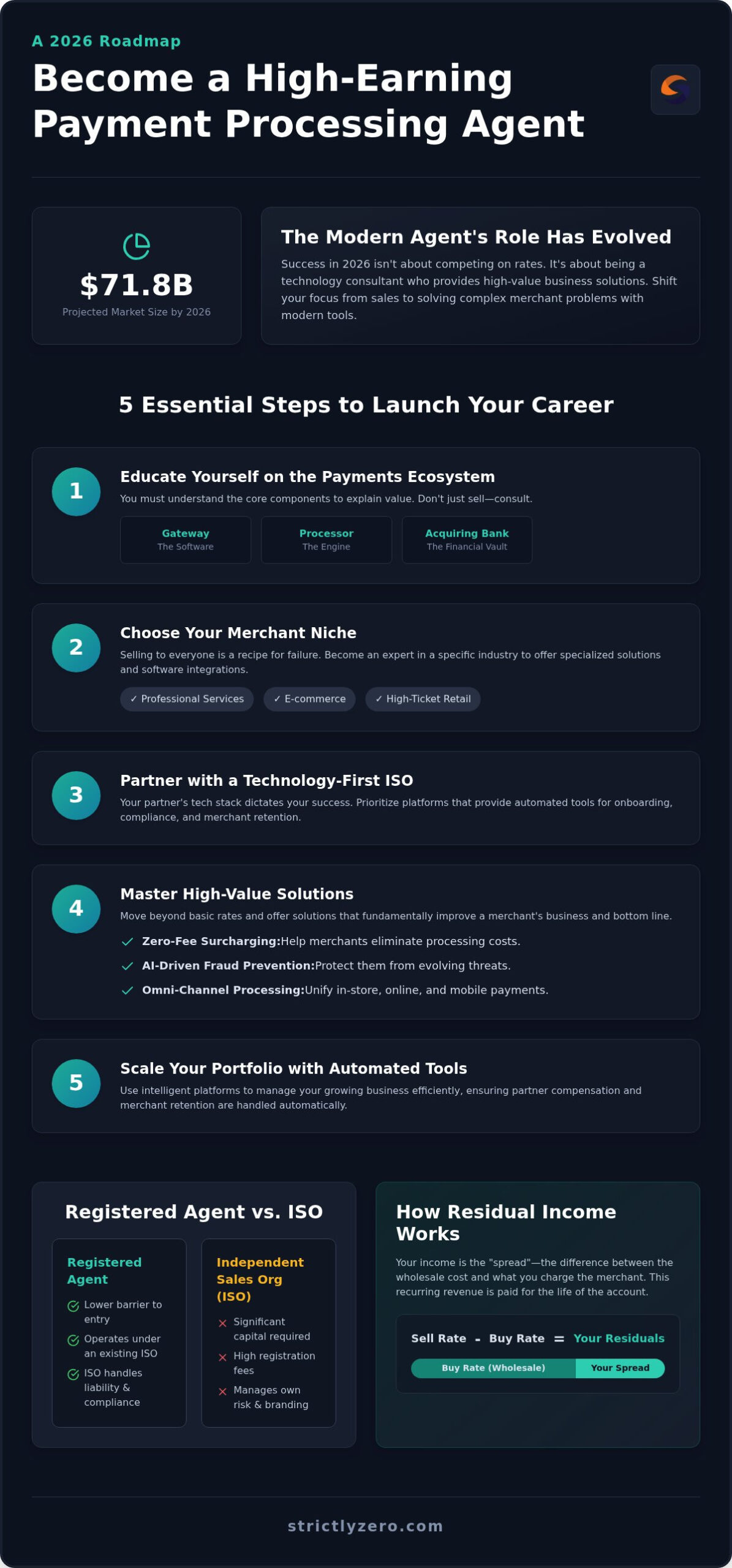
Registered Agent vs. Independent Sales Organization (ISO)
Many beginners confuse these two roles, but the differences in liability and cost are substantial. An agent typically operates as a sales partner under an existing ISO. This path has a much lower barrier to entry because the ISO handles the heavy lifting of backend technical support, high-level compliance, and most of the liability. In contrast, starting a full ISO requires significant capital for Visa and Mastercard registration fees, which can cost thousands of dollars annually, plus the burden of maintaining your own branding and risk management systems. Most successful professionals start as agents to learn the ropes and build a portfolio before ever considering the jump to a full ISO structure.
How Residual Income Works
5 Essential Steps to Becoming a Payment Processing Agent
Moving from a curious observer to a professional agent requires a structured approach. Learning how to become a payment processing agent involves more than just signing a contract; it’s about building a foundation for a scalable business. You need to understand the mechanics of the industry and align yourself with technology that solves real merchant pain points. The following steps outline the path to entering the field as a high-performing professional.
Step 1: Educate Yourself on the Payments Ecosystem
You must distinguish between mobile, e-commerce, and standard ACH processing. Each has unique security requirements and fee structures. The ecosystem involves three main players: the gateway (the software), the processor (the engine), and the acquiring bank (the financial vault). Interchange fees are the non-negotiable base cost of all transactions set by card networks like Visa and Mastercard. Understanding these components allows you to explain value to a merchant without sounding like a typical salesperson.
Step 2: Choose Your Merchant Niche
Selling to everyone is a recipe for failure in 2026. Generalists often struggle because they can’t offer specialized solutions for specific business workflows. Focus on high-growth niches like professional services, e-commerce, or high-ticket retail. Evaluate a niche by looking at its average transaction volume and risk profile. High-risk categories might offer higher margins, but they also face stricter underwriting. By specializing, you become an expert in the specific software integrations those businesses need.
Step 3: Partner with a Technology-First ISO
Your partner’s tech stack dictates your success. Look for API-first platforms and automated tools that handle the heavy lifting of merchant onboarding. Transparent reporting and real-time residual tracking are non-negotiable for anyone serious about the business. Many top agents choose to partner with a tech-forward provider to access advanced features like automated compliance and intelligence tools. This partnership is what allows you to offer zero fee credit card processing, a primary differentiator in today’s market.
Once you’ve selected a partner, you’ll undergo a standard application and background check process. Prepare to provide your tax information and proof of your business entity if you’re operating as an LLC. You’ll also need a firm grasp of PCI DSS compliance to ensure your merchants’ data stays secure. Understanding merchant category codes (MCC) is equally vital, as these dictate the risk level and pricing for every business you sign. Mastering these details early prevents delays during the underwriting phase and builds trust with your future clients.
Evaluating Partner Platforms: Beyond Basic Residuals
Many aspiring professionals researching how to become a payment processing agent make the mistake of chasing the highest residual split possible. While a 90% split sounds impressive, it’s worth exactly zero if your merchants cancel their service within three months because of outdated technology. Success in 2026 relies on the three pillars of a modern platform: automation, intelligence, and compliance. You need a partner that offers more than just a place to process cards; you need a comprehensive business ecosystem that keeps your clients happy.
Legacy processors often rely on “statement-only” platforms where you only see your earnings once a month. Modern agents demand real-time dashboards that provide instant visibility into transaction volume and merchant health. You should prioritize partners that offer omni-channel capabilities, including Virtual Terminals, Payment Links, and mobile invoicing. These tools allow you to win larger, more sophisticated accounts that need more than a simple countertop terminal. Providing a seamless experience across all sales channels is how you build a portfolio that lasts for years and resists competitor poaching.
Automated Residual Management with ClearSplit™
As you scale your business, managing commissions for sub-agents or referral partners becomes a massive administrative headache. Manual spreadsheets are prone to errors and breed distrust among your team. This is where ClearSplit™ changes the game by automating complex compensation structures. It ensures every partner gets paid accurately and on time without you spending hours on manual data entry. Transparency in residuals is the most important factor in building trust between an agent and an ISO. When your team can see their earnings in real-time, they’re more motivated to help you grow the portfolio.
Predictive Intelligence: Using ChurnIQ™ to Save Your Portfolio
Merchant churn is the single biggest threat to your long-term residual income. In a competitive market, other agents will constantly try to poach your clients with promises of lower rates. ChurnIQ™ uses predictive intelligence to identify at-risk merchants before they ever pick up the phone to cancel. By analyzing patterns in processing volume and support interactions, the system alerts you when a merchant needs attention. This proactive approach allows you to address concerns and save the account, which is much more cost-effective than finding a new merchant. Building a stable business isn’t just about signing new deals; it’s about keeping the ones you already have.
Mastering the Zero-Fee Sales Pitch for Merchants
If you want to know how to become a payment processing agent who actually closes deals, you have to stop talking about basis points and start talking about bottom-line savings. In 2026, the most powerful door-opener is the “Zero-Fee” model. Merchants are tired of receiving complex monthly statements that eat into their margins. By leading with a solution that eliminates those costs, you move from being a vendor to a strategic partner. This approach works because it addresses the merchant’s biggest pain point immediately: the high cost of doing business.
The backbone of this pitch is the Smart Pricing Engine. This technology handles the heavy lifting of state-by-state surcharge compliance automatically. For example, with the Illinois Interchange Fee Prohibition Act (IFPA) taking effect in July 2026, merchants can no longer be charged interchange on tax and gratuity. Trying to track these rules manually is impossible for a small business owner. A modern Surcharge & Dual Pricing Engine ensures the merchant stays within legal bounds, even in restricted states like Colorado or Illinois, while protecting them from federal prohibitions on surcharging debit cards.
Surcharging vs. Dual Pricing: The Agent’s Toolkit
Understanding the technical difference between these two models is essential for your sales toolkit. Surcharging involves adding a specific fee (usually capped at 3% or the cost of processing) to credit card transactions at the point of sale. Dual pricing, however, presents two separate prices to the customer: one for cash and one for card. You should recommend dual pricing for retail or high-traffic environments where transparency is key. Surcharging is often better for professional services or B2B accounts. Using a compliant engine ensures that no matter which model the merchant chooses, they remain protected from regulatory fines.
Handling Objections and Closing the Deal
The most common objection you’ll hear is, “Will my customers be upset about the fee?” To handle this, shift the conversation to the “Total Cost of Ownership.” Explain that customers are already used to this model at gas stations and government offices. You can use a processing cost calculator to show the merchant exactly how much they’ll save. A surcharge program can effectively eliminate 95-100% of a merchant’s processing costs overnight. When a business owner sees that they can add thousands of dollars back to their annual profit without increasing sales, the decision becomes easy. To start offering these high-impact solutions to your clients, you can apply to join a tech-forward partner network today.
Scaling Your Payment Business with Strictly
Once you’ve mastered the basics of how to become a payment processing agent, the focus shifts from individual sales to enterprise-level growth. Moving beyond the “lone wolf” stage is where the true wealth potential of the payments industry reveals itself. By building a team, you create a business that generates revenue even when you aren’t personally knocking on doors. This transition requires a shift in your daily operations, moving from direct selling to managing a portfolio and a sales force.
Protecting your growing residuals is just as important as signing new merchants. AI-driven fraud prevention is a critical tool in this regard. It monitors transaction patterns in real-time, stopping fraudulent activity before it damages your merchants’ reputations or triggers costly chargebacks. When your merchants stay safe, your residuals remain secure. Using the ultimate payment processing platform for ISOs gives you the oversight needed to manage these risks while scaling your operations across multiple industries and regions.
Building a Sub-Agent Network
Recruiting and training a network of sub-agents allows you to scale your reach without increasing your personal workload. The challenge is often the administrative burden of tracking split commissions. ClearSplit™ solves this by managing multi-tier commission structures automatically. This transparency builds trust with your team, as they can see their earnings in real-time. To attract top talent, you must provide your agents with the best technology, such as virtual terminals and invoicing tools, ensuring they have the competitive edge needed to win accounts.
Transitioning to a Full ISO
Scaling eventually leads to the milestone of becoming a full Independent Sales Organization. This transition involves registering directly with card brands and taking on more responsibility for branding and risk. You’ll typically need a substantial monthly processing volume and the capital to cover registration fees before making this move. Strictly supports agents throughout this evolution, providing the technical infrastructure and partner management tools necessary for full independence. When you’re ready to take the next step in your career, partner with Strictly today to start your journey as a payment processing agent.
Build Your Future in the Payments Industry
The landscape of merchant services has shifted from simple rate reductions to complex technology consulting. Understanding how to become a payment processing agent in 2026 means embracing tools that offer real value, such as automated compliance and predictive analytics. You’ve learned that the most successful agents don’t just sell; they solve the problem of high overhead through compliant surcharge programs and omni-channel flexibility.
By choosing a partner that prioritizes your growth, you can move from a solo salesperson to a scalable agency. You need infrastructure that handles the heavy lifting, from ClearSplit™ automated residuals to ChurnIQ™ retention intelligence that keeps your portfolio stable. The compliant Zero-Fee surcharge engine ensures your merchants remain protected across all state lines while you build long-term wealth.
Now is the time to take action and secure your place in this recession-proof industry. Become a Strictly Partner and scale your payments business today. With the right technology and a strategic mindset, your potential for recurring residual income is virtually limitless.
Frequently Asked Questions
Do I need a license to become a payment processing agent?
You don’t need a specific state-issued professional license to start this career, but you must be registered as a sales agent under a registered Independent Sales Organization (ISO). This process involves a background check and a signed agreement with your partner processor. If you eventually decide to scale into a full ISO, you’ll need to register directly with Visa and Mastercard, which involves significant annual fees and rigorous audits.
How much money can a payment processing agent make?
Income potential is uncapped and primarily depends on the volume of transactions processed by your merchant portfolio. Most agents earn through monthly residuals, which are small percentages of every sale your merchants make. High-performing agents who focus on high-volume niches or “Zero-Fee” models can build six-figure recurring incomes over several years. It’s a long-term game where your past work continues to pay you every month.
What is the difference between an agent and a broker in merchant services?
The terms are often used interchangeably, but an agent is typically a dedicated sales representative for one specific ISO. A broker often operates more independently, sometimes maintaining relationships with multiple processors to find the best fit for diverse merchant needs. When researching how to become a payment processing agent, you’ll find that most beginners benefit from the structured support and specialized technology provided by a single, high-quality ISO partnership.
How do I find merchants to sell credit card processing to?
You can find merchants through local business networking, industry-specific trade shows, and targeted digital marketing. Successful agents often focus on a specific niche, like professional services or e-commerce, to become experts in those specific pain points. Referrals from existing happy clients are the most effective way to grow. Offering modern solutions like AI-driven fraud prevention also helps you stand out from legacy competitors who only focus on rates. For example, you can explore Enterprise Threat Intelligence and Domain Feeds to help your clients identify potential brand impersonation before it impacts their operations.
What are the startup costs for becoming an independent sales agent?
Startup costs are remarkably low for agents working under an established ISO, often limited to basic business expenses like forming an LLC and setting up a website. Unlike a full ISO registration, which costs thousands of dollars in card brand fees, someone learning how to become a payment processing agent can often get started for under $1,000. Your primary investment will be the time spent on education and initial merchant outreach to build your first portfolio.
Is credit card surcharging legal in all 50 states in 2026?
No, surcharging remains illegal in Connecticut, Massachusetts, and Maine as of August 2026. Other states like Colorado and Illinois have specific caps or restrictions on how much a merchant can charge. It’s vital to use a compliant surcharge engine that automatically adjusts based on the merchant’s location. Federal law also prohibits surcharging on debit and prepaid card transactions nationwide, regardless of which state the business operates in.
Can I sell payment processing part-time?
You can definitely start selling merchant services part-time while maintaining another job. Many professionals use it as a way to build a secondary stream of residual income before transitioning to a full-time career. However, providing excellent support to your merchants is crucial for retention. As your portfolio grows, the administrative demands and the need for proactive merchant management usually require a full-time commitment to scale the business effectively.