

If you’re still adding a 3% fee at the checkout screen in 2026, you aren’t just offsetting costs; you’re essentially handing a class-action lawyer the keys to your business. It’s frustrating to watch over 3% of every sale disappear into processing fees, especially when the california credit card surcharge law makes recouping those costs feel like a legal minefield. You want to protect your margins, but the fear of being flagged for “junk fees” under SB 478 is a constant source of anxiety for many California merchants.
This guide provides a clear path to $0 processing fees while staying fully compliant with California’s strict transparency requirements. We’ll break down the critical difference between illegal drip pricing and a legal dual pricing model that satisfies both state regulators and card network rules. You’ll learn how to navigate the latest 2025 disclosure updates for restaurants and how automated software can handle these complex calculations for you. By the end, you’ll have a roadmap to eliminate overhead without the risk of a lawsuit.
Key Takeaways
- Learn how to balance legal surcharging with the strict transparency requirements of SB 478 to protect your business from class-action lawsuits.
- Understand why the california credit card surcharge law requires you to include all mandatory fees in your advertised prices to avoid “junk fee” violations.
- Compare surcharging and dual pricing models to see which one offers the most effective way to reach $0 processing fees in 2026.
- Use our 2026 compliance checklist to ensure you’ve notified card brands and updated your signage correctly before changing your pricing.
- Discover how an automated Smart Pricing Engine handles debit detection and real-time rule updates so you don’t have to manage compliance manually.
Is Surcharging Legal in California in 2026?
Many business owners still believe that charging a fee for credit card use is illegal in the Golden State. This confusion stems from a 1985 law, California Civil Code 1748.1, which explicitly banned the practice. However, the legal reality of the california credit card surcharge law shifted dramatically in 2018. Today, surcharging is legal, provided you follow strict transparency rules. The California Attorney General now focuses on preventing “bait and switch” pricing rather than banning the fees themselves. This means you can’t show one price and surprise the customer with a fee at the very end of the transaction.
A Surcharge (payment systems) model is different from a cash discount. In a cash discount, you display the high price and deduct a percentage for cash. In a surcharge model, you add a fee to the credit price. While both are legal, the way you communicate these prices determines whether you stay compliant or face state penalties.
To better understand how these rules have changed over time, watch this helpful video:
The Italian Colors v. Becerra Ruling
The turning point for California merchants was the Italian Colors Restaurant v. Becerra case. The court ruled that the state’s ban on surcharges unconstitutionally restricted a merchant’s right to free speech. Specifically, the court found that how a business describes a price difference is a form of communication. This landmark decision opened the door for zero fee credit card processing strategies. Merchants now have the right to tell customers exactly why a price is higher, though they must do so without being deceptive.
Credit vs. Debit: The Golden Rule
While you can surcharge credit cards, you must never apply a fee to a debit card transaction. This is a non-negotiable rule under both federal law and the california credit card surcharge law. Even if a customer runs their debit card “as credit” by signing instead of using a PIN, it’s still a debit transaction. Accurately identifying the card type at the point of sale is your first line of defense against legal trouble.
Accidentally surcharging a debit card can lead to massive fines from card brands like Visa and Mastercard, sometimes reaching thousands of dollars per occurrence. To stay safe, you need to understand these distinctions:
- Credit Cards: Can be surcharged up to 3% in most cases.
- Debit Cards: Surcharging is strictly prohibited by federal law.
- Prepaid Cards: Generally treated like debit cards and should not be surcharged.
Understanding SB 478: California’s “Honest Pricing” Requirements
SB 478, which went into effect on July 1, 2024, has completely redefined the landscape for merchants. While the previous section established that surcharging is legally protected speech, SB 478 dictates exactly how you must “speak” those prices to your customers. This “Honest Pricing” law targets so-called junk fees by requiring that any mandatory charge be included in the advertised or listed price upfront. You can no longer advertise a service for $100 and then tack on a $3 fee at the final payment screen.
In 2026, the interpretation of the california credit card surcharge law is stricter than ever. If a fee is mandatory for a specific payment method, it must be visible at the first point of contact. This means the total cost of the item, including the surcharge, must be the baseline price shown to the consumer. Adding a fee only at the checkout stage is now seen as a deceptive practice that violates the spirit of price transparency.
Advertising Prices Compliantly
To remain compliant, your signage must be crystal clear. A simple way to handle this is by listing the credit card price as the standard price and offering a discount to those who pay with cash. For example, your menus or price tags could state: “Price includes a 3% credit card fee; cash users save 3%.” This disclosure needs to be prominent. You should place signage at your business entrance, on every page of your digital menu, and at the physical point of sale. Transparency isn’t just about the numbers; it’s about making sure the customer isn’t caught off guard.
The Risk of “Drip Pricing”
Drip pricing occurs when a business reveals fees bit by bit as a customer moves through a transaction. California regulators are aggressively pursuing businesses that use these tactics to make their prices look lower than they actually are. The state’s Department of Justice frequently references California Civil Code section 1748.1 to remind merchants that they cannot mislead consumers about the true cost of credit. This is particularly vital for digital storefronts. Your ecommerce payment processing setup must be configured to show the full, all-in price early in the shopping journey.
Failing to follow these rules in 2026 can lead to significant legal penalties and costly class-action lawsuits. If you want to eliminate processing costs without the manual headache of updating every price tag, you might consider using a surcharge and dual pricing engine that automatically calculates and displays compliant pricing across all your sales channels.
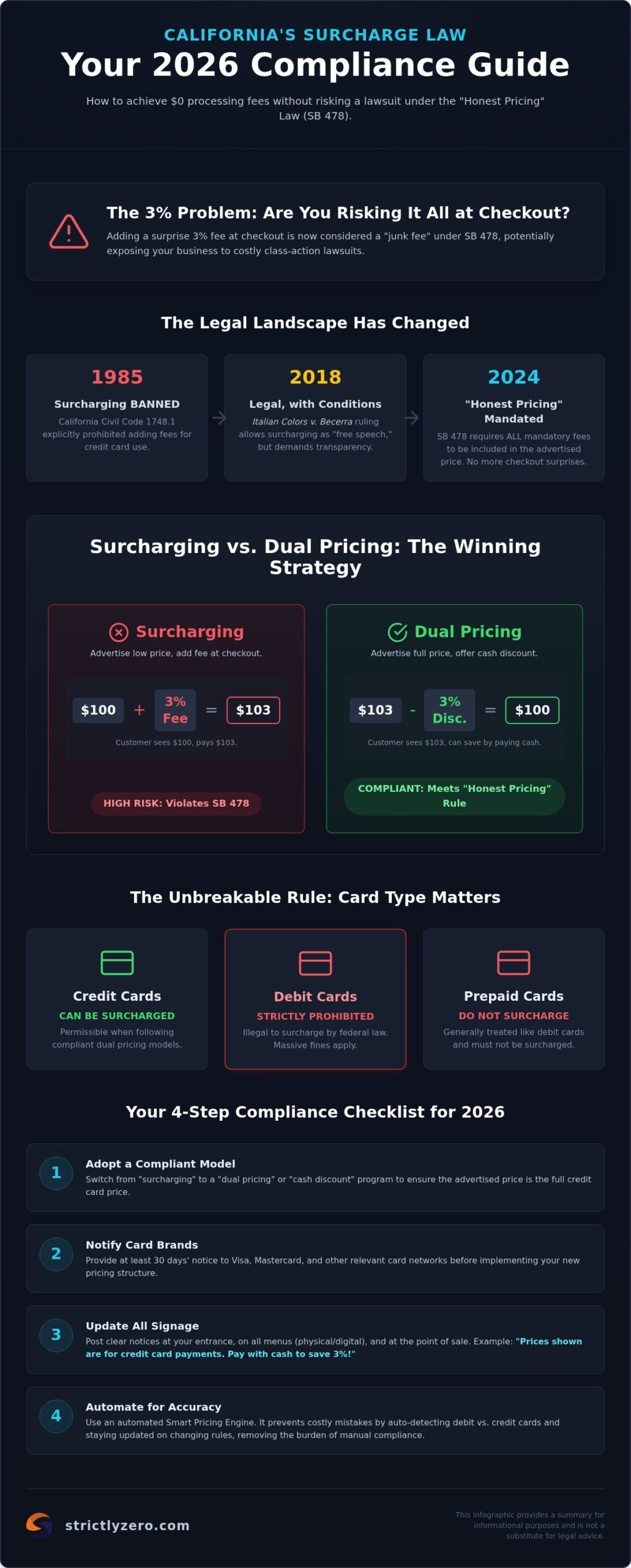
Surcharging vs. Dual Pricing: Which Model Wins in California?
Choosing the right pricing model is the difference between a thriving business and one bogged down by legal letters. While surcharging was once the standard, the 2026 landscape for the california credit card surcharge law has made it much more difficult to implement without triggering a violation. Surcharging involves adding a fee at the end of a transaction, which often clashes with the “upfront pricing” requirements of SB 478. Dual pricing, however, has emerged as the clear winner for merchants who want to eliminate fees while maintaining total transparency.
Dual pricing presents two distinct prices to the consumer at every point of interaction. Instead of surprising a customer at the register, you show them the credit price and the cash price simultaneously. This approach is widely considered the safest route for compliance because it removes the “hidden fee” argument entirely. From a psychological standpoint, customers respond much better to having a choice rather than feeling penalized for their preferred payment method. It shifts the narrative from “paying extra” to “choosing the cash discount.”
The Mechanics of Dual Pricing
Dual pricing requires you to list both the cash and credit costs on every price tag, shelf label, or digital display. By doing this, you aren’t technically adding a surcharge; you’re offering two different prices for two different services. This structure directly aligns with the transparency mandates found in California Civil Code § 1748.1. To make this work without a manual nightmare, you need deep integration with modern credit card processing for small business systems. These platforms can automatically generate the correct prices for your POS system and online store, ensuring that what the customer sees is exactly what they pay.
The Limits of Surcharging
If you decide to stick with a standard surcharge model, you must adhere to strict card brand regulations. As of 2026, Visa and Mastercard generally cap surcharges at 3% or the merchant’s actual cost of acceptance, whichever is lower. It’s illegal to profit from a surcharge; the fee must strictly cover the processing costs. Additionally, you’re required to notify the card brands and your payment processor at least 30 days before you begin surcharging. Failing to provide this notice or exceeding the 3% cap can lead to immediate account suspension or heavy fines, making it a high-risk strategy compared to the dual pricing alternative.
- Surcharging: Risky under SB 478, requires 30-day brand notice, capped at 3%.
- Dual Pricing: Safest for CA compliance, no surprise fees, better for customer retention.
A Step-by-Step Compliance Checklist for 2026
Implementing a program under the california credit card surcharge law requires more than just changing a setting on your terminal. Your first move must be notifying your payment processor and major card brands at least 30 days before you begin. This is a non-negotiable network rule. Once that clock starts, audit every piece of customer-facing material. Whether it’s a physical menu or a digital price list, the “all-in” price must be what the customer sees first. If you don’t include mandatory fees in the advertised price, you’re inviting an SB 478 violation.
Technical precision is your best defense against fines. You must ensure your hardware has automated debit detection. Since surcharging debit is illegal, your system needs to identify the card type instantly and bypass the fee. Finally, look at your receipts. The surcharge must appear as a separate, clearly labeled line item so the customer knows exactly what they paid for. This level of transparency protects you from claims that you’re hiding the true cost of the transaction.
Mandatory Signage Requirements
California storefronts must follow specific placement rules to ensure disclosures are conspicuous. Signs should be placed at both the entrance and the point of sale. For e-commerce, the disclosure must be “above the fold” or placed immediately adjacent to the product price. Use clear language like: “We apply a 3% surcharge to credit card transactions, which is not greater than our cost of acceptance.” The font size should be large enough for an average consumer to read without effort.
Staff Training and Scripting
Your employees are the face of your compliance strategy. They need to know how to explain the pricing model without using inaccurate terms. Never let staff call a surcharge a “tax” or a “government fee.” These are private business charges, not state mandates. Train them to frame the conversation around choice. If a customer objects, the script should highlight the lower cash price as a benefit. For example: “Our prices reflect the cost of credit, but you can save 3% right now by paying with cash.”
Staying compliant doesn’t have to be a manual burden for your business. You can automate your surcharge compliance to ensure every transaction follows the latest state rules without extra effort from your team.
How Strictly Automates California-Compliant Surcharging
The anxiety surrounding the california credit card surcharge law often stems from the manual effort required to stay compliant. Strictly eliminates this burden by integrating state-specific rules directly into the payment flow. Our Smart Pricing Engine serves as a safety net, ensuring that every transaction adheres to SB 478 transparency requirements without requiring constant oversight from your staff. It’s not just about processing payments; it’s about providing a framework that prevents legal errors before they happen.
One of the most significant risks for California merchants is the accidental surcharging of debit cards. While many systems struggle to distinguish between card types at the point of sale, Strictly provides real-time debit versus credit detection at the hardware level. This automated check is mandatory for staying within the law, as even “signature debit” transactions must remain fee-free. By removing the human element from this decision, you protect your business from the heavy fines and card brand penalties mentioned earlier in this guide. Our system also handles automated receipt generation, ensuring every customer receives the required California legal disclosures in writing.
The Power of the Smart Pricing Engine
Strictly’s Smart Pricing Engine doesn’t just detect the card; it automatically adjusts the final price based on your chosen model. Whether you use dual pricing or a standard surcharge, the engine calculates the exact amount in real-time. This allows you to reach $0 processing fees legally and consistently. Because regulations change, we push state-by-state compliance updates directly to your terminal. You don’t have to worry about late-2025 amendments to SB 478 because the system updates itself to reflect the current legal landscape. This automation means your business stays compliant even as the rules evolve.
Transparent Reporting for Business Owners
Beyond the transaction, Strictly provides the documentation you need to survive a state audit or a PCI DSS review. Our dashboard offers detailed logs of every fee applied and every disclosure shown to the customer. You can track your total savings in real-time, seeing exactly how much overhead you’ve eliminated. This omni-channel support ensures your online store and physical location are perfectly synced under the best credit card processing for small business framework available in 2026.
If you’re ready to stop losing 3% of your revenue to processing costs, it’s time to switch to a system built for California’s unique environment. Eliminate your processing fees today with Strictly’s compliant surcharge program and get back to growing your business without the fear of “junk fee” litigation.
Secure Your Margins with Compliant Pricing
The landscape of the california credit card surcharge law has evolved from a simple ban to a sophisticated transparency framework. By now, it’s clear that staying compliant in 2026 requires more than just good intentions; it requires a proactive shift toward upfront pricing and automated detection. Whether you choose a dual pricing model or a strictly regulated surcharge program, the goal remains the same: eliminate the 3% overhead that eats into your profits without inviting legal scrutiny.
You don’t have to manage these complex SB 478 requirements on your own. By leveraging technology that handles real-time debit detection and mandatory state disclosures, you can protect your business from junk fee litigation while enjoying zero-fee merchant services. It’s time to stop letting processing costs dictate your bottom line and start using a system that works for you. Automation is the only way to ensure every transaction follows the rules without constant manual oversight.
Switch to Strictly and Eliminate Your Processing Fees Legally to benefit from automated SB 478 compliance and the security of a platform designed for the modern California merchant. Take control of your margins today and build a more transparent, profitable future for your business.
Frequently Asked Questions
Is it legal to charge a credit card fee in California in 2026?
Yes, it is legal to charge a credit card fee in California. While a 1985 statute originally banned the practice, landmark court rulings in 2018 determined that merchants have a First Amendment right to communicate these price differences. You must now follow the california credit card surcharge law by ensuring every fee is disclosed transparently and included in the advertised price to fully comply with SB 478 regulations.
What is the maximum credit card surcharge allowed in California?
The maximum surcharge is generally capped at 3% of the total transaction amount. This limit is strictly enforced by card network rules from Visa and Mastercard. Additionally, state and federal guidelines specify that you cannot profit from the fee. You are only allowed to charge enough to cover your actual cost of card acceptance, which for most small businesses stays within that 3% window.
Do I have to include the surcharge in my advertised price because of SB 478?
Yes, SB 478 requires that any mandatory fee be included in the advertised or listed price. You can’t list an item for $20 and add a surcharge only at the final checkout screen. Instead, you should display the credit card price as the primary advertised price. This ensures customers see the total cost upfront, which is the core requirement of California’s 2024 “honest pricing” legislation.
Can I charge a surcharge on debit cards in California?
No, you cannot surcharge debit cards in any situation. Federal law and the california credit card surcharge law strictly prohibit fees on debit transactions. This rule applies even if the customer runs the card as “credit” by signing instead of using a PIN. Surcharging a debit card can lead to immediate fines from card brands and potential legal action from the California Attorney General.
What is the difference between a surcharge and a cash discount?
A surcharge is an extra fee added to a standard price when a customer uses a credit card. A cash discount is a reduction in price for customers who pay with cash. Under SB 478, cash discounts are often easier to manage because you advertise the higher credit price as the standard and offer a “savings” at the register, which satisfies transparency requirements much more naturally.
What happens if I don’t disclose the surcharge upfront in California?
Failing to disclose fees upfront can lead to consumer protection lawsuits and heavy fines under SB 478. California regulators view hidden fees added at checkout as “drip pricing,” which is a violation of the state’s transparency laws. Beyond legal trouble, you risk having your merchant account suspended by card networks for violating their specific rules regarding how surcharges must be communicated to the customer.
How do I notify Visa and Mastercard that I am surcharging?
You must notify your payment processor and the major card brands at least 30 days before you start surcharging. Most payment processors provide a specific online form or portal to handle this notification process for you. This mandatory waiting period allows the networks to ensure your business is properly registered and that your intended surcharge percentage does not exceed the 3% cost of acceptance limit.
Is dual pricing better than surcharging for California businesses?
Dual pricing is generally considered the superior model for California merchants in 2026. Because it displays both the cash and credit prices on every price tag or digital display, it automatically complies with SB 478’s upfront pricing rules. It also tends to be better for customer relations, as it frames the price difference as a cash savings benefit rather than a penalty for using a credit card.