

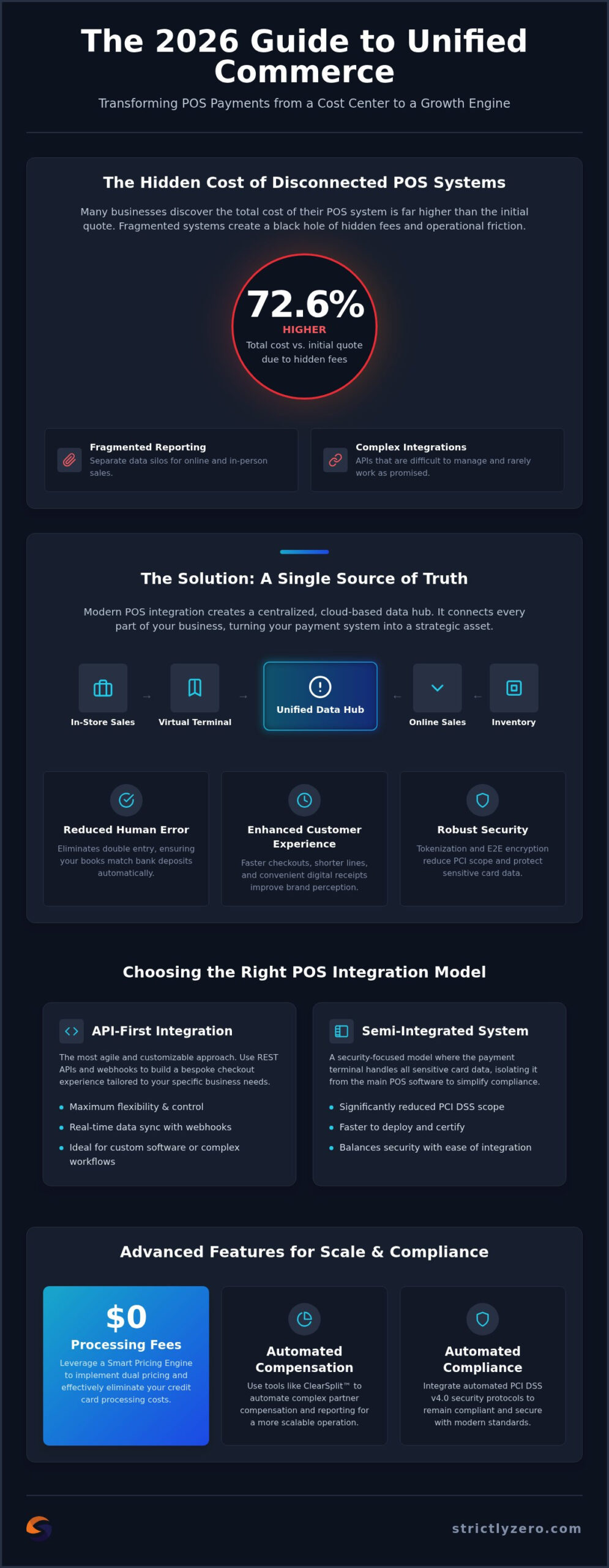
Did you know that the total cost of a POS system can end up being 72.6% higher than the initial quote once you factor in hidden fees and data migration? It’s a frustrating reality for many business owners who watch their hard-earned margins disappear into a black hole of transaction costs and fragmented reporting. You’re likely tired of managing separate silos for online and in-person sales while waiting for complex API integrations that never quite work as promised. A seamless pos payment integration shouldn’t be a luxury reserved for giant enterprises.
If you’re ready to stop overpaying for the simple act of accepting money, you’re in the right place. This 2026 guide to unified commerce shows you how to connect your systems to achieve a truly streamlined experience. You’ll learn how to leverage a smart pricing engine to reach $0 processing fees, automate your compliance with the latest PCI DSS v4.0 standards, and finally see your entire business through one single dashboard. We’ll break down the shift toward AI-enabled, cloud-based platforms that turn your payment processor into a partner for growth rather than just another monthly expense.
Key Takeaways
- Understand how the shift to unified commerce transforms your point-of-sale from a simple card reader into a powerful, cloud-based data hub.
- Identify the best pos payment integration model for your business, whether you need a semi-integrated setup for security or a fully integrated API-first approach.
- Discover how to leverage a Smart Pricing Engine to implement dual pricing and effectively eliminate credit card processing fees.
- Learn how to automate complex partner compensation and reporting using specialized tools like ClearSplit™ for a more scalable operation.
- Ensure your business remains compliant with modern standards by integrating automated PCI DSS v4.0 security protocols into your daily workflow.
What is POS Payment Integration and Why Does It Matter?
Think of pos payment integration as the digital bridge between your business software and your payment processor. In the past, many merchants relied on “standalone” terminals that operated independently from the register. Today, the industry has shifted toward unified, cloud-based data streams. A modern Point of Sale (POS) system isn’t just a cash drawer; it’s a centralized hub that communicates directly with your payment gateway to authorize transactions in milliseconds. This connection ensures that every swipe, dip, or tap is recorded automatically without the need for a human to interfere.
To see how these systems communicate in a real-world setting, watch this helpful breakdown:
Manual entry is the primary enemy of retail efficiency and accuracy. When staff must re-key totals from a register into a credit card terminal, reconciliation nightmares follow. Mistakes are inevitable. Integration eliminates this friction by creating a single source of truth for inventory and accounting. When a sale happens, your stock levels and financial records update instantly across every platform you use. Automation is now mandatory.
The Evolution of Omni-Channel Payments
Modern consumers expect a fluid experience whether they’re buying from a smartphone or a physical counter. Effective pos payment integration connects the dots between ecommerce payment processing and your brick-and-mortar sales. This real-time synchronization is critical for inventory management. It prevents you from selling the last item in stock online while a customer is physically holding it in your store. For service-based professionals or non-traditional retail environments, using a Virtual Terminal allows you to process card-not-present transactions that still sync perfectly with your main sales records.
Key Benefits for Small and Mid-Sized Businesses
For small and mid-sized enterprises, the impact on the bottom line is immediate. You’ll see improvements in both operational speed and data security. The shift to an integrated model provides several distinct advantages:
- Reduced Human Error: No more “double entry” means your books actually match your bank deposits every single night.
- Enhanced Customer Experience: Faster checkouts and the ability to send digital receipts directly to a customer’s inbox improve brand perception and reduce line lengths.
- Robust Security: Security is paramount. Advanced integration uses tokenization and end-to-end encryption to protect sensitive data. Since the POS software never “sees” the raw card data, your scope for PCI compliance is significantly reduced, saving you time and potential audit costs.
How POS Payment Integration Works: Technical Models
Understanding the technical architecture of your checkout counter doesn’t require a computer science degree. In 2026, modern POS systems have moved away from rigid, siloed setups toward flexible environments that prioritize data flow. The way your software communicates with your hardware determines everything from your daily workflow to your vulnerability to data breaches. Choosing the right pos payment integration model is a strategic decision that impacts your long-term scalability and overhead costs.
The API-First Integration Model
The most agile businesses currently favor an API-first approach. Developers use REST APIs to build highly customized checkout experiences that fit specific business needs rather than forcing a business to adapt to a generic tool. This model relies on webhooks to provide real-time transaction notifications, ensuring your inventory and customer records update the moment a payment is approved. An API acts as a secure translator that allows your POS software to send transaction details to the payment processor without manual intervention. If you’re looking to build a bespoke system, you can explore how an API-first platform simplifies this process.
Semi-Integrated Systems and Security
Security is the primary reason many merchants choose a semi-integrated model. In this setup, the POS software sends the transaction amount to the terminal, but the terminal handles the sensitive card data and communicates directly with the processor. Because the sensitive data bypasses the POS software entirely, your business significantly reduces its PCI DSS compliance burden. This is especially relevant now that PCI DSS v4.0 requirements became mandatory on March 31, 2025. These systems often include AI-driven fraud prevention at the point of sale, which analyzes transaction patterns in real-time to stop suspicious activity before it hits your bank account.
Real-Time Pricing and Cloud Dynamics
A critical component of a 2026 integration is the Smart Pricing Engine. This software layer sits between the transaction and the final total, determining the most cost-effective way to process the payment in real-time. It automatically identifies card types and applies compliant surcharging or dual pricing based on the latest state-by-state regulations. While local server integrations still exist, they’re rapidly being replaced by cloud-based models. Cloud integrations offer a “single source of truth” that you can access from any device, ensuring that your data isn’t trapped on a physical hard drive in a back office. This shift allows for the automated reporting and unified dashboards that modern merchants need to stay competitive.
Choosing the Right POS Integration Strategy
Scalability is the next hurdle. If you plan to expand to multiple locations, your integration must support centralized data management. You don’t want to log into five different portals to see your daily totals. When evaluating top-rated credit card processing services, look for those that provide a unified dashboard for all channels. This level of visibility is only possible through high-quality developer documentation and robust API support. For a deeper dive into choosing a provider, check out our guide on credit card processing services.
Evaluating Platform Flexibility
Flexibility means your software grows with you. Does the platform support recurring billing for subscription models or one-click payment links for remote sales? Modern businesses often use a mix of accounting, CRM, and ERP software. Your integration should play nicely with these third-party tools to prevent manual data entry. Opting for a hardware-agnostic pos payment integration is a smart long-term move. It prevents you from being locked into a specific manufacturer’s device, giving you the freedom to upgrade your tablets or terminals as newer, faster tech hits the market in the coming years.
Security and Compliance Considerations
Compliance isn’t optional, and it’s getting more complex. In 2026, your system must fully adhere to PCI DSS v4.0 standards, which became mandatory on March 31, 2025. A well-designed integration uses tokenization to swap sensitive card data for non-sensitive “tokens.” This ensures that even if your POS software is compromised, the hackers won’t find any usable card numbers. It’s a critical layer of defense that protects both your reputation and your bank account.
Finally, consider the regulatory maze of surcharging. Rules vary by state, and they change frequently. An integrated Smart Pricing Engine can automate this compliance. It detects the card type and the merchant’s location in real-time, applying the correct surcharge or dual pricing automatically. This takes the guesswork out of the hands of your staff and ensures you stay on the right side of the law while drastically reducing your processing overhead.
Eliminating Fees Through Smart POS Integration
Most discussions about POS systems focus on software subscriptions or hardware aesthetics. They often ignore the elephant in the room: the 2.6% to 2.9% plus transaction fees that eat your profits every month. Through modern pos payment integration, you can implement zero fee credit card processing directly at the register. This isn’t just about adding a fee; it’s about using a Dual Pricing model. This system automatically displays a cash price and a credit price, giving customers the choice while ensuring your business doesn’t lose money on the convenience of card payments.
Automated surcharge detection is a key part of this technology. It’s illegal to surcharge debit cards, even if they’re run as “credit.” An integrated system identifies the card type instantly. If it’s a debit card, the surcharge isn’t applied. If it’s a credit card, the system handles it according to 2026 state regulations. This automated approach is much safer and more compliant than manual “checkout fees” added by staff, which often lead to audits and fines. When your software handles the math, your employees can focus on the customer instead of worrying about compliance rules.
The Smart Pricing Engine Advantage
A Smart Pricing Engine calculates the exact surcharge based on real-time regulations. It eliminates the risk of overcharging or applying fees in states where they’re restricted. To maintain transparency, the integration pushes these details to digital signage and printed receipts. You can frame passing on credit card fees to customers as a way to keep your base prices lower for everyone. It’s a benefit for cash-paying customers and a transparent choice for those using credit. This transparency builds trust and reduces friction at the point of sale.
Maximizing Profit Margins
Switching from a traditional fee model to a surcharge model offers a massive ROI. Instead of losing thousands of dollars a year to processing costs, those funds stay in your business for reinvestment. A strategic pos payment integration also cuts down on labor. You don’t have to manually reconcile different fee structures or fix errors from manual entry at the end of the night. Automated fee-offsetting software protects merchant margins by ensuring every transaction covers its own cost of acceptance. If you want to see how much you could save, calculate your potential savings with a smart integration.
Scaling with Strictly: The Future of Integrated Payments
Scaling a payments business requires more than just processing power. It requires a partner that provides the tools to manage a growing portfolio without adding headcount. Strictly has become the preferred choice for those who need a robust pos payment integration that prioritizes transparency and automation. By offering an API-first omni-channel platform, it allows developers to focus on the user experience while the backend handles the complex logic of moving money securely. It’s not just about the transaction; it’s about the infrastructure that supports it.
Management tools like ClearSplit™ change the game for partner compensation. Instead of waiting weeks for manual residual calculations, partners see their earnings in real-time. This automation removes the administrative burden that usually stifles growth. Additionally, ChurnIQ™ provides the retention intelligence needed to spot at-risk accounts before they leave. It uses data to tell you exactly where your merchant base stands, allowing you to protect your portfolio’s health through data-driven insights. For those who need a reliable payment processing platform for ISOs, these specialized tools are essential for long-term stability.
Tools for Partners and ISOs
Residual management is often a manual nightmare for large-scale payment businesses. Strictly automates this entire process, providing detailed reporting that keeps your partners informed and your books balanced. You can also white-label the entire integration experience. This means your clients interact with your brand while benefiting from the underlying technology. For those building custom software, dedicated developer support is available to help navigate unique pos payment integration challenges. This ensures your product gets to market faster with fewer technical hurdles.
The Roadmap to $0 Processing Fees
The journey toward eliminating transaction costs begins with a strategic implementation of the Smart Pricing Engine. This process moves from the initial API call to a fully functioning, compliant zero-fee environment. Strictly doesn’t just provide the tools; it provides a roadmap for merchants transitioning to dual pricing models. This support ensures that your customers understand the value of the new pricing structure while your margins remain protected. It’s a comprehensive approach that turns the checkout counter into a competitive advantage rather than a cost center.
Scale your business with Strictly’s unified platform today.
Take Control of Your Transaction Future
The landscape of unified commerce is moving fast. By 2026, businesses that still rely on manual data entry or standalone terminals will struggle to compete with those using streamlined, cloud-based systems. Implementing a robust pos payment integration isn’t just a technical upgrade; it’s a strategic move to protect your margins and unify your sales data across every channel. You’ve seen how the right architecture can simplify PCI compliance and how a smart pricing engine can turn transaction costs into a thing of the past.
It’s time to stop letting processing fees dictate your bottom line. With a platform that’s compliant in all 50 states and includes AI-driven fraud prevention, you can scale with confidence. Tools like ClearSplit™ ensure your partners are compensated instantly, removing the administrative weight from your shoulders. Eliminate your processing fees with Strictly’s integrated surcharge platform. Your journey toward $0 fees and a single source of truth for your business starts today. You have the tools and the roadmap; now it’s time to build a more profitable future.
Frequently Asked Questions
What is the difference between an integrated and non-integrated POS?
An integrated system automatically syncs your sales data with your payment processor, while a non-integrated setup requires staff to manually type transaction totals into a standalone terminal. Non-integrated systems often lead to human error and accounting discrepancies. With an integrated pos payment integration, the terminal “talks” to the register, updating your inventory and financial records in real-time. This eliminates the need for manual reconciliation at the end of every business day.
How much does it cost to integrate a payment gateway with my POS?
Costs depend on your software and hardware needs. Industry data for 2026 shows POS software subscriptions can range from $0 to over $149 per month per location. Hardware costs also vary, with mobile readers starting as low as $49 while full stations can cost up to $1,699. You should also account for hidden fees like data migration or PCI compliance, which some merchants report can increase the total cost of ownership by over 70%.
Is it legal to pass on credit card processing fees via an integrated POS?
It’s legal to pass on these costs in most states, provided you follow specific disclosure and card brand requirements. Modern systems use a smart pricing engine to ensure compliance by automatically identifying card types. For instance, you can’t surcharge debit cards even if they’re processed as credit. Using an automated engine helps you navigate these state-by-state regulations in 2026 without risking fines or merchant account termination.
Do integrated POS systems work with mobile and tablet devices?
Yes, mobile and tablet-based integrations are the fastest-growing segment of the market. Many businesses now use iPads or Android tablets as their primary registers, connecting to card readers via Bluetooth or specialized hubs. These mobile solutions offer the same pos payment integration benefits as fixed terminals, including real-time inventory updates and unified reporting. This flexibility allows staff to take payments anywhere in a store or at a customer’s table.
What technical skills are required for a POS payment integration?
Most modern systems are designed for simplicity, requiring no special technical skills for standard setups. You’ll usually just connect your hardware to the network and follow an on-screen setup wizard. If your business requires a custom build, a developer can use REST APIs to connect your specific software to the gateway. This API-first approach allows for bespoke checkout experiences but does require knowledge of managing webhooks and real-time data notifications. To further enhance your app’s communication capabilities, you can check out Linq for developer-friendly messaging APIs.
How does an integrated POS handle refunds and chargebacks?
Integrated systems streamline the refund process by allowing you to reverse a transaction directly from the sales record in your dashboard. The system automatically updates your inventory and accounting logs, so your books stay balanced. For chargebacks, the integration often provides a centralized portal where you can view dispute details and upload supporting evidence. This unified approach saves hours of manual work compared to hunting through paper receipts or separate bank statements.
Can I use my existing bank with a new POS payment integration?
You can often keep your existing business bank account for deposits, but you’ll likely need to switch to a compatible payment processor that supports your POS software. Not every processor can communicate with every register. It’s best to look for a platform that offers omni-channel processing to ensure your online and in-person sales flow into the same account. This setup provides a clearer picture of your cash flow and simplifies your tax reporting.