
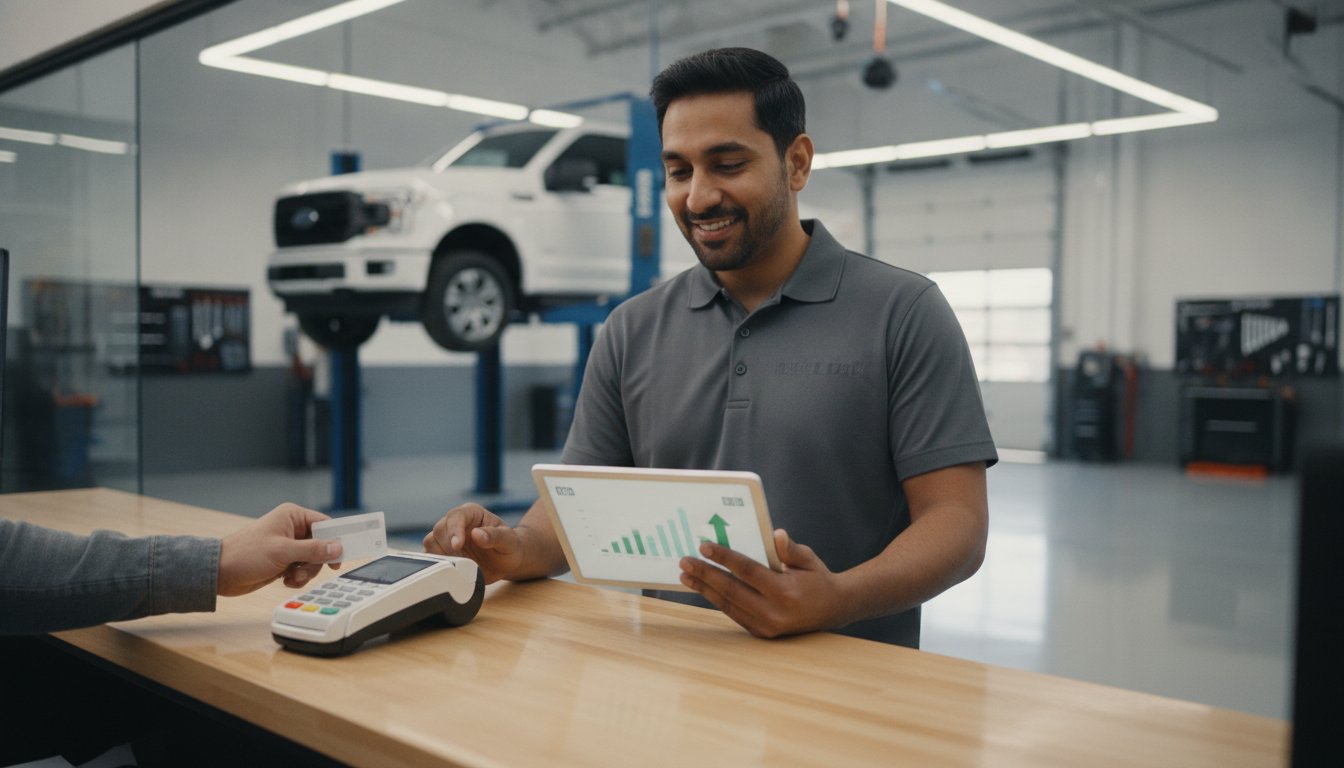
Your shop’s 10% profit margin isn’t just being squeezed by rising parts costs; it’s being siphoned off by every swipe, dip, and tap at the counter. Finding the right credit card processing for auto repair shops is no longer just about convenience. It is about survival. You work too hard on high-ticket engine and transmission repairs to lose hundreds of dollars every week to merchant fees. It is frustrating when payment hardware fails during the 5 PM rush or when a customer files a chargeback months after their car left the bay.
The good news is that modern payment solutions can turn these overhead costs into pure profit. This 2026 guide shows you how to eliminate processing fees entirely while offering your customers flexible financing options that make big repairs more affordable. We will explore how to implement compliant surcharge engines, offer integrated POS lending, and use AI-driven fraud prevention to keep your revenue where it belongs: in your business.
Key Takeaways
- Learn how to recover lost revenue by implementing compliant surcharge and dual pricing models that shift processing costs away from your bottom line.
- Discover how virtual terminals and text-to-pay invoicing streamline your workflow and allow you to collect deposits securely over the phone.
- Identify the most cost-effective credit card processing for auto repair shops by auditing your current merchant statements to identify hidden fees.
- Protect your shop from expensive chargebacks on high-ticket repairs with AI-driven fraud prevention tools designed for the automotive service industry.
- Increase your average repair order by offering integrated POS lending, giving customers the flexibility to finance major engine or transmission work.
Why Traditional Merchant Services Are Draining Auto Shop Profits
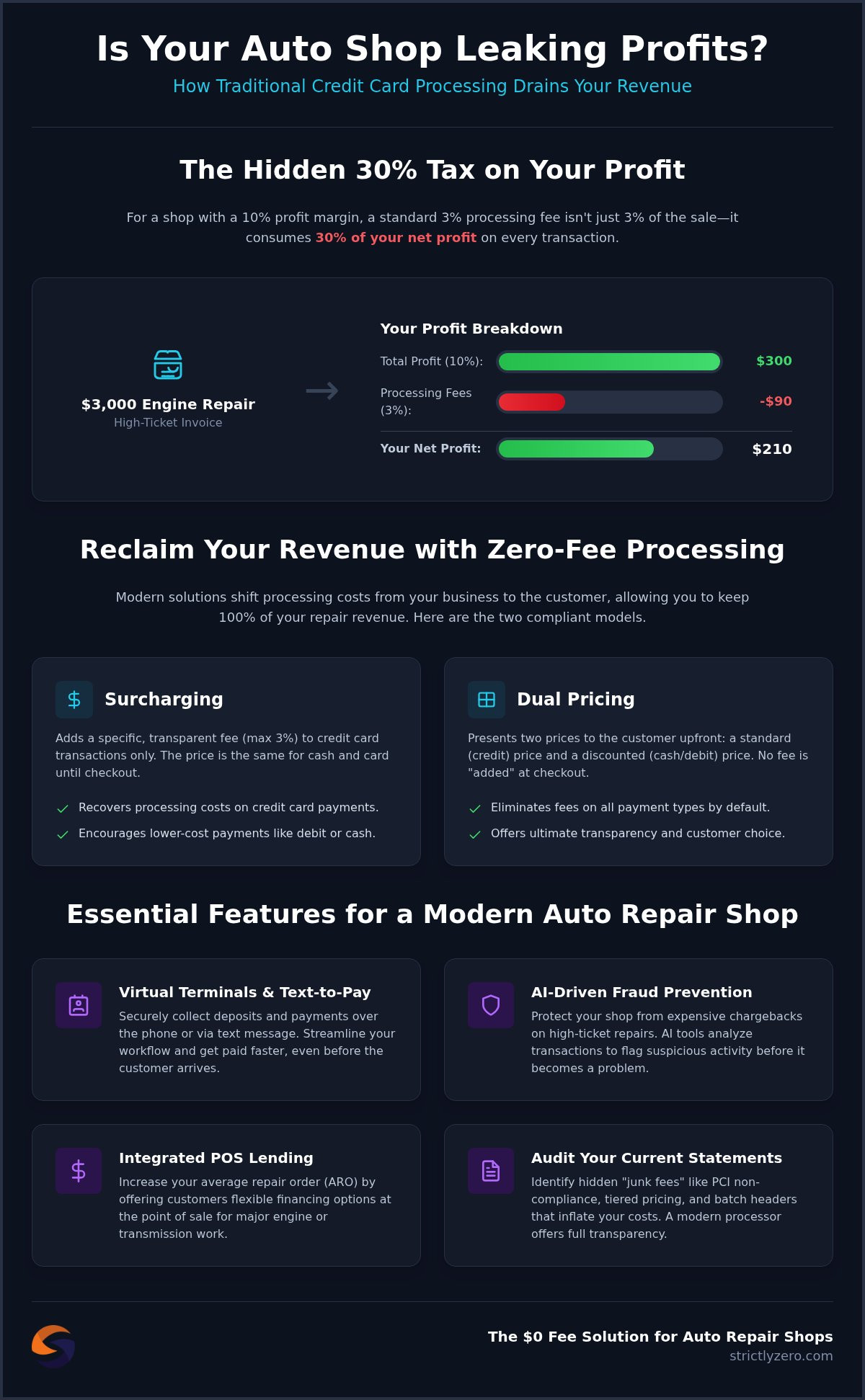
Most shop owners view credit card processing for auto repair shops as a fixed utility, much like electricity or water. This perspective is a costly mistake. If your shop is operating on the industry average profit margin of 8% to 10%, a 3% processing fee is actually siphoning off 30% or more of your net profit on every job. On a $3,000 engine replacement, that $90 fee is a direct hit to your bottom line. To accept these payments, every business needs a merchant account, but traditional providers often leverage the high-ticket nature of the automotive industry to inflate their own margins.
To better understand how these fees impact your bottom line, watch this helpful video:
The automotive industry is frequently classified as high-risk by processors. This isn’t a reflection of your business’s integrity; it’s a reaction to your high average ticket size and the frequency of chargebacks. When a customer is unhappy with a complex repair, they may bypass your service desk and go straight to their bank. Processors hedge against this risk by charging higher rates, often disguised through complex pricing models that favor the bank over the mechanic.
The High Cost of High-Ticket Repairs
Transmission and engine work often result in invoices exceeding $2,000. When you combine these high-ticket totals with traditional flat-rate pricing, you’re paying a massive premium. Many processors bump these transactions into “mid-market” or “non-qualified” tiers because they involve keyed-in data or high-end rewards cards. This skimming compounds over a year. A shop doing $100,000 in monthly volume could be losing $3,000 every month just to move money from the customer’s pocket to the shop’s bank account.
Hidden Traps in Standard Merchant Agreements
Standard merchant agreements are often riddled with “junk fees” that appear as small, innocuous line items. You’ll likely see charges for PCI non-compliance, monthly statement fees, and batch headers. These small amounts add up to thousands annually. Even more damaging is tiered pricing, where a low “teaser rate” only applies to basic debit cards. When a customer pays with a premium rewards card, the rate can jump to 3.5% or higher. If you’re searching for the cheapest credit card processing, you must look past the advertised percentage and find a partner that offers full transparency through interchange-plus pricing or a modern zero-fee model.
Zero-Fee Processing: Surcharging vs. Dual Pricing for Mechanics
Eliminating merchant fees requires a strategic shift in how you handle every transaction. For many, the answer lies in surcharging or dual pricing. These models allow you to maintain your margins without absorbing the cost of the customer’s choice to use a high-rewards credit card. Choosing the right credit card processing for auto repair shops means understanding the legalities and the psychology behind these two approaches. It’s about protecting your bottom line while keeping the customer experience smooth.
Surcharging is the practice of adding a specific percentage fee to a credit card transaction to cover the cost of processing. As of August 2026, the industry standard cap for these fees is 3%. While approximately 35% of small businesses in the U.S. now use this model, it’s not a free-for-all. You must follow strict rules to stay compliant. For example, you cannot surcharge debit or prepaid cards, even if the customer runs them as “credit” at the terminal. Violating these rules can lead to heavy fines or the loss of your merchant account.
How a Smart Surcharge Program Works
Modern technology has removed the guesswork from compliance. A smart pricing engine automatically detects the card type at the point of sale. If a customer dips a debit card, the system bypasses the surcharge entirely, ensuring you stay within card network rules. You’ll also need to meet specific disclosure requirements. This includes clear signage at your service desk and entry, notifying drivers of the fee before they pay. For a deeper look at how this works, check out this guide on zero fee credit card processing. If your shop is in Colorado, the system must also account for the state’s specific 2% cap, while shops in Maine, Massachusetts, or Connecticut must avoid surcharging altogether due to state bans.
Dual Pricing: The Ultimate Margin Protector
Dual pricing is often seen as the more customer-friendly alternative. Instead of adding a fee at the end, you present two distinct prices on your repair estimates: a cash price and a card price. This transparency helps avoid the “nickel-and-dimed” feeling that 87% of consumers report in recent surveys. It frames the lower cost as a cash discount rather than the higher cost as a penalty. Dual pricing is a model that offers a discount for non-card payments. By presenting the choice clearly on the invoice, you empower the customer while protecting your profit. Implementing a compliant surcharge and dual pricing engine ensures your shop stays profitable regardless of how your customers choose to pay.
Essential Payment Features for Modern Service Centers
Modern credit card processing for auto repair shops has evolved far beyond the plastic terminal sitting on your front desk. To stay competitive in 2026, your shop needs a software-first approach that meets customers where they are. This means moving away from the traditional model of waiting for a driver to physically arrive with a card in hand. By utilizing omni-channel tools, you can capture revenue faster and more securely than ever before.
Text-to-pay and digital invoicing have become standard expectations for the modern driver. Recent data shows that 92% of U.S. merchants now accept digital wallets; your customers want that same level of convenience for their car repairs. Sending a secure payment link via SMS allows a customer to review their final bill and settle the invoice from their office or home. It ensures the funds are in your account before they even walk through your door for pickup.
Virtual Terminals and Payment Links
A virtual terminal turns any computer or tablet into a secure payment hub. This feature is essential for taking deposits over the phone for special-order parts or high-ticket engine work. Using a virtual gateway provides a layer of security that simple phone-in orders often lack. It allows you to store a card on file securely, which is perfect for recurring fleet maintenance contracts or monthly service clubs. This digital-first approach also helps eliminate the 5 PM lobby rush. When customers pay in advance via a secure link, they can simply grab their keys and go. This frees up your service writers to handle new walk-ins and phone inquiries during your busiest hours.
POS Lending: Closing the Big Jobs
High-ticket repairs are the lifeblood of a profitable shop, but they’re often the hardest to close. When a customer is hit with an unexpected $5,000 transmission rebuild, they might feel forced to walk away. Point-of-sale (POS) lending changes that dynamic. As of 2026, 58% of U.S. merchants have adopted “Buy Now, Pay Later” or similar lending options to help customers manage large expenses. Integrating these financing choices directly into your payment flow allows you to offer instant options at the service desk. It turns a stressful emergency into a manageable monthly payment, helping you secure the job while ensuring your shop gets paid in full immediately. This is a critical tool for increasing your average ticket size without putting additional financial strain on your loyal customers.
How to Choose the Best Credit Card Processor for Your Shop
Selecting the right partner for credit card processing for auto repair shops requires more than just comparing a few percentage points. Many providers lure you in with a low teaser rate only to bury you in junk fees later. To find a solution that actually protects your margins, you need a structured evaluation process. Start by auditing your current merchant statements to find your true effective rate. You calculate this by dividing your total monthly fees by your total processing volume. If that number is significantly higher than the interchange rates mentioned earlier, it’s time to look for a more transparent payment processor.
Fraud Prevention and Chargeback Defense
High-ticket repairs like engine swaps make your shop a target for friendly fraud and legitimate disputes. You need AI-driven fraud detection that analyzes transaction patterns in real time to flag suspicious activity before the work begins. When a dispute does occur, your processor should act as your first line of defense. The right platform helps you win these battles by organizing documentation and repair orders into a compelling case for the bank. Chargeback protection should include automated evidence collection to save you hours of administrative work. This proactive approach ensures that a single unhappy customer can’t wipe out a week’s worth of profit.
Omni-Channel Flexibility
Your shop doesn’t just operate at the front desk. Modern credit card processing for auto repair shops must be flexible enough to handle payments in the bay, at the service counter, and even on the road. If you offer roadside assistance or mobile mechanic services, you need mobile processing that syncs perfectly with your main office records. An omni-channel approach ensures that whether a customer pays via a text link or a physical card, all data is unified in one reporting dashboard. This visibility allows you to track your daily “take-home” revenue without digging through multiple systems. To see how a modern platform can eliminate your fees and secure your transactions, get started with Strictly today.
Strictly: The $0 Fee Solution for Auto Repair Shops
Strictly stands out as the industry leader because it addresses the specific friction points of high-ticket automotive service. While other processors offer generic retail tools, Strictly provides a specialized surcharge and dual pricing engine designed to protect your 8% to 10% profit margins. By shifting the cost of transaction fees away from your business, you can keep 100% of your labor and parts revenue. This is the zero-fee revolution that modern mechanics need to thrive in 2026.
The complexity of credit card processing for auto repair shops often stems from varying state regulations. Strictly’s Smart Pricing Engine automates this compliance for you. If your shop is in Colorado, the system automatically applies the 2% surcharge cap. If you operate in Maine, Massachusetts, or Connecticut, the platform ensures you remain compliant with state-level bans. This automation removes the legal risk from your service desk, allowing your team to focus on fixing cars rather than studying payment laws.
Automated Compliance and Security
Security is paramount when handling $3,000 engine repairs or $5,000 transmission jobs. Strictly provides AI-driven fraud prevention as a default feature, protecting your shop from the high-risk nature of the automotive industry. Our platform adheres to strict PCI DSS security standards, ensuring that every transaction is encrypted and secure. This peace of mind extends to your customers, who can trust that their sensitive data is handled with professional care. By automating the evidence collection for potential disputes, we help you defend your revenue against unfair chargebacks without the administrative headache.
Getting Started with Strictly
Transitioning to a zero-fee model is simpler than most shop owners realize. The onboarding process for new merchants is streamlined to get you up and running quickly. Once your account is active, you gain immediate access to the virtual terminal and digital invoicing tools. You can start sending text-to-pay links and taking secure phone deposits on day one. Our API-first platform also allows for deep integration with your existing shop management systems, creating a unified workflow from the initial estimate to the final payment. It is time to stop letting merchant fees erode your hard-earned profits. You can eliminate your processing fees with Strictly today and start seeing the impact on your bottom line immediately.
Future-Proof Your Shop’s Bottom Line
The 3% fee on a major engine repair isn’t just a cost of doing business; it’s a significant portion of your take-home pay. By moving to a model that leverages compliant surcharging and dual pricing, you protect your margins on every high-ticket invoice. Modern tools like virtual terminals and text-to-pay links eliminate the 5 PM lobby rush while ensuring you get paid before the car even leaves the bay. Choosing the right credit card processing for auto repair shops means demanding more than just a lower rate. It’s about finding a partner that offers $0 Merchant Fees with Compliant Surcharging, AI-Driven Fraud Prevention, and Integrated POS Lending to help you close the biggest jobs.
Your shop deserves to keep every dollar of labor and parts revenue you’ve earned. Stop paying for your customers’ credit card rewards—Switch to Strictly Today. You’ve built a business based on trust and technical expertise. Now it’s time to back that up with a payment strategy that works as hard as your mechanics do.
Frequently Asked Questions
Is it legal to add a surcharge to credit card payments in my auto shop?
Surcharging is legal in 47 states as of August 2026. Only Maine, Massachusetts, and Connecticut currently prohibit the practice. To stay compliant, you must follow card network rules, which include a 3% cap on the surcharge amount and clear signage at your shop’s entrance and service desk. Using an automated engine ensures you follow these rules without manual errors.
How do I explain a surcharge fee to my customers without losing business?
Transparency is the most effective way to handle this conversation. Explain that the fee covers the high cost of processing premium rewards cards, which allows you to keep your hourly labor rates lower. Many shops offer a cash or check option to give customers a way to avoid the fee. This honesty builds trust and prevents drivers from feeling surprised at the register.
Can I surcharge debit card transactions at my repair shop?
No, surcharging debit cards is strictly prohibited by federal law and card network regulations. This rule applies even if the customer chooses to run their debit card as “credit” at your terminal. Implementing the right credit card processing for auto repair shops is vital because a smart system will automatically detect the card type and bypass the fee for debit users.
What is the difference between surcharging and dual pricing for mechanics?
Surcharging adds a percentage fee to the listed price when a credit card is used. Dual pricing displays two separate prices for every service: a lower price for cash and a higher price for cards. Dual pricing is legal in all 50 states and is often preferred by customers because it frames the price difference as a cash discount rather than a penalty.
How does text-to-pay help my auto repair business?
Text-to-pay allows you to send secure invoice links directly to a customer’s phone. This feature speeds up the 5 PM pickup rush because customers can pay for their repairs before they even leave their office. It also creates a secure digital record of the transaction, which is helpful for documenting authorization on expensive engine or transmission work.
Will my shop management software integrate with a zero-fee processor?
Most modern zero-fee platforms use API-first technology to sync with popular shop management systems. This integration ensures that when a customer pays their bill, the repair order is automatically updated in your records. It eliminates the need for double-entry and helps keep your bookkeeping accurate without extra administrative work from your service writers.
What happens if a customer disputes a high-ticket repair charge?
If a customer files a chargeback, your processor acts as your defense by gathering evidence like signed repair orders and digital payment logs. Advanced credit card processing for auto repair shops includes AI-driven fraud prevention to flag high-risk transactions before they happen. This proactive approach helps protect your shop’s revenue from “friendly fraud” on expensive repairs.
How quickly do I get my funds from a zero-fee processing model?
Most shops receive their funds within one to two business days after the transaction is batched. Some platforms offer next-day or even same-day funding options to help you manage your cash flow for immediate needs like parts orders and payroll. You should always verify the specific settlement schedule with your provider to ensure it meets your shop’s operational requirements.