

What if the convenience of your current payment processor is actually a “convenience tax” that’s quietly eroding your profit margins? For many merchants, the reality of paypal processing fees for business in 2026 has become a complex maze of 3.49% base rates and $0.49 fixed costs that punish small-ticket sales. When you add international surcharges and currency conversion spreads that can push effective rates toward 8%, that familiar “Buy Now” button starts to look like a liability rather than an asset.
It’s frustrating to watch your hard-earned revenue disappear into a black hole of opaque fees and ecosystem add-ons. We agree that you shouldn’t have to choose between customer trust and your own bottom line. This guide promises to help you master the 2026 PayPal fee structure while introducing a compliant framework to eliminate these costs entirely through a modern surcharge model. We will provide a clear breakdown of current pricing and show you the exact path to achieving $0 in processing fees without sacrificing the omni-channel experience your customers expect.
Key Takeaways
- Understand the 2026 flat-rate structure and why the $0.49 fixed fee disproportionately impacts low-value transactions.
- Identify hidden “ecosystem taxes” like the $20 chargeback fee and why PayPal doesn’t refund processing costs on customer returns.
- Learn how to neutralize paypal processing fees for business by implementing a compliant surcharge model that shifts costs away from your bottom line.
- Navigate the 2026 legal landscape of surcharging with an automated engine that handles state-by-state compliance and debit card detection.
- Audit your current effective rate to see how much you could save by switching to an omni-channel platform designed for margin preservation.
Breaking Down PayPal Business Fees in 2026: The “Convenience Tax”
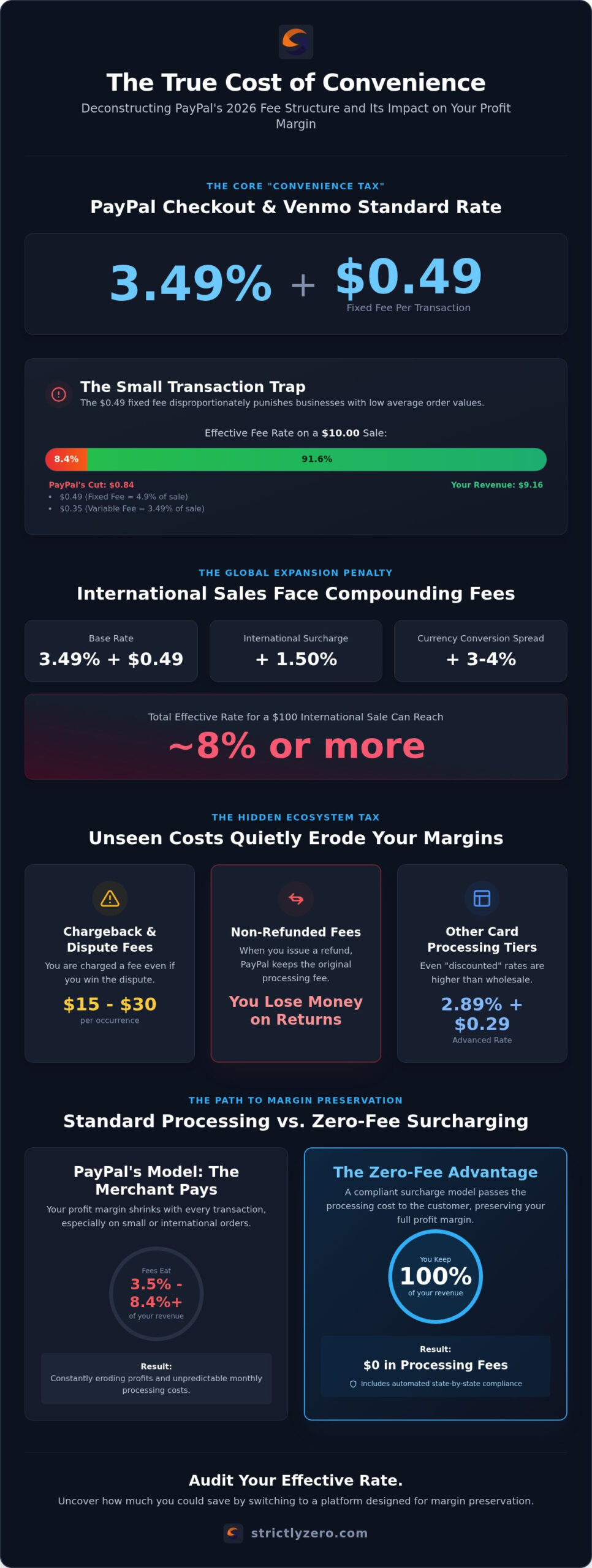
The 2026 fee landscape isn’t just complex; it’s designed to prioritize platform ease over merchant profitability. While many small businesses rely on the brand’s ubiquity, the actual paypal processing fees for business have settled into a high-cost flat-rate model. For most US-based merchants, the headline rate for PayPal Checkout or Venmo transactions is 3.49% plus a $0.49 fixed fee. This simplicity appeals to startups, but it creates a “convenience tax” that scales poorly as your volume grows. Understanding PayPal’s business model reveals a strategy built on capturing a percentage of every possible touchpoint, often at rates that dwarf traditional processing models.
The $0.49 fixed fee is particularly aggressive for businesses with low average order values. If you sell a digital product or a small accessory for $10, that fixed fee alone eats 4.9% of your revenue. When you add the 3.49% variable rate, your effective fee jumps to nearly 8.4%. This erosion of margins makes it difficult for micro-transaction businesses to survive or scale without significant price hikes. Because these fees are deducted before the funds ever hit your account, the true impact on your cash flow is often hidden until the end of the month.
Domestic vs. International Transaction Tiers
Selling across borders adds another layer of financial friction. On top of the domestic rates, PayPal applies a 1.50% international surcharge for commercial transactions. This isn’t where the costs end. If the transaction requires currency conversion, you’ll likely face the following compounding expenses:
- International Surcharge: A flat 1.50% added to the base transaction rate.
- Currency Conversion Spread: A hidden cost typically ranging from 3.00% to 4.00% of the transaction value.
- Fixed Fees: The standard $0.49 fee still applies, regardless of the currency used.
For a $100 international sale, these layers can push your total cost of acceptance toward 8% or more. This makes global expansion significantly more expensive than many merchants realize during their initial planning phases. The impact of “Market/Region” grouping also means your effective rate can fluctuate wildly depending on where your customers are located.
Standard Card Processing vs. Advanced Checkout
Even if you bypass the branded PayPal buttons, the costs remain steep. Standard credit and debit card payments via the platform typically carry a 2.99% + $0.49 rate. While these standard paypal processing fees for business are common, they are rarely the most cost-effective option for established companies. Some qualified merchants may access the Advanced Card Processing tier, which features a 2.89% + $0.29 rate. While this looks like a discount, it’s still significantly higher than the wholesale rates found in the wider processing market. These tiers keep your margins locked into a structure where the processor always wins, regardless of whether the customer uses a basic debit card or a high-reward credit card.
The PayPal Ecosystem Tax: Hidden Costs Beyond the Transaction
Beyond the visible transaction rates, the true cost of paypal processing fees for business is often buried in auxiliary charges that aggregate over time. Most merchants fail to calculate their “Effective Rate,” which represents the total of all fees divided by total sales volume. This number is frequently much higher than the advertised 3.49% because it includes dispute fees, withdrawal costs, and the fact that the original processing fee is not returned when you issue a refund. These micro-costs create an ecosystem tax that quietly erodes your profitability.
Dispute and Chargeback Management Costs
In 2026, dispute management has become a significant overhead for online sellers. PayPal applies a $15 fee for standard disputes, which escalates to $30 for merchants classified as “high volume.” If a dispute turns into a chargeback, you’ll face a $20 fee per occurrence. While Seller Protection is marketed as a safeguard, its strict eligibility requirements often leave businesses exposed to “unauthorized” reversals. Historical regulatory actions against PayPal highlight why merchants should be cautious about relying solely on platform-provided security. Many businesses now prefer AI-driven fraud prevention models that proactively block suspicious transactions rather than paying for reactive, fee-heavy protection.
Invoicing and Virtual Terminal Add-ons
Professional tools like digital invoicing and virtual terminals also carry premium price tags. Sending a professional invoice through the platform costs 3.49% + $0.49 per transaction. Virtual terminals, used for keyed-in payments over the phone, are often the most expensive way to process because they lack the security of a physical card or a branded login. For a comprehensive look at optimizing these channels, read our Credit Card Processing for Small Business: The 2026 Essential Guide.
The cost of accessing your capital adds a final layer of expense. Standard transfers might be free, but they often take several business days to reach your bank. If you need liquidity immediately, the instant withdrawal fee is 1.50% of the amount, with a minimum of $0.25 and a maximum of $15. When you combine these payout costs with the standard paypal processing fees for business, the total cost of ownership can become unsustainable. Moving your operations to a platform with a built-in surcharge and dual pricing engine allows you to reclaim these margins and keep more of what you earn.
PayPal vs. Zero-Fee Surcharging: The Math of Margin Preservation
When you stop looking at individual transactions and start looking at annual volume, the difference between a flat-rate model and a zero-fee model is staggering. For a single $1,000 order, standard paypal processing fees for business at the 3.49% + $0.49 rate cost you exactly $35.39. In contrast, Strictly’s model allows you to process that same $1,000 for $0.00 in merchant costs. This isn’t just a minor saving; it’s a fundamental shift in how you preserve your margins, especially for B2B companies and high-AOV service providers where fees can easily reach thousands of dollars per month.
High-ticket industries are particularly vulnerable to the percentage-based model. While a few cents on a coffee might seem negligible, a 3.49% haircut on a $5,000 contract is $174.50. By implementing a surcharge or dual pricing engine, you reclaim that revenue immediately. This approach ensures that your business isn’t footing the bill for the customer’s credit card rewards or travel points. Instead, you provide a transparent path for the customer to choose how they want to pay, whether through a low-cost method or a premium credit card.
The Smart Pricing Engine Advantage
The primary hurdle for many businesses considering a switch is the complexity of card types. You can’t legally surcharge debit cards, which is where many DIY models fail. Strictly’s Smart Pricing Engine solves this by automatically detecting card types in real-time. This ensures that credit card users pay the surcharge while debit card users are processed at the standard rate, keeping your business fully compliant. By removing the “Interchange” mystery, you gain a predictable financial model. For a deeper look at this shift, explore our guide on the Best Credit Card Processing for Small Business in 2026.
Customer Psychology: Surcharge vs. Cash Discount
Many merchants worry that shifting fees to the customer will drive them away. However, the 2026 consumer is increasingly familiar with “Dual Pricing” where they see a cash price and a credit price. This transparency actually builds trust because it stops the practice of hiding processing costs inside inflated product prices. While some debates exist regarding the legality of credit card surcharges and their impact on brand perception, a clear, compliant presentation at checkout often reduces cart abandonment. Providing multiple payment paths, such as ACH for lower-cost transfers or a credit option with a transparent surcharge, gives customers the power of choice.
Preserving your margin doesn’t require complex accounting. It requires a platform that understands that your revenue belongs to you, not your processor. By moving away from the “Convenience Tax” mentioned in previous sections, you’re not just saving money; you’re future-proofing your business against the next round of paypal processing fees for business hikes.
Compliance and Legalities of Surcharging in 2026
While the high cost of paypal processing fees for business is a known burden, many merchants hesitate to switch to surcharging due to fear of legal complexity. In 2026, the regulatory landscape has matured, providing a clear but strict framework for cost recovery. Surcharging is now legal in the vast majority of U.S. states, provided merchants follow specific disclosure and registration requirements. States like New York, California, and Florida have implemented updated transparency laws that require businesses to display the total price inclusive of the credit card surcharge or clearly list the dollar amount of the fee before the transaction is finalized.
Visa and Mastercard have also refined their merchant rules to ensure a level playing field. As of 2026, credit card surcharges are typically capped at 3% or the merchant’s actual cost of acceptance, whichever is lower. Failure to adhere to these caps or neglecting to register your surcharge program with the card brands can result in heavy fines or the termination of your merchant account. This is why many businesses stick with the “safe” flat-rate model of PayPal, even though it costs them significantly more in the long run. However, you don’t have to choose between legal safety and profitability.
The most critical rule in 2026 remains the absolute prohibition of surcharging debit cards. Under federal law and card brand regulations, debit and prepaid cards must always be processed without an added fee. Penalties for “debit surcharging” are severe and are often detected through automated audits by card networks. To stay safe, merchants need a system that can distinguish between a credit and debit card instantly at the point of sale or checkout. If you’re ready to move beyond the high-margin tax of paypal processing fees for business, you must ensure your new path is built on a foundation of automated compliance.
Automated 2026 Compliance Standards
Managing state-by-state compliance manually is nearly impossible for omni-channel sellers. Strictly’s Smart Pricing Engine manages this in real-time by identifying the customer’s location and the specific card type used. This automation ensures that your checkout process displays the required 2026 signage and notifications, keeping you on the right side of both state laws and Visa/Mastercard rules. By automating the detection of debit cards, you eliminate the risk of accidental non-compliance that often plagues manual surcharge setups.
Achieving a $0 Fee Outcome
Transitioning to a surcharge model isn’t just about cutting costs; it’s about implementing a professional, transparent system that your customers can trust. To understand the full transition process and how to maintain compliance while protecting your margins, see our guide on how to achieve a $0 processing fee outcome. If you’re tired of losing 3.49% of every sale, it’s time to switch to a compliant surcharge engine that does the heavy lifting for you.
Making the Switch: Moving from PayPal to Strictly
To break free from the cycle of high paypal processing fees for business, you must first quantify the impact on your specific volume. Start by performing a simple audit of your last three monthly statements. Divide the total fees paid by your total gross sales to find your true “Effective Rate.” Most merchants discover that while they expected to pay 3.49%, the reality is closer to 5% after fixed fees and ecosystem add-ons are tallied. This number represents the immediate margin you can reclaim by switching to a more efficient model.
Setting up a Strictly omni-channel account is designed to be a seamless transition for both online and mobile payments. Once your account is active, the primary step is integrating the Smart Pricing Engine into your existing checkout workflow. This technology replaces the “black box” pricing of legacy processors with a transparent system that identifies card types in real-time. Because Strictly doesn’t charge monthly software fees or hidden taxes for basic account maintenance, every dollar you save through the surcharge engine stays in your business bank account.
Transitioning Recurring Billing and Invoices
One of the biggest hurdles in switching processors is the fear of losing customer data. Strictly facilitates the migration of payment profiles, ensuring your recurring billing cycles remain uninterrupted. You can set up automated invoices and subscriptions that utilize the surcharge model, allowing you to maintain a $0 processing cost even on long-term contracts. For businesses with complex structures, the platform includes specialized tools for better management:
- ClearSplit™: Automates partner residuals so you don’t have to manually calculate payouts.
- ChurnIQ™: Provides deep insights into portfolio management and customer retention.
- AI-Driven Fraud Prevention: Protects your revenue from the disputes and chargebacks that often plague flat-rate processors.
Conclusion and Next Steps
The 2026 “Zero-Fee” revolution isn’t just a trend; it’s a necessary evolution for merchants who want to survive in a high-cost economy. By moving away from the convenience tax of traditional paypal processing fees for business, you’re choosing to value your own labor and expertise over the processor’s bottom line. You now have the breakdown of the current fee structures, the math behind the savings, and the compliance framework needed to succeed. The path to margin preservation is clear. Eliminate your processing fees today with Strictly and start keeping 100% of your credit card sales.
Reclaim Your Profit Margins in 2026
The landscape of digital payments has fundamentally shifted. Sticking with legacy paypal processing fees for business means accepting a permanent “convenience tax” on every sale you make. We’ve explored how the compounding effect of flat rates, fixed transaction costs, and hidden ecosystem add-ons can push your effective rates far beyond the advertised percentages. These costs don’t just eat your profits; they restrict your ability to scale and compete in a crowded market.
By moving to a modern omni-channel platform, you can utilize a smart pricing engine to automate 2026 state-by-state compliance and eliminate the mystery of credit card interchange fees. This transition ensures that your business remains legally protected while shifting the burden of processing costs away from your bottom line. It’s time to stop letting your processor dictate your profitability. You can stop paying PayPal fees and switch to Strictly today to eliminate 100% of your processing fees with full omni-channel support for all payment types. Your revenue belongs to you, and the tools to protect it are finally within reach.
Frequently Asked Questions
What are the PayPal business fees for 2026?
In 2026, the standard paypal processing fees for business include a 3.49% plus $0.49 rate for PayPal Checkout and Venmo transactions. If you use standard credit and debit card processing, the rate is 2.99% plus $0.49. Other specific methods like QR codes carry a 2.29% plus $0.09 fee. These rates don’t include international surcharges or currency conversion spreads, which add another 1.50% and 3.00% to 4.00% respectively to your costs.
Is it legal to pass PayPal fees to the customer via surcharging?
PayPal explicitly prohibits merchants from surcharging on transactions processed through their branded “Buy Now” or “Checkout” buttons. While credit card surcharging is legal in most U.S. states as of 2026, you cannot apply these fees to PayPal’s specific ecosystem products. To legally pass processing costs to customers, you must use a compliant third-party processor that supports surcharging on standard credit card transactions while following state-specific disclosure and notification requirements.
What is the difference between a surcharge and a cash discount?
A surcharge is an additional fee added to a transaction when a customer chooses to pay with a credit card. In contrast, a cash discount model presents a higher standard price and offers a lower price for customers who pay with cash or debit. Both models aim to protect merchant margins, but they require different disclosure methods. Dual pricing displays both costs side-by-side, providing the most transparency for 2026 consumers who want clear payment options.
Does PayPal offer a zero-fee processing option for merchants?
PayPal doesn’t offer a zero-fee processing option for merchants. Their business model is built on flat-rate and percentage-based fees that are deducted from every transaction before the funds reach your account. Because they don’t support a compliant surcharge engine for their branded services, merchants using the platform will always incur a cost. To eliminate these fees, you need an omni-channel processor specifically designed for cost recovery and margin preservation through a compliant surcharge model.
How does Strictly’s Smart Pricing Engine detect debit cards?
The Smart Pricing Engine uses real-time Bank Identification Number (BIN) lookups to instantly identify the card type during the checkout process. This technology distinguishes between credit cards, which can be legally surcharged, and debit or prepaid cards, which cannot. By automating this detection, the system ensures your business stays compliant with federal regulations and card brand rules without requiring manual intervention or risking accidental penalties. It’s the most reliable way to maintain 2026 compliance standards.
Can I use Strictly with my existing e-commerce website?
Yes, you can integrate Strictly with most existing e-commerce platforms and websites. The system provides omni-channel payment processing that works across online stores, mobile apps, and virtual terminals. This allows you to maintain your current digital storefront while upgrading your backend to a model that eliminates paypal processing fees for business. The integration process is designed to be straightforward, ensuring your customer experience remains smooth while your profit margins increase through automated cost recovery.
What is an “effective rate” and how do I calculate it?
Your effective rate is the actual percentage of revenue you lose to processing costs after all fees are counted. To calculate it, divide your total monthly fees, including fixed fees, dispute charges, and add-ons, by your total gross sales for that same period. For example, if you paid $500 in fees on $10,000 in sales, your effective rate is 5%. This number is often much higher than your advertised base rate due to fixed costs.
Are there monthly fees for the Strictly surcharge program?
Strictly doesn’t charge monthly software fees for its surcharge program. The platform is designed to be a zero-fee evolution of traditional processing, focusing on helping merchants recover 100% of their credit card costs. Unlike legacy processors that often hide ecosystem taxes in monthly subscriptions, this model prioritizes your margin preservation. You get access to the Smart Pricing Engine and omni-channel tools without the burden of recurring platform costs that eat into your monthly savings.