
Credit Card Surcharge Laws by State 2026: The Complete Merchant Guide
Published:

What if the 4% surcharge you’re charging today becomes a $5,000 legal violation because you missed a single update to credit card surcharge laws by state 2026? Most business owners feel like they’re playing an endless game of catch-up with payment processors and state legislatures. You want to keep your margins healthy, but the fear of a surprise audit from Visa or a letter from a state attorney general is a constant stressor. It’s frustrating when the rules change while you’re just trying to run a shop.
We’ve simplified this chaos by building a definitive roadmap to help you master the complex landscape of 2026 surcharge regulations. You’ll get the exact information needed to protect your revenue without accidentally breaking the law. This guide provides a clear “Yes” or “No” for your specific location, breaks down the January 2026 compliance updates, and gives you a checklist to eliminate processing fees entirely.
Key Takeaways
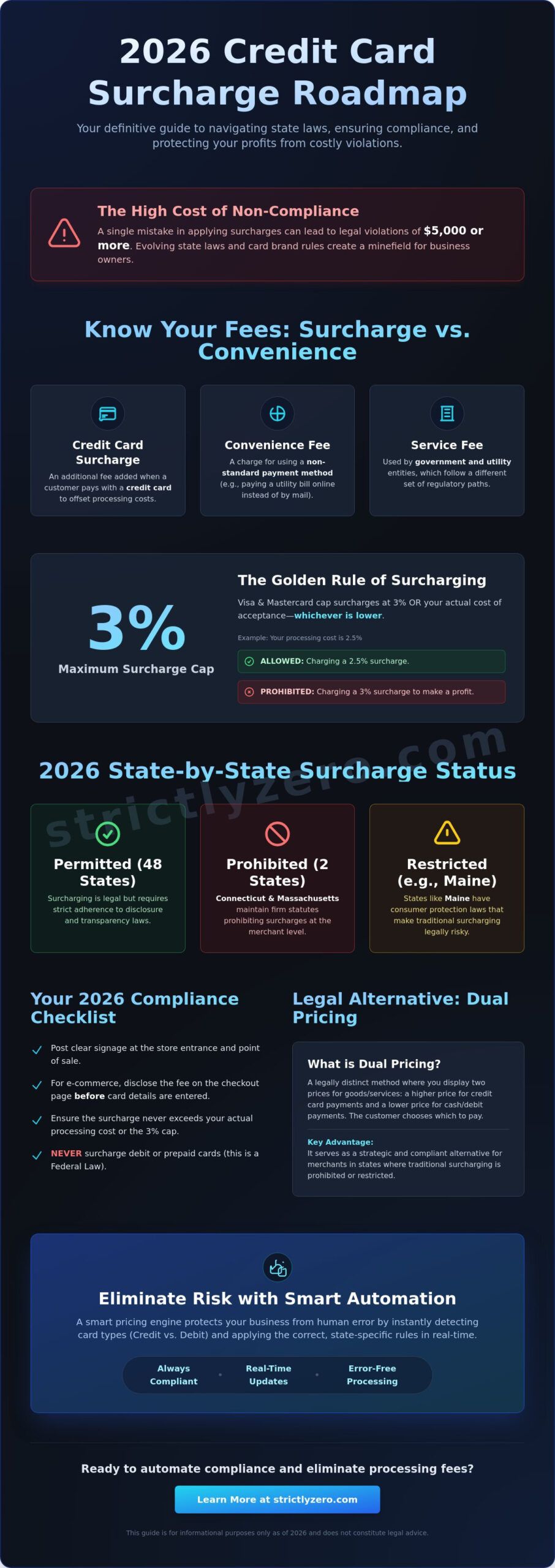
- Understand the critical legal distinctions between surcharges, convenience fees, and service fees to ensure your business uses the correct fee structure.
- Access a comprehensive breakdown of credit card surcharge laws by state 2026 to determine if your current pricing model is permitted, restricted, or prohibited.
- Learn how to navigate card brand compliance, including mandatory notice requirements and the federal ban on surcharging debit transactions.
- Discover why dual pricing serves as a strategic legal alternative for merchants operating in states where traditional surcharging is not an option.
- Find out how real-time automation can protect your business from compliance errors by instantly detecting card types and state-specific regulations.
Table of Contents
- What is a Credit Card Surcharge? 2026 Definitions
- 2026 State-by-State Surcharge Map: Restricted vs. Legal
- Federal Laws and Card Brand Compliance Checklist
- Surcharging vs. Dual Pricing: Which is Right for You?
- Automating Compliance with Strictly’s Smart Pricing Engine
What is a Credit Card Surcharge? 2026 Definitions
A credit card surcharge is an additional fee that a business adds to a transaction when a customer chooses to pay with a credit card. It’s a strategy used by merchants to offset the interchange fees and processing costs that banks charge for every swipe. Between 2024 and 2026, the legal landscape for these fees shifted significantly. While federal courts have largely protected the right to surcharge, states like New York and New Jersey implemented strict transparency laws in 2024 that set the standard for how businesses must display prices in 2026. Staying compliant with credit card surcharge laws by state 2026 requires a clear understanding of these evolving definitions.
The core benefit of this practice is the ability for a business to pass the cost of card acceptance directly to the consumer. This helps maintain profit margins, especially for small businesses operating on thin spreads. To grasp the foundational mechanics of What is a Credit Card Surcharge?, it’s helpful to view it as a cost-recovery mechanism rather than a revenue generator. By 2026, most states require that the “total price” including the surcharge be shown clearly before the customer reaches the checkout counter.
To better understand this concept, watch this helpful video:
Surcharge vs. Convenience Fees
Merchants often confuse surcharges with convenience fees, but they aren’t the same. A convenience fee is charged for the privilege of using a non-standard payment channel, such as paying an utility bill online when the standard method is via mail or in person. You cannot use both a surcharge and a convenience fee on a single transaction. Special rules apply to Business-to-Government (B2G) entities; utility companies and government agencies often use “service fees” which follow different regulatory paths than standard retail surcharges. Under credit card surcharge laws by state 2026, mixing these definitions can lead to heavy fines and audits.
The 3% Rule: Card Brand Caps in 2026
Major card brands like Visa and Mastercard have strict rules to prevent merchants from overcharging customers. In April 2023, Visa officially lowered its maximum surcharge cap from 4% to 3%, a move that Mastercard also followed. This 3% cap is a hard limit in 2026. You’re prohibited from charging a fee that exceeds your actual cost of acceptance. If your merchant account only costs you 2.5% to process, you can’t legally charge a 3% surcharge to make a profit. Surcharging is strictly for cost recovery, not for padding your bottom line.
As of 2026, the maximum permissible credit card surcharge rate is capped at 3% or the merchant’s actual cost of acceptance, whichever is lower.
2026 State-by-State Surcharge Map: Restricted vs. Legal
The legal environment for credit card surcharge laws by state 2026 is defined by a transition from total bans to complex transparency mandates. While most of the country has legalized the practice, the administrative requirements are becoming more rigorous. You can track these shifts through the 2026 State-by-State Surcharge Map, which highlights how 48 states now permit surcharging in some capacity. This shift followed several high-profile First Amendment court rulings that redefined surcharges as a form of “speech” regarding pricing.
Even in states where it’s legal, disclosure is mandatory. You must post clear signage at the entrance and at the register. If you run an e-commerce site, the disclosure must appear on the checkout page before the consumer enters their card details. The number of “No Surcharge” states is declining, but regulation is increasing to prevent “drip pricing” where fees are hidden until the last second. State attorneys general are increasingly focused on how these fees are presented to the public.
States Where Surcharging is Prohibited
Connecticut and Massachusetts remain the only states with firm, active statutes that prohibit credit card surcharging at the merchant level. Connecticut General Statutes § 42-133ff and Massachusetts General Laws c. 140D, § 28A are strictly enforced. Maine also maintains a unique posture for 2026. While Maine doesn’t have a ban as rigid as Massachusetts, its consumer protection laws make traditional surcharging risky for the average business owner. Merchants in these areas don’t need to eat the processing costs, though. They should implement dual pricing strategies. This allows you to offer a “cash price” and a “card price” without violating state-level surcharge bans.
States with Heavy Restrictions (NY, CA, CO)
California, New York, and Colorado have enacted specific laws that go beyond the standard card brand caps. California SB 478, which became fully enforceable by 2025, requires that any mandatory fee be included in the advertised price. You can’t list a price of $20 and then add a 3% surcharge at the register; the $20.60 price must be visible from the start. New York follows a similar “dollars and cents” rule. Under NY General Business Law § 518, you’re required to display the total cost of the item if paid by credit card. Colorado merchants face a different hurdle. While Visa and Mastercard allow up to 3%, Colorado law HB21-1289 caps the surcharge at exactly 2% or the merchant’s actual cost of processing, whichever is lower. Staying compliant in these states requires precise software that calculates these limits in real-time.
Federal Laws and Card Brand Compliance Checklist
Understanding credit card surcharge laws by state 2026 requires looking past local statutes to federal regulations and card brand mandates. Visa and Mastercard demand a 30 day notification period before a merchant begins surcharging. This isn’t a suggestion; it’s a contractual requirement. If you skip this notice to your acquirer, you risk immediate fines or merchant account closure. While state laws on credit card surcharges provide the legal framework for each jurisdiction, these card brand rules create the operational boundaries you must follow to stay in business.
Every transaction needs a clear paper or digital trail. The surcharge cannot be hidden in the item price. It must appear as a separate line item labeled clearly as “Credit Card Surcharge” or “Surcharge Fee” on the final receipt. In 2026, automated auditing software used by card brands can flag receipts that don’t show this breakdown, leading to automatic non-compliance penalties.
The Debit Card Trap
Surcharging a debit card is the fastest way to lose your merchant account. Federal law, specifically the Durbin Amendment, makes it illegal to surcharge debit transactions. It doesn’t matter if the customer chooses “credit” at the terminal or if it’s a “signature debit” transaction. Modern payment gateways in 2026 use Bank Identification Number (BIN) lookups to identify the card type in under 200 milliseconds. If your system isn’t programmed to block these fees automatically, you’re in violation. The legal consequences of “mismasking”—intentionally labeling a debit transaction as credit to bypass system blocks—include heavy fines from the CFPB and permanent blacklisting by card networks.
Signage and Disclosure Standards
Transparency is non-negotiable for compliance. You’ve got to display a notice at the point of entry and the point of sale. The wording must be exact. A sign should state: “We impose a surcharge of X% on credit card transactions, which is not greater than our cost of acceptance. We do not surcharge debit cards.” For e-commerce, this disclosure must appear on the checkout page before the final transaction is initiated. You can’t hide it in the terms and conditions. If you take orders over the phone, your staff must verbally state the fee before processing the payment. This ensures your business stays aligned with the evolving credit card surcharge laws by state 2026 and avoids costly consumer disputes.
Surcharging vs. Dual Pricing: Which is Right for You?
Choosing between a surcharge and dual pricing depends on your specific business model and your geographic location. While credit card surcharge laws by state 2026 continue to evolve, understanding the structural differences is vital for staying compliant. Surcharging adds a percentage fee, currently capped at 3% by major card networks, to a credit transaction at the point of sale. Dual pricing displays two distinct prices for every item: one for cash and one for card. This distinction is more than just semantics; it changes how customers perceive your brand and how you handle your accounting.
Dual pricing serves as a strategic workaround in jurisdictions where traditional surcharging faces strict regulations. By presenting a “cash price” and a “card price,” you aren’t adding a fee but offering a choice. This model complies with the strictest interpretations of best credit card processing for small business in 2026 because it avoids the “hidden fee” stigma. Psychology plays a massive role here. Data from 2024 consumer behavior reports suggests that 68% of shoppers prefer seeing a discount for cash rather than a penalty for using plastic.
The Benefits of Dual Pricing
Dual pricing offers universal legality across all 50 states. It eliminates the risk of violating credit card surcharge laws by state 2026 because the merchant isn’t technically “surcharging.” Retailers find this model easier to manage because modern POS systems handle the price toggle automatically. You don’t have to track specific surcharge line items for tax reporting; you simply record the total sale price based on the payment method used. This transparency leads to higher customer retention in high-traffic retail environments where speed and clarity are essential.
When Surcharging is Better (B2B)
Professional services and B2B companies often find the surcharge model more effective. When dealing with high-ticket invoices, a clear line item for a credit card fee is easier for accounting departments to track and categorize. If you’re managing ecommerce payment processing, a surcharge is often simpler to integrate into digital checkout flows than displaying dual prices for every SKU. For a $5,000 professional service fee, a 3% surcharge is a transparent cost of convenience that most corporate clients expect and accept without friction.
Ready to eliminate your processing costs legally? Find the right zero-fee solution for your business here.
Automating Compliance with Strictly’s Smart Pricing Engine
Staying compliant with credit card surcharge laws by state 2026 is a moving target that requires technical precision. Strictly’s Smart Pricing Engine acts as a digital shield, identifying the customer’s geographic location and card type at the millisecond of the transaction. This technology ensures your business never accidentally applies a fee in a prohibited jurisdiction or on a prohibited card type. Because state legislatures in places like New York and Colorado frequently update their disclosure requirements, having a system that adapts instantly is no longer optional for high-volume merchants.
Strictly’s platform uses automated Bank Identification Number (BIN) detection to identify debit cards before the transaction is finalized. Federal law, specifically the Durbin Amendment, prohibits surcharging on debit cards even if they are processed as “credit” transactions. By using this engine, you can recover the 3% to 4% typically lost to merchant services while ensuring every transaction remains within legal boundaries. This automation integrates directly with zero fee credit card processing, allowing you to offset transaction costs without the risk of merchant account termination or state-level fines.
Real-Time Compliance Updates
Relying on manual spreadsheets to track legislative changes is a massive liability. Over the last 24 months, several states have clarified their stance on how surcharges must be displayed to consumers, often requiring the total price to be shown inclusive of fees. Strictly’s Compliance-as-a-Service approach for 2026 provides a hands-off solution for businesses that can’t afford legal errors. You’ll enjoy total peace of mind knowing that automated BIN detection prevents the system from ever surcharging a debit card, keeping your business on the right side of federal and state regulations simultaneously.
Partnering for Success
Independent Sales Organizations (ISOs) and Merchant Service Providers (MSPs) rely on Strictly to deliver bulletproof programs to their merchant portfolios. Setting up credit card processing for small business requires a balance between cost savings and legal adherence. Strictly provides the infrastructure to maintain that balance without requiring the business owner to become a legal expert. The engine handles the complex math and the varying percentage caps dictated by credit card surcharge laws by state 2026, so you can focus on operations.
To protect your business from the complexities of evolving regulations, you need a partner that understands the technical nuances of payment law. Contact Strictly to automate your surcharge compliance today and start saving on every transaction while maintaining 100% legal integrity.
Future-Proof Your Business Against 2026 Compliance Risks
Navigating the evolving landscape of credit card surcharge laws by state 2026 requires more than just a passing glance at local statutes. States like New York and Connecticut maintain strict transparency mandates, while card brands like Visa and Mastercard updated their rules in April 2023 to enforce a 3% maximum surcharge cap. You can’t afford to guess whether a customer is swiping a debit or credit card at the register. Incorrectly applying fees to debit transactions is a direct violation of federal law and can lead to immediate merchant account termination.
Success in the coming year relies on precision and automation. You must distinguish between card types at the point of sale and adjust rates based on the customer’s specific geography in real time. Strictly’s Smart Surcharge Engine handles these complexities for you by providing automated state-by-state compliance, real-time BIN-level debit detection, and transparent 2026-ready reporting. It’s time to stop worrying about shifting regulations and start focusing on your bottom line.
Eliminate your processing fees legally with Strictly’s Smart Surcharge Engine
Protect your margins while staying on the right side of the law. You’ve got the tools to grow your revenue without the headache of manual compliance tracking.
Frequently Asked Questions
Is it legal to surcharge credit cards in California in 2026?
Yes, it’s legal to surcharge credit cards in California. While the state previously had a ban, the 2018 court ruling in Italian Colors v. Becerra made that ban unenforceable. You must still follow strict disclosure requirements and ensure your fees don’t exceed the 3% limit set by card networks.
Can I surcharge a debit card if the customer chooses “Credit” on the terminal?
No, you cannot surcharge a debit card under any circumstances. Federal law and card network rules prohibit fees on debit transactions, even if they’re processed as credit. If you charge a fee on a debit card, you risk heavy fines and the immediate termination of your merchant account.
What is the maximum percentage I can charge as a surcharge in 2026?
The maximum surcharge allowed is 3% of the total transaction value. This cap was officially lowered from 4% on April 15, 2023, by major card networks like Visa and Mastercard. Staying updated on credit card surcharge laws by state 2026 ensures your business doesn’t collect more than your actual processing costs.
Do I need to notify my merchant bank before I start surcharging?
You must notify your merchant bank and the major card networks at least 30 days before you implement a surcharge program. This written notice is a mandatory requirement for compliance. Most processors provide a specific form or online portal to help you submit this notification correctly.
What happens if I surcharge in a state where it is prohibited?
Surcharging in a prohibited state like Connecticut or Massachusetts can result in civil penalties of $500 per violation. Beyond government fines, card networks can revoke your ability to accept credit cards entirely. These states maintain active bans that override general network permissions, so you must verify local statutes first.
What is the difference between a surcharge and dual pricing?
A surcharge adds a fee to the advertised price at checkout, while dual pricing displays two distinct prices for every item. Dual pricing shows both a cash price and a credit card price clearly on the tag or menu. Many businesses choose dual pricing because it simplifies compliance with credit card surcharge laws by state 2026.
Does New York law require me to show the total price including the surcharge?
Yes, New York law requires you to display the total “credit card price” clearly for every item. Since the law update on February 11, 2024, merchants can’t simply post a sign mentioning a percentage fee. You must show the exact dollar amount the customer will pay if they choose to use a credit card.
Is surcharging legal for online e-commerce transactions?
Surcharging is legal for online transactions as long as you follow the same disclosure rules as physical stores. You must display the surcharge amount on the final checkout page before the customer clicks the “pay” button. Your e-commerce platform’s software must also be able to distinguish between credit and debit cards to avoid illegal fees.