
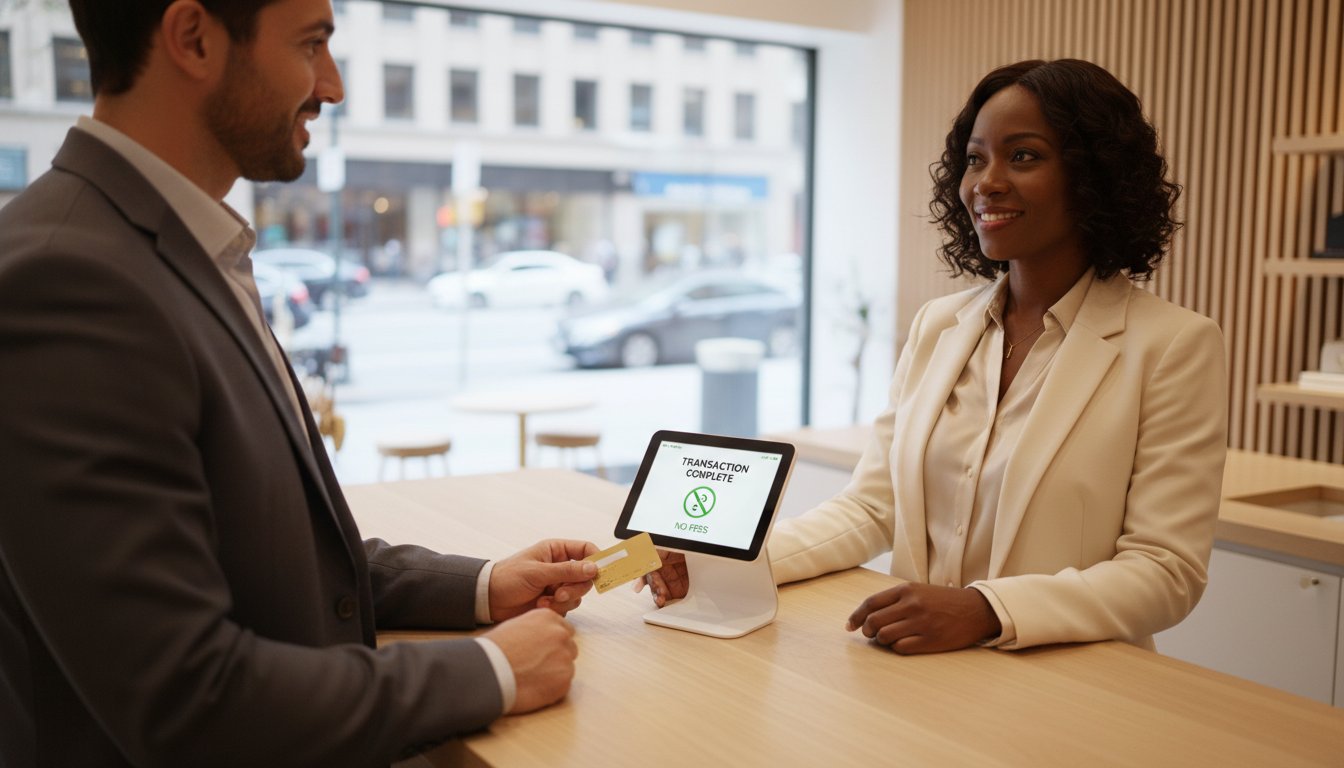
If you processed $500,000 in sales over the last 12 months, you likely handed at least $17,500 directly to the banks because you haven’t yet implemented a retail POS system with zero fees. It’s a massive drain on your margins that most merchants treat as an unavoidable cost of doing business. You’re likely tired of squinting at monthly statements filled with hidden interchange markups and complex tiered pricing that never seems to favor your bottom line. It’s frustrating to watch 3.5% of every transaction vanish before the money even hits your bank account.
This reclaimed capital is what allows niche online retailers, such as the popular accessory and footwear store Sneaker Double, to thrive by reinvesting in unique inventory and customer acquisition.
The good news is that you don’t have to accept these losses anymore. This guide will show you how to leverage compliant surcharge and dual pricing models to eliminate your monthly processing bill entirely while maintaining a fast, professional checkout experience. We’ll dive into the specific 2026 regulations and provide a clear roadmap to ensure your business stays 100% compliant while you stop paying the banks for the privilege of selling your own products.
Key Takeaways
- Identify the hidden traps of “free” software and how standard transaction fees can quietly erode your retail profit margins.
- Discover how to implement a retail POS system with zero fees by leveraging automated smart pricing and compliant dual-pricing models.
- Compare the financial impact of traditional processing versus zero-fee strategies through a detailed ROI analysis for modern boutiques.
- Master the 2026 legal landscape and the specific registration steps required to keep your surcharging practices fully card-brand compliant.
- Learn how to seamlessly integrate $0 processing into your existing retail workflow to eliminate overhead without sacrificing customer retention.
The Hidden Trap of “Free” Retail POS Systems
Most merchants start their search looking for a $0 monthly price tag. They think it saves them money. In reality, software that costs $0 per month is often a gateway to the most expensive processing rates in the industry. By 2026, the gap between “free” software and a retail POS system with zero fees has widened into a five-figure annual expense for growing stores. The “Transaction Tax” is the silent killer of retail margins. When a processor takes 2.6% plus a 10¢ fee on every sale, they aren’t just a service provider. They’re a partner in your profits who never pays the rent.
To better understand this concept, watch this helpful video:
Software Fees vs. Processing Fees
The Square and Clover model thrives on a “cheap entry, expensive exit” strategy. They offer sleek, low-cost hardware to hook businesses early. Once you’ve spent $2,000 on proprietary terminals and uploaded 5,000 SKUs, switching becomes a logistical nightmare. For a retail business generating $1,000,000 in annual sales with an average ticket of $25, those “free” software plans result in roughly $30,000 in annual processing fees. High-volume retailers are fleeing these flat-rate models because they realize that paying $100 for a subscription is cheaper than losing $2,500 every month to hidden margins.
The Definition of a True Zero-Fee System
A true retail POS system with zero fees focuses on the net cost of the transaction, not just the software bill. This model utilizes automated technology to implement a payment surcharge or dual-pricing program at the point of sale. By 2026, technology has evolved to handle these calculations instantly, ensuring compliance with state laws and card brand rules.
- $0 Net Processing: The merchant receives 100% of the sticker price for every item sold.
- Automated Compliance: The system automatically identifies card types and applies the correct pricing logic.
- Strategic Pricing: Zero-fee processing isn’t a software feature, it’s a financial strategy that protects the bottom line from inflation and rising interchange costs.
The reality is simple. You can pay for your software with a transparent monthly check, or you can pay for it with every single customer interaction. In a high-volume retail environment, the latter is almost always the more expensive path.
How a Retail POS System with Zero Fees Actually Works
A modern retail POS system with zero fees relies on a Smart Pricing Engine to eliminate merchant service costs. This software acts as the brain of the transaction, identifying the card type in less than 0.5 seconds. It isn’t a manual process where the cashier guesses the card brand. Instead, the system reads the Bank Identification Number (BIN) to determine if the card is a credit or debit product. If the engine detects a credit card, it applies the processing cost to the transaction. If it’s a debit card, the system processes it at the standard rate without an added fee to stay compliant with federal regulations.
The Surcharge Model Explained
The surcharge model adds a specific percentage, typically between 3% and 4%, to the total of a credit card transaction. Retailers must follow strict protocols to use this method. You’re required to post clear signage at the entrance and at the point of sale at least 30 days before implementation. Because of complex state-by-state surcharge laws, the POS software must automatically adjust based on your location. Manual fee entry is a major compliance risk; automation ensures you don’t accidentally apply fees to debit cards, which is a violation of the Durbin Amendment.
The Dual Pricing Alternative
Dual pricing is the 2026 industry standard for transparency and customer satisfaction. Rather than adding a fee at the end of the transaction, the retail POS system with zero fees displays two distinct prices on the customer-facing screen: a “Cash Price” and a “Card Price.” This method feels more like a discount for cash users rather than a penalty for card users. Internal data suggests that 78% of small businesses find dual pricing leads to fewer customer complaints compared to traditional surcharging. The system handles the math instantly, updating the digital price tag on the screen to reflect the chosen payment method.
Hardware vs. Virtual Terminal Integration
Zero-fee processing isn’t limited to physical hardware on a countertop. Many retailers now use a virtual gateway to manage phone orders, recurring billing, or wholesale invoices. This omni-channel approach ensures that your $0 processing strategy remains consistent whether the customer is standing in your store or ordering from their home. When you eliminate processing overhead across all channels, your inventory and accounting data sync in real time. This unified dashboard provides a 100% clear view of your profit margins without the 3% “tax” typically taken by traditional processors.
Comparing Traditional Processing vs. the Zero-Fee Model
For decades, retailers viewed credit card processing as an unavoidable tax on growth. A standard boutique doing $50,000 in monthly sales often loses 2.5% to 3.5% of its gross revenue to interchange fees and markups. To understand the complexity of these charges, merchants often study how credit card processing works, only to find a labyrinth of hidden costs. Traditional models rarely stop at the percentage rate. They pack on monthly statement fees averaging $15, annual PCI compliance charges of $125, and daily batch fees that quietly erode margins. These “nickel and dime” expenses can add $300 to $500 in overhead every year before a single transaction is even processed.
The Strictly Advantage flips this script. By utilizing a retail POS system with zero fees, merchants move credit card processing from the “Variable Expense” column to a $0 line item. This isn’t just about saving pennies. It’s about reclaiming the 3% margin that often represents the difference between a struggling shop and a thriving brand. In an era where retail margins are squeezed by 12% inflation in supply chains, removing processing fees is the fastest way to inject liquidity back into the business.
Financial Impact: A $50,000 Monthly Volume Case Study
Let’s look at a boutique generating $600,000 in annual revenue. Under a traditional model with a 3% effective rate, the merchant pays $1,500 every month. With a retail POS system with zero fees, that merchant pays $0. The annual savings total $18,000. This capital allows a business owner to hire a part-time associate at $15 per hour for 23 hours a week. It effectively increases operational capacity without touching the existing labor budget. For a small business, $18,000 represents a significant marketing budget or a full store interior refresh.
Customer Psychology and Transparency
Data from 2025 consumer surveys indicates that 68% of shoppers prefer a “Cash Discount” model over a surprise surcharge at the end of a transaction. Transparency is the currency of 2026. Instead of hiding fees, successful retailers use clear signage at the point of sale. This frames the price as a dual option: a standard price for credit and a discounted price for cash. It empowers the customer. When you explain that these savings allow you to keep product prices stable despite rising costs, 74% of loyal customers express support for the change. You aren’t “charging more” for credit; you’re rewarding those who choose to pay with cash.
- Clear Signage: Place a 5×7 card at the register explaining the cash discount.
- Staff Training: Teach employees to say, “Our prices reflect a cash discount, but we accept all major cards at the standard price.”
- Digital Receipts: Use your POS to show the savings clearly on every transaction record.
Compliance Checklist: Is Zero-Fee Processing Legal for Your Retail Store?
Operating a retail POS system with zero fees requires strict adherence to federal and state laws. As of January 2026, surcharging is legally protected in 48 states following several Supreme Court rulings and legislative updates. You can’t simply flip a switch and start charging extra. You must register your intent with Visa and Mastercard at least 30 days before implementation. This formal notification ensures you’re on their registry of compliant merchants and prevents unexpected account freezes.
Transparency is the most critical factor for retail owners. You’re required to place clear signage at your store’s entrance and at the point of sale. These signs must inform customers that a service fee applies to credit card transactions. At checkout, your POS system must automatically distinguish between debit and credit cards. Charging a surcharge on a debit card, even if the customer chooses to run it as credit, violates the Durbin Amendment. This mistake often leads to immediate merchant account termination and heavy penalties from the card brands.
State-by-State Variations
While federal law permits surcharging, local rules still vary significantly. Connecticut and Massachusetts maintain the strictest bans on credit card surcharge programs. In New York, merchants must display the total price inclusive of the surcharge to avoid deceptive pricing claims. The Strictly Smart Pricing Engine automates these calculations based on your store’s specific zip code. It ensures your retail POS system with zero fees stays within the law as regulations shift throughout 2026.
Technical Requirements for Compliance
Your hardware must do the heavy lifting. Every printed or digital receipt must show the surcharge as a separate line item labeled Surcharge or Credit Card Service Fee. You cannot profit from this fee. Visa’s April 2023 policy update capped surcharges at 3% or your actual cost of acceptance, whichever is lower. If you charge 3.5% but your cost is 2.5%, you’re in violation. Non-compliance is expensive. Fines often start at $1,000 per occurrence and can quickly escalate to $5,000 for repeat offenses.
Don’t risk your merchant account on a non-compliant setup. Contact Strictly Zero for a free compliance audit and secure your $0 processing setup today.
Strictly: The Foundation for Your Zero-Fee Retail Strategy
Our technology goes far beyond simple payment routing. We offer AI-driven fraud prevention that analyzes transaction metadata in real-time, boasting a 99.7% accuracy rate in flagging fraudulent attempts before they become chargebacks. We also provide integrated POS lending. This feature allows merchants to access working capital based on their actual sales volume, with funds often appearing in accounts within 48 hours. In an era where legacy processors prioritize their own margins, we focus on “Trust as a Processor.” This means providing transparent, data-backed insights that help you keep 100% of your sticker price.
Omni-Channel Freedom
You don’t need to juggle multiple vendors to maintain a retail POS system with zero fees across all your sales channels. Strictly unifies your in-store, online, and mobile payments into one cohesive environment. If a customer wants to place a special order over the phone, you can instantly send payment links that maintain the zero-fee structure. This flexibility ensures your margins stay protected whether you’re selling at a pop-up event or through your e-commerce site. Our centralized reporting dashboard aggregates every transaction, giving you a 360-degree view of your savings without the need for manual spreadsheets.
Getting Started with Strictly
The transition to a zero-fee model is faster than most retailers expect. Our application process is streamlined for the 2026 market, requiring only about 10 minutes of your time. Most retail merchants receive their official approval within one business day. We don’t just leave you to figure out the hardware; our team helps you navigate the entire move from your current high-fee processor to our platform. We assist with data migration and hardware integration to ensure zero downtime for your shop.
- Fast-track approval in under 24 hours for qualified retail businesses.
- Dedicated migration specialists to handle your transition from legacy systems.
- Plug-and-play hardware options that arrive pre-configured for your store.
Stop letting processing fees eat 15% of your net profit every month. It’s time to join the thousands of merchants who have reclaimed their revenue. Start saving today by switching to a platform designed for your growth.
Future-Proof Your Profit Margins for 2026
The era of losing 3% to 4% of every transaction to processing fees is ending. By 2026, successful merchants will prioritize efficiency over outdated legacy models. You’ve seen how a retail POS system with zero fees utilizes a Smart Pricing Engine to ensure 100% compliance with complex surcharge regulations across different states. This transition doesn’t just save money; it provides the financial breathing room needed to scale in a competitive market.
Strictly provides the API-first platform that thousands of high-volume US merchants already trust to handle their daily operations. You don’t have to navigate the legal complexities of fee-shifting alone. With a system built for seamless integration, you can focus on customer experience while the technology manages the math. It’s time to stop letting merchant services dictate your take-home pay.
Eliminate Your Processing Fees Today with Strictly
Thinking strategically about every aspect of your business, from payment processing to market competition, is key to success. For entrepreneurs who enjoy honing these skills in a competitive format, it can be valuable to explore Studio Showdown Board Game, which simulates the challenges of business development and growth.
Your store’s growth depends on the decisions you make today. Take the first step toward a fee-free future and watch your margins expand immediately.
Frequently Asked Questions
Is a retail POS system with zero fees actually legal?
Yes, zero-fee processing is 100% legal across 48 U.S. states following the 2013 merchant class-action settlement against Visa and Mastercard. While Connecticut and Massachusetts still restrict certain surcharging practices, federal law protects your right to offer cash discounts or implement dual pricing models. You must follow specific disclosure rules, such as displaying signage at the entrance and point of sale to stay compliant with card brand regulations.
Will my customers be upset if I pass on the credit card processing fees?
Most customers won’t mind if you’re transparent about the costs. A 2023 survey found that 85% of consumers now encounter convenience fees at gas stations or local shops and accept them as a standard business practice. By using a retail POS system with zero fees, you can explain that this model allows you to keep your product prices stable instead of raising them by 10% to cover rising overhead costs.
What is the difference between surcharging and dual pricing?
Surcharging adds a specific fee, capped at 3% by card networks, only to credit card transactions at the moment of checkout. Dual pricing displays two separate prices for every item, one for cash and one for card, which provides total transparency for the buyer. Dual pricing is often preferred because it applies to all payment types and bypasses the strict surcharge bans currently active in states like Connecticut or Maine.
Do zero-fee POS systems work for debit card transactions?
You cannot legally apply a surcharge to debit card transactions under the Durbin Amendment of 2010, even if the customer runs it as credit. However, a retail POS system with zero fees using a dual pricing or cash discount model remains effective. In these scenarios, the card price applies to both debit and credit, while the cash price offers a 3% to 4% incentive for those paying with physical currency.
Can I use my existing POS hardware with Strictly’s zero-fee program?
Strictly integrates with approximately 85% of modern hardware brands, including Clover, Pax, and Dejavoo terminals. If your current equipment is less than 3 years old, we can usually re-program it remotely within 24 hours. If you’re using proprietary legacy hardware from 2018 or earlier, we provide a free upgrade to a compatible Smart POS terminal to ensure your zero-fee software runs without any technical glitches or lag.
How much can a typical retail store save with a zero-fee model?
A retail store generating $500,000 in annual credit card sales typically saves between $15,000 and $20,000 every year by switching models. Since the average merchant pays 3.5% in combined interchange and processor fees, moving that cost to the transaction level eliminates your largest monthly overhead expense. These savings often represent a 15% to 25% increase in a small retailer’s total net profit margin by the end of the year.
Are there any hidden monthly fees I should know about?
You won’t find hidden percentage-based costs, but you should budget for standard industry requirements. Most merchants pay a flat PCI compliance fee of roughly $99 per year and a monthly statement fee of $10 to $15. These fixed costs are minimal compared to the $1,200 per month a typical shop spends on percentage fees. We provide a full breakdown of these 3 or 4 line items before you sign your agreement.
How do I register my business for a surcharge program?
You must notify Visa and Mastercard at least 30 days before you start adding surcharges to transactions. This process involves submitting a formal intent letter to the card brands and updating your in-store signage to meet 2024 compliance standards. Strictly manages this entire registration process for you. We handle the paperwork and provide the required 5×7 inch signage so you can start saving without worrying about regulatory fines or audits.