

The strictest checkout isn’t always the safest one. A blanket rule that blocks suspicious-looking orders may also turn away legitimate customers, so preventing ecommerce fraud takes more than adding friction at checkout.
If you’re weighing chargebacks and unauthorized transactions against false declines and extra work for your team, that trade-off is real. Strong controls matter, but they need to fit your products, customers, and level of risk. Too little scrutiny can leave gaps; too much can cost you good sales.
This practical guide shows how to build a layered fraud-prevention process without treating every order as equally risky. You’ll learn how to assess risk across the customer journey, choose proportionate checks, and keep checkout moving for legitimate buyers. We’ll also cover how to compare fraud-prevention tools and providers, including the features, integrations, configuration options, reporting, and responsibilities to verify before making a decision.
Key Takeaways
- Preventing ecommerce fraud works best as a layered process that accounts for risk across the payment journey, not a single checkout rule.
- Compare rule-based checks, manual review, authentication, and automated risk tools by their use case, workload, and potential customer friction.
- Start by mapping payment channels, typical order patterns, disputes, and the time your team can spend reviewing flagged transactions.
- Shortlist prevention solutions based on your sales channels and systems, then verify their features, integrations, reporting, and implementation responsibilities.
- Strictly offers AI-driven fraud prevention within an omnichannel payment processing platform. Assess its capabilities against your needs before deciding.
What Preventing Ecommerce Fraud Means for Your Store
Every merchant balances three concerns: fraudulent orders that can cost time and inventory, checkout checks that may frustrate shoppers, and the staff hours needed to review suspicious activity. Preventing ecommerce fraud isn’t about rejecting every order that looks unusual. It means choosing checks that help protect the business while allowing legitimate purchases to move forward.
Ecommerce fraud prevention is the coordinated use of checks and responses to identify, assess, and address suspicious activity across the payment journey. Prevention puts checks in place before a loss occurs. Detection flags activity that may need attention, and investigation gathers context to help decide what to do. Dispute handling comes later, when a customer challenges a completed transaction.
For a broader foundation, Internet fraud prevention covers common forms of online fraud and general approaches to reducing risk.
For a practical overview, watch this video from The Reach Network:
Which ecommerce fraud risks should merchants understand?
Unauthorized card use happens when someone pays with card details they aren’t permitted to use. Account takeover involves gaining access to a customer’s account, often to place orders or misuse saved information. Payment abuse can also include disputes over valid purchases or attempts to exploit refunds and other store policies. Your exposure depends on factors such as the products you sell, your sales channels, and the steps customers take from checkout to fulfillment.
A mismatch between billing and delivery details, an unfamiliar device, or an unusual order size can be a clue, but none proves fraud. A customer might be travelling, buying a gift, or using a new device. Consider each signal alongside the rest of the order, and avoid treating one difference as a definitive verdict.
Why can aggressive fraud blocking hurt a store?
A legitimate order can resemble a risky one. A first-time customer may make a large purchase, or a returning shopper may change their delivery address. If a store automatically blocks every order that triggers a concern, it can decline genuine customers and leave them confused or frustrated. Additional verification can also interrupt checkout, so match the level of scrutiny to the order and its context.
The guiding principle is proportion. Use checks to inform decisions rather than replacing judgment with a blanket rule. To apply that principle, consider how controls can work together across the payment process.
How Ecommerce Fraud Prevention Works in Layers
A payment moves through several decision points. At checkout, your store or payment setup collects details such as the amount, billing and shipping information, and payment credentials. The transaction is then sent for authorization, where the relevant payment participants return an approval or decline. Authorization confirms whether a payment can proceed; it doesn’t, by itself, prove that the person placing the order is the rightful buyer. Depending on your setup, you may also review an order before fulfillment.
Layered controls add checks at appropriate points instead of relying on one signal or a single yes-or-no rule. For example, an address check might prompt a closer look, while an authentication step or staff review adds context before an order is released. Fraud signals are most useful when assessed together, not in isolation. No combination guarantees that every fraudulent order will be caught, and the data and tools available vary by processor and merchant configuration.
What signals may help identify a risky transaction?
Billing and shipping details that don’t match, an order pattern that differs from a customer’s usual activity, or unexpected changes in account behavior may warrant attention. They’re clues, not proof: a gift purchase or a move could explain an address difference. Address verification compares submitted billing details with information held by the card issuer, while a card security code provides another check. Neither establishes who is placing the order or authenticates every buyer.
Device information, transaction velocity (how frequently attempts occur), and location data may also help some systems assess risk. Ask providers which signals are available in your setup, how they affect a decision, and what happens when data is missing or unclear. If a system flags an order, confirm whether your team can see the reason for the flag before deciding whether to review, verify, or decline it.
Where do authentication and payment security fit?
EMV 3-D Secure is an authentication approach for online card payments. Depending on the implementation and transaction, it may involve an additional customer step or a less visible assessment. Availability and details can vary, so confirm how it works with your payment provider and the relevant card participants. For a deeper look at multifactor authentication in ecommerce, consult this NIST guide on Multifactor Authentication for E-Commerce.
Keep authentication distinct from payment-data security and order-risk decisions. PCI DSS is a security standard for protecting payment account data; it isn’t a tool for deciding whether a specific order is fraudulent. Check current requirements and guidance with the PCI Security Standards Council and your payment partners. If you’re reviewing fraud prevention as part of a broader payment workflow, you can also explore Strictly’s AI-driven fraud prevention and verify which capabilities fit your setup.
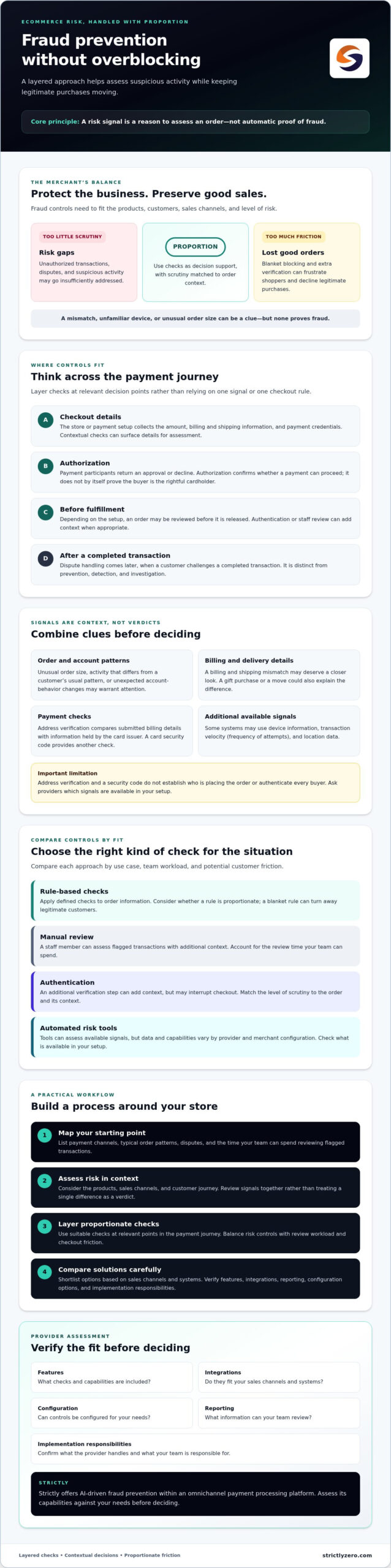
Comparing Ecommerce Fraud Controls Without Overblocking Customers
Stronger checks don’t automatically produce better decisions. A strict rule may stop a suspicious order, but it can also decline a genuine customer. The aim of preventing ecommerce fraud is to apply a level of scrutiny that fits the order’s context while keeping review work manageable.
Use this comparison to identify trade-offs, then confirm how each option works with your processor and store setup.
| Control | Best suited to | Operational effort | Potential customer friction | Questions to verify |
|---|---|---|---|---|
| Rule-based checks | Applying clear conditions, such as flagging orders above a chosen value | Requires staff to set, monitor, and update rules | Can be low if rules flag orders for review, higher if they automatically block them | Can rules be adjusted by order type, and can flagged transactions be reviewed before a decline? |
| Manual review | Assessing orders that need human context | Uses staff time and needs a consistent review process | May delay fulfillment or require customer follow-up | What information can reviewers see, and how are decisions recorded? |
| Authentication | Adding a step to help verify a customer during payment | Depends on implementation and how exceptions are handled | Some flows may ask customers to complete an additional step | When is authentication requested, and what happens if a customer can’t complete it? |
| Automated risk tools | Assessing transactions using available data and configured criteria | Setup and ongoing oversight vary by provider | Depends on decision settings and whether additional checks are triggered | What data informs decisions, what can merchants adjust, and what reporting is available? |
When should an order be reviewed, challenged, or declined?
Let lower-risk orders proceed with less friction where your process supports it. If an order has several concerning signals, route it for review or consider an appropriate verification step before fulfillment. Set thresholds and escalation steps using your products, order patterns, dispute history, and review capacity rather than adopting a generic rule. For example, define what information a reviewer should check and what circumstances require escalation, so similar orders receive consistent treatment.
Review outcomes regularly. Possible false declines, confirmed fraud, and unresolved cases can show whether your thresholds need adjustment. A decline isn’t automatically a successful fraud decision, and an approved order isn’t proof that a control worked.
How should merchants compare automated fraud tools?
Ask providers to explain how decisions are made, which data signals are used, and which settings your team can change. Check whether the tool fits your payment setup, how much integration work is required, what the review workflow looks like, and whether reporting can help you assess outcomes. Also ask how customer data is handled, how long it’s retained, and what privacy or other applicable requirements you should consider.
How to Build a Practical Ecommerce Fraud Prevention Workflow
A useful workflow starts with your store’s actual activity, not a universal set of rules. Map where payments come from, what normal orders look like, how disputes are handled, and how much time your team can spend reviewing flagged transactions. This baseline helps you choose controls that fit your business and gives you a reference point for judging whether a change helps or adds unnecessary friction. Include the handoff from payment review to fulfillment, so staff know whether an order is waiting on a decision or ready to ship.
How can a store set up proportionate checks?
Map the steps from checkout to fulfillment, then decide where a check can take place with the least interruption. For example, an order that needs more context might be held for review before shipping rather than blocked automatically at checkout. Create clear paths for routine orders, orders requiring review, and cases that need escalation. For each path, document what staff should check, what actions they can take, and when a case should be escalated. Train staff to record decisions consistently and limit access to sensitive customer information to those who need it.
Which results should merchants monitor over time?
Track confirmed fraud, disputes, manual-review outcomes, and suspected false declines where your data allows. Compare results by payment channel, product, order value, and customer journey to spot patterns, but don’t assume a correlation proves what caused an outcome. A useful review asks whether a change reduced a specific problem without creating more declines, delays, or work for staff. Set a recurring review cadence your team can maintain, and adjust a control only when the evidence supports a change.
Use this adaptable workflow to put those principles into practice:
- Document your baseline. List your payment channels, typical order patterns, dispute history, existing checks, and review capacity.
- Map the customer and order journey. Identify where information is collected, where a payment is authorized, and when fulfillment decisions are made.
- Set proportionate routes. Define what happens to routine orders, those needing a closer look, and transactions that warrant escalation. Make the criteria understandable to staff.
- Test one change at a time. Adjust a rule or review step, then record its effect on confirmed risk, staff workload, and customer friction. Changing several controls at once makes results harder to interpret.
- Review and refine. Examine outcomes on a recurring schedule, note unresolved cases, and revise the workflow when patterns or business needs change.
A documented process makes preventing ecommerce fraud easier to evaluate without treating every customer or transaction the same. If you’re reviewing how fraud prevention fits into your payment setup, explore Strictly payment solutions and confirm which capabilities suit your workflow.
Choosing an Ecommerce Fraud Prevention Solution and Next Steps
A useful shortlist starts with your operation, not a vendor’s feature list. Consider which sales channels you use, the types and value of transactions you process, the systems involved in checkout and order management, and how much time your team can devote to reviewing flagged orders. A tool that fits one merchant’s workflow may add unnecessary complexity to another’s. Write down the problems you need to address first, such as unclear review decisions or friction for legitimate customers, then compare providers against those needs.
What should merchants ask before adopting a fraud tool?
Ask providers to explain how their solution would fit your ecommerce payment processing and order-management workflows. Request clear answers to questions such as:
- Features: Which signals and controls are available, and can your team adjust them?
- Review: Can staff examine flagged transactions? How are review decisions handled and recorded?
- Integration: Does the solution work with your current payment setup and other systems? What implementation steps are required?
- Reporting: What outcomes can you see, and can reports help distinguish confirmed fraud, review results, and possible false declines?
- Support and responsibilities: What support is included, who manages setup and ongoing configuration, and what tasks remain with your team?
- Data handling: What customer information is used, how is it protected, and how long is it retained?
Ask for specifics rather than assuming a feature is included. Compare answers against your workflow and review capacity, and check any applicable privacy or security requirements with appropriate advisers.
How does fraud prevention fit into payment processing?
Fraud controls are one part of the payment process, alongside checkout, authorization, order review, fulfillment, and dispute handling. Evaluate how these steps connect: a control that flags a transaction is only useful if your team knows what to do next, while a payment approval alone doesn’t determine whether an order should be fulfilled. A guide to ecommerce payment processing can provide useful context on how payments move through your store.
Strictly offers omnichannel payment processing and AI-driven fraud prevention. Its platform supports online, in-person, and mobile payments, but specific fraud features, integrations, settings, and reporting should be verified directly before you assess fit. As you continue preventing ecommerce fraud, compare those details with your channels, transaction profile, existing systems, and staff capacity.
Explore Strictly’s payment processing platform as a next step in evaluating how payment processing and fraud prevention could fit your business.
Build a Fraud Process You Can Refine
Preventing ecommerce fraud doesn’t require blocking every order that raises a question. Start with a clear picture of your payment channels, order patterns, and review capacity, then use proportionate checks that work together. Track confirmed fraud, disputes, review outcomes, and possible false declines so you can adjust your process based on what’s happening in your store.
When comparing solutions, look beyond a feature list. Check how a tool fits your payment and order workflows, what information it uses, which settings you can control, and what reporting and support are available. A good fit should make sense for your business and the way your team handles decisions.
Strictly offers AI-driven fraud prevention and payment processing for online, in-person, and mobile channels. Explore how its platform may fit your needs, and verify available features and implementation details as you assess your options.
Explore Strictly’s payment processing platform and take a practical next step toward a more thoughtful, adaptable fraud-prevention process.
Frequently Asked Questions
What is the most effective way to prevent ecommerce fraud?
The most effective approach is a layered process tailored to your store, rather than one rule that blocks every questionable order. Combine suitable checkout checks with a clear path for reviewing unusual transactions, then track confirmed fraud, disputes, and possible false declines. For example, an order that triggers a single concern might receive a closer review, while several risk signals together may warrant escalation. Refine controls using your own results.
How can I prevent credit card fraud on my ecommerce website?
Use your payment provider’s available card-security checks, such as address verification and card security code checks, while treating their results as clues rather than proof of identity. Set a process for reviewing orders that show multiple concerns before fulfillment, and ask your provider what authentication options are available. Protect payment data through appropriate security practices, too. The exact checks and information available depend on your processor and how your store is configured.
Can fraud prevention tools block legitimate customers?
Yes. A legitimate customer may make an unusual purchase, use a new device, or ship an order to a different address, and automated rules can mistake these behaviors for risk. Tune settings to your order patterns and decide which cases should be reviewed instead of automatically declined. Monitor possible false declines alongside confirmed fraud and disputes. If a pattern suggests genuine buyers are being blocked, reassess the relevant rule or threshold.
What are common signs of ecommerce fraud?
Possible warning signs include billing and shipping details that differ, repeated payment attempts, an order pattern that departs from a customer’s usual activity, or unexpected account changes. None confirms fraud on its own. A gift purchase, travel, or a new device can explain unusual details. Consider the full transaction context, including any other available signals, and follow a consistent review process before deciding whether to fulfill, verify, or decline an order.
Does 3-D Secure prevent all online payment fraud?
No. EMV 3-D Secure is an authentication approach that can add a customer verification step or support a less visible assessment, depending on the implementation and transaction. It can contribute to a broader payment-security process, but it doesn’t establish that every order is legitimate or address every type of fraud. Ask your payment provider how 3-D Secure works in your setup, when it may be used, and what happens when authentication can’t be completed.
How often should a business review its ecommerce fraud controls?
Review controls on a recurring schedule your team can sustain, and revisit them when payment channels, order patterns, or business processes change. Look at confirmed fraud, disputes, manual-review outcomes, unresolved cases, and suspected false declines where data is available. Compare patterns across products, channels, and order types without assuming one factor caused an outcome. Make adjustments deliberately, ideally changing one control at a time so you can assess its effects.