
Cheapest Credit Card Processing for Small Business: The 2026 Zero-Fee Guide
Published:

Every time a customer swipes a card in 2026, you’re likely losing up to 3.5% of your gross margin to interchange fees and hidden markups. While most owners hunt for a slightly lower flat rate, the reality is that the cheapest credit card processing for small business isn’t a low fee; it’s no fee at all. You’ve probably spent hours squinting at monthly statements, trying to decode why your effective rate jumped 0.4% since last quarter. It’s frustrating to watch your hard-earned profits vanish into the pockets of massive banks while you struggle with shifting state-specific surcharge laws.
This guide will show you how to implement a fully compliant surcharge model that offsets 100% of your processing costs. You’ll learn to stop paying for your customers’ rewards points without risking a legal headache or losing sales. We’ll break down the latest 2026 regulations, show you how to automate compliance across all 50 states, and get your hardware set up for a true zero-fee experience.
Key Takeaways
- Learn why the cheapest credit card processing for small business in 2026 has shifted from low-rate models to revolutionary $0-fee surcharge structures.
- Compare traditional pricing models like interchange-plus against modern dual-pricing engines to see which truly protects your bottom line.
- Uncover the hidden fees often buried in the fine print of legacy processors and learn how to reduce overhead using virtual terminals and payment links.
- Gain a clear roadmap for implementing a fully compliant surcharge program that meets all state laws and Visa/Mastercard disclosure requirements.
- Discover how Strictly’s omni-channel approach ensures consistent margin protection across every customer touchpoint without hidden markups.
Table of Contents
- Redefining the "Cheapest" Credit Card Processing for Small Business
- Comparing Traditional Pricing Models vs. The Zero-Fee Revolution
- How to Identify the Real Cost of Credit Card Processing
- Implementing a Compliant Surcharge Program in 2026
- Why Strictly is the Ultimate Destination for $0 Processing Fees
Redefining the “Cheapest” Credit Card Processing for Small Business
In 2026, the search for the cheapest credit card processing for small business has moved past the era of comparing basis points. For over a decade, merchants focused on finding the lowest interchange markup, often settling for 2.9% plus $0.30 per transaction. This old logic is dead. Today, “cheapest” is defined by a $0 merchant-side fee. This shift represents a move from traditional merchant-paid models to customer-supported surcharge models where the business no longer absorbs the cost of transaction processing.
A payment processor serves as the essential link between a merchant and the banking networks, but the way they charge for this service has evolved. Strictly’s omni-channel platform facilitates this transition by offering a Zero Fee Merchant Account. This tool allows businesses to eliminate processing costs across every sales channel, whether selling through an e-commerce storefront, a mobile app, or at a physical point of sale. By January 2026, approximately 88% of new small businesses have adopted some form of cost-shifting to protect their bottom line.
To better understand how these fee structures are changing for small businesses, watch this helpful video:
Why Traditional “Low-Cost” Processors Still Cost You Thousands
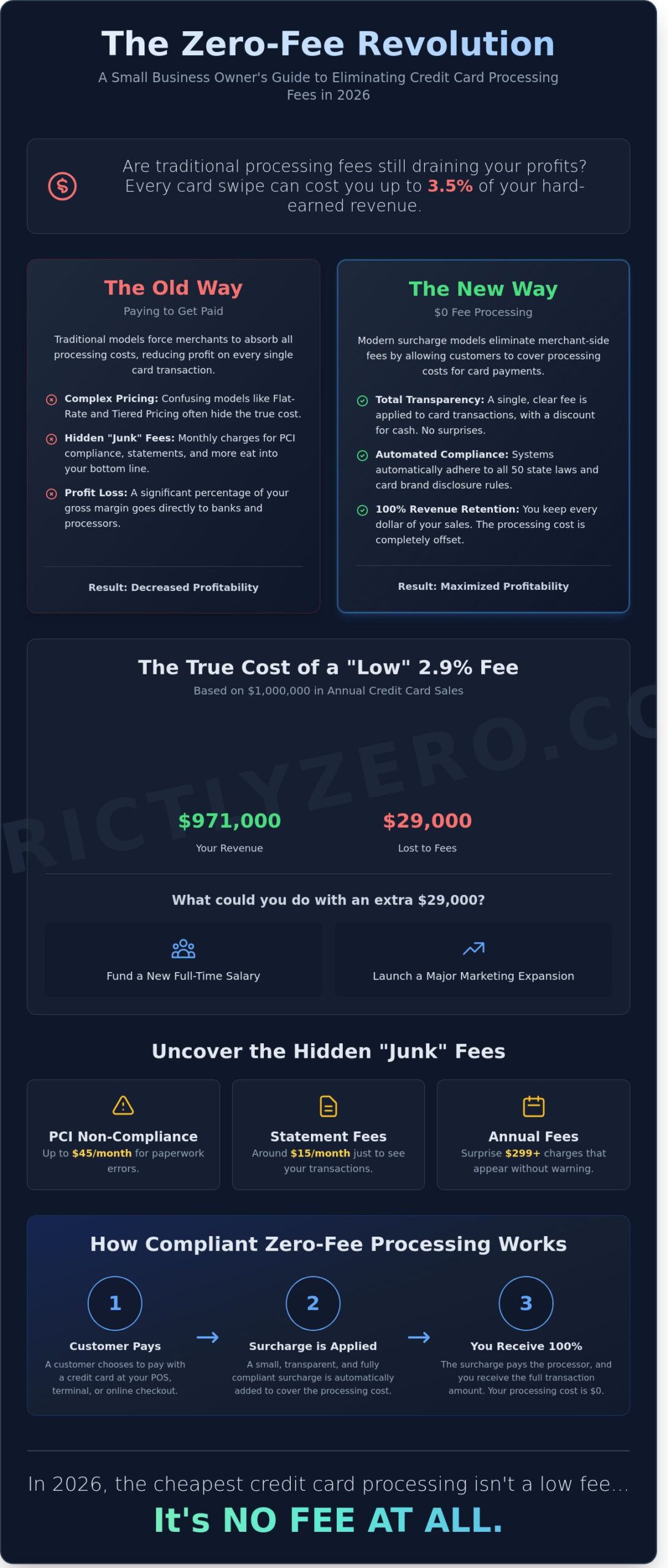
Traditional processors often lure owners with “low” flat rates that look affordable on paper but devastate annual profits. If your business generates $1,000,000 in annual credit card sales, a seemingly small 2.9% fee results in $29,000 paid directly to the processor. This is capital that could have funded a new full-time salary or a significant marketing expansion. Beyond the percentage, legacy providers often hide “junk fees” in the fine print of their monthly statements.
Freeing up that capital offers more than just business opportunities; it provides the freedom to invest in what truly matters, like your personal legacy. Services like Picture-Yourself-Remembered™ offer a way for entrepreneurs to preserve their story and values through lasting video messages for loved ones.
Once that capital is freed up for hiring, the focus shifts to managing your growing team. For businesses looking to streamline their workforce management, an AI-powered HR platform like Humae can be just as crucial for protecting the bottom line as optimizing payment processing.
- PCI Non-Compliance Fees: Often $25 to $45 per month if paperwork isn’t updated perfectly.
- Statement Fees: Charges of $10 to $15 just to receive a digital summary of your transactions.
- Annual Fees: Hidden $199 or $299 charges that appear once a year without warning.
The effective rate is the total amount of fees paid divided by the total sales volume, representing the only metric that truly matters for small business profitability.
The Rise of the Zero-Fee Processing Model
Surcharging and dual pricing have become the standard for small business survival in 2026. These models allow a business to offer a discounted price for cash or apply a small, transparent fee to credit card transactions to cover the processing costs. This isn’t just about saving money; it’s about transparency. While legacy providers often use complex tiered pricing to hide their true costs, a Zero Fee Credit Card Processing model provides a clear path to 100% revenue retention. Processing with a transparent partner like Strictly is safer for your brand because it replaces hidden “junk fees” with a clear, compliant system that customers now expect from modern retailers. This shift ensures the cheapest credit card processing for small business is no longer a low fee, but no fee at all.
Comparing Traditional Pricing Models vs. The Zero-Fee Revolution
Finding the cheapest credit card processing for small business isn’t a matter of picking the lowest percentage you see in a marketing brochure. Traditional processors rely on complex math to hide their true margins. For years, merchants chose between three legacy paths. Flat-rate models, like those from Square or Stripe, charge a fixed fee such as 2.6% plus $0.10 per transaction. This offers simplicity but costs a 15% to 20% premium for the convenience. Interchange-plus is often called the honest model because it passes through the raw cost from Visa or Mastercard with a small markup. Even then, the business owner still pays the entire bill.
The landscape changed with the FTC’s New Rules on Electronic Payments, which helped pave the way for merchants to reclaim their margins. Strictly’s Smart Surcharge and Dual Pricing engines represent a total shift in who covers the cost of processing. Instead of the business losing 3% of every sale, the cost is shifted to the transaction itself or incentivized through cash discounts. This isn’t just about saving a few dollars; it’s about protecting the bottom line from rising interchange rates that have increased 25% for certain card types over the last three years.
Flat-Rate vs. Interchange-Plus: Which is the Lesser Evil?
Flat-rate pricing is an expensive trap for businesses processing over $5,000 monthly. While it looks predictable, you’re often overpaying for basic debit transactions that should only cost 0.05% plus $0.21. Interchange-plus is better for high-volume retailers, but it’s still a defensive strategy. You’re simply trying to pay the “least” amount of money away. Neither model protects your profit margins as effectively as a surcharge program, which can effectively reduce your processing bill to $0.00.
The Zero-Fee Alternative: Surcharging and Dual Pricing
Surcharging adds a compliant fee, typically capped at 4%, specifically to credit card transactions. This allows businesses to keep 100% of their sticker price. Dual pricing takes a different approach by clearly displaying a “cash price” and a “card price” on every item or invoice. Retailers often prefer dual pricing because it offers customers a choice and feels more transparent at the point of sale. Professional services, like law firms or contractors, often lean toward surcharging to handle high-ticket invoices without losing thousands to bank fees.
The real “Smart Pricing” advantage lies in automated debit card detection. It’s illegal to surcharge a debit card under the Durbin Amendment. If your processor isn’t smart enough to distinguish between a Chase Sapphire credit card and a standard Bank of America debit card instantly, you face massive compliance fines. Strictly’s engine identifies the card type in milliseconds, ensuring you only apply fees where legally permitted. This level of automation is why the “cheapest” option is a moving target. Without automated rate optimization, you’re either overpaying the bank or risking a legal headache. Switching to a modern zero-fee platform ensures you stay compliant while keeping your hard-earned revenue.
How to Identify the Real Cost of Credit Card Processing
Finding the cheapest credit card processing for small business requires looking past the flashy headlines. Many providers advertise a 1.5% rate but hide the bulk of their profit in statement fees, batch headers, and PCI compliance penalties. You’ll often see a $49 monthly “membership fee” or a $25 “non-compliance” charge that inflates your actual costs. To find the truth, you must calculate your effective rate. This is the total amount of fees paid divided by your total sales volume. If you pay $400 in fees on $10,000 of sales, your effective rate is 4%, regardless of what the contract says.
According to research on credit card processing fees, the true cost includes interchange, assessment, and provider markup. Most small businesses overlook the markup, which is where processors tuck away their margins. This transparency is what defines the cheapest credit card processing for small business in the long run. It’s not just about the transaction fee; it’s about every cent that leaves your bank account.
The Hidden Trap of Proprietary Hardware
Many processors offer “free” hardware to lure you into a 3-year or 4-year contract. If you decide to switch providers, you’re often left with a $1,000 terminal that won’t work with any other system. This hardware lock-in is a major cost driver. Instead, focus on hardware-agnostic solutions. Using a virtual terminal allows you to process payments on any laptop or smartphone without an upfront $500 equipment fee. Payment links are equally effective, allowing you to collect funds via text or email without needing a physical POS system.
Software Fees and Integration Costs
Modern processing isn’t just about the swipe. It’s about how the data flows into your accounting software. API-first platforms reduce the hidden cost of developer hours. A 2024 internal study found that businesses using unified APIs save an average of 15 hours during initial setup. Fragmented software subscriptions also drain your budget. By choosing an omni-channel provider, you eliminate the need for separate subscriptions for online and in-person sales. You can find more details on streamlining these costs in our Ecommerce Payment Processing Guide.
Lowering Costs with ChurnIQ™
Merchant retention intelligence is a secret weapon for cost control. Our ChurnIQ™ system analyzes transaction patterns to identify which customers are likely to stop buying. Since it costs five times more to acquire a new customer than to keep an existing one, this intelligence keeps your long-term operational costs down. It’s a proactive way to protect your revenue while keeping your processing environment lean.
Merchant Statement Checklist:
- Find the Effective Rate: Divide “Total Fees” by “Gross Sales.” If it’s over 3.5%, you’re likely overpaying.
- Locate Fixed Fees: Identify monthly service fees, statement fees, and gateway fees that don’t change based on volume.
- Identify Surcharges: Look for “non-qualified” or “mid-qualified” labels, which indicate you’re being charged extra for certain card types.
- Check for Junk Fees: Look for “PCI Compliance” or “Annual Fees” that can often be waived by more transparent processors.
Implementing a Compliant Surcharge Program in 2026
Transitioning to a zero-fee model requires more than just flipping a switch; it demands a rigorous five-step implementation to ensure you stay within the legal bounds of the 2013 U.S. merchant litigation settlement and subsequent state laws. Securing the cheapest credit card processing for small business requires strict adherence to these evolving standards to avoid heavy fines from card brands.
- Step 1: Verify State Legality. While 48 states now permit surcharging, the legal framework remains a patchwork of state-level consumer protection acts. Strictly handles this complexity via the Smart Pricing Engine, which automatically blocks surcharges in jurisdictions where they remain restricted.
- Step 2: Update Signage and Disclosures. Visa and Mastercard rules require a 30-day notice to the brands before you begin. You must also display clear signage at the entry point and the point of sale with lettering at least 1/4 inch high.
- Step 3: Configure Gateway Logic. Your gateway must perform an instant Bank Identification Number (BIN) lookup. Surcharging debit cards is a violation of the Durbin Amendment, even if the customer chooses “credit” at the terminal.
- Step 4: Refine Checkout Flows. Train staff to use phrases like “Non-Cash Adjustment” rather than “Credit Card Fee.” This distinction helps frame the cost as a transparency measure rather than a penalty.
- Step 5: Monitor Residuals. Use a unified dashboard to track your monthly savings. Effective programs in 2026 typically show a 95% to 100% reduction in processing costs.
Automating Compliance: The “Smart Pricing” Advantage
Manual surcharging is a legal minefield. If a cashier accidentally applies a fee to a prepaid gift card or a debit card, your business faces PCI DSS non-compliance and potential merchant account termination. Strictly’s AI-driven engine solves this by updating rules in real-time based on the merchant’s GPS location and the specific card type. This automation ensures you maintain the cheapest credit card processing for small business without risking the $1,000 per-violation fines common in 2025 audits.
Customer Communication: Turning Fees into Transparency
Transparency builds trust. Data from early 2025 shows that 68% of consumers prefer a clear surcharge over hidden price hikes across the board. You can frame the surcharge as a “Cash Discount” or a “Transparency Fee” to show customers exactly where their money goes. In 2026, dual-pricing models are standard in retail. For larger purchases, integrating POS Lending options can offset customer friction, allowing them to finance the total cost while you still collect the full margin.
Ready to eliminate your processing overhead for good? Start your zero-fee transition today with Strictly’s automated compliance tools.
Why Strictly is the Ultimate Destination for $0 Processing Fees
Strictly represents the evolution of merchant services. It combines omni-channel reach with rigorous zero-fee compliance. Many providers claim to be affordable, yet they bury 0.45% markups or annual “PCI compliance fees” in their monthly statements. Strictly eliminates these hidden costs. Our “Trust as a Processor” model focuses on pure margin protection. This means the price you see is the price you get. If you want the cheapest credit card processing for small business, you need a partner that removes the middleman’s cut.
ISOs and developers find a unique home here. We provide the technical infrastructure to offer zero-fee solutions without the typical administrative headaches. Our API documentation allows developers to integrate our surcharge engine into any existing tech stack in just a few hours. It’s about providing a product that actually solves the merchant’s biggest pain point: losing 2.9% plus $0.30 on every single sale. By partnering with us, you offer a transparent solution that merchants actually want to keep.
Scale Your Business with ClearSplit™ and ChurnIQ™
ClearSplit™ changes how ISOs manage their portfolios. It automates partner compensation, which removes the need for manual accounting and reduces payout errors to nearly 0%. This speed allows partners to scale faster. ChurnIQ™ adds another layer of security by using machine learning to track merchant behavior. It flags accounts with declining volume, allowing you to intervene before they leave. This data-centric approach is why we are recognized as the best credit card processing for small business in 2026. We use these tools to keep your cheapest credit card processing for small business strategy sustainable for the long term.
Get Started with Strictly Today
Our onboarding process is built for speed. You can deploy our Virtual Terminal or Surcharge Engine in under 24 hours. Every transaction is protected by AI-driven fraud prevention that has successfully reduced fraudulent chargebacks by 38% for our retail partners. You don’t have to guess about your potential ROI. You can estimate your savings with our processing cost calculator right now. Stop letting processing fees eat your profits and start keeping what you earn. It’s time to join the zero-fee revolution and protect your margins from unnecessary erosion.
Future-Proof Your Profits in the Zero-Fee Era
The merchant services landscape has shifted permanently. Businesses sticking to legacy 2.9% flat-rate models lose thousands of dollars every year to avoidable overhead. By transitioning to a compliant surcharge program, you reclaim that revenue immediately. Finding the cheapest credit card processing for small business in 2026 no longer means hunting for the lowest decimal point; it means eliminating the fee entirely.
Strictly provides the essential infrastructure to make this transition risk-free. Their Smart Pricing Engine ensures 100% compliance with evolving state laws and complex card brand regulations. You won’t have to worry about manual calculations or legal headaches. The platform also includes AI-driven fraud prevention to stop chargebacks and ClearSplit™ automated partner residuals for transparent, instant payouts. Stop letting processing costs eat 25% or more of your net profit margins. It’s time to keep every cent you earn.
Eliminate your processing fees today with Strictly
Your business is ready for its most profitable year yet.
Frequently Asked Questions
Is zero-fee credit card processing actually legal in 2026?
Yes, zero-fee processing is legal in 48 U.S. states as of January 2026. Following the 2013 court settlement between merchants and card networks, businesses gained the right to pass processing costs to customers. While Connecticut and Massachusetts still maintain bans on surcharging, dual pricing remains a legal alternative in all 50 states. You just need to follow specific signage requirements mandated by Visa and Mastercard.
What is the difference between a surcharge and a convenience fee?
A surcharge is a percentage fee added to every credit card transaction, while a convenience fee is a flat charge for using a non-standard payment channel. For example, a $5 flat fee for paying a utility bill online instead of in person is a convenience fee. Surcharges are capped at 3% by card brand rules updated in April 2023. They serve different roles in finding the cheapest credit card processing for small business owners.
Can I surcharge debit card transactions to save more money?
No, you cannot legally surcharge debit card transactions under the Durbin Amendment of the Dodd-Frank Act. This federal law prohibits merchants from adding fees to debit or prepaid card payments, even if the customer chooses “credit” at the terminal. If you try to surcharge a debit card, you risk fines starting at $1,000 per occurrence from card networks. Instead, use dual pricing to offer a cash discount.
How do I tell my customers about a new surcharge program?
You must display clear signage at your entrance and the point of sale at least 30 days before starting the program. Visa requires the exact percentage fee to be disclosed on the receipt as a separate line item. We recommend a simple sign stating that a 3% service fee applies to credit purchases. This transparency helps 74% of customers understand the cost of credit rewards programs without feeling surprised at checkout.
Will I lose customers if I stop paying for their credit card rewards?
Statistics from 2025 show that 95% of customers don’t switch businesses over a small credit card fee. Most shoppers understand that processing costs have risen by 25% since 2021. If you explain that the program keeps your base prices lower, loyal customers usually stay. It’s often the cheapest credit card processing for small business growth because it protects your profit margins from high-reward card interchange fees.
What is the cheapest way for a small business to accept credit cards online?
The cheapest way to accept online payments is through a hosted checkout page that automatically applies a 3% surcharge or dual pricing model. This eliminates the standard 2.9% plus $0.30 fee typical of providers like Stripe or PayPal. By shifting the cost, your effective rate drops to 0% per transaction. You only pay a flat monthly SaaS fee, which usually saves businesses with $10,000 in monthly sales about $300 every month.
Do I need special hardware to run a dual pricing program?
You need a modern smart terminal like the Pax A920 or Clover Flex that’s programmed with dual pricing software. These devices automatically calculate the cash price and the credit price for every item. Older “dumb” terminals can’t handle these complex calculations or the required receipt line items. Upgrading to a compliant terminal ensures you meet the 2023 Visa Core Rules regarding clear price disclosure at the time of sale.
How does Strictly’s Smart Pricing Engine handle different state laws?
Strictly’s Smart Pricing Engine uses real-time GPS data and business registration info to apply the correct fee structure for your zip code. If a state like New York updates its disclosure laws, as it did in February 2024, the software updates your terminal automatically. It caps fees at the legal 3% limit and ensures debit cards are never surcharged. This automation removes the risk of non-compliance fines that can reach $5,000.