
The Best Merchant Account for Service Business: 2026 Buying Guide
Published:
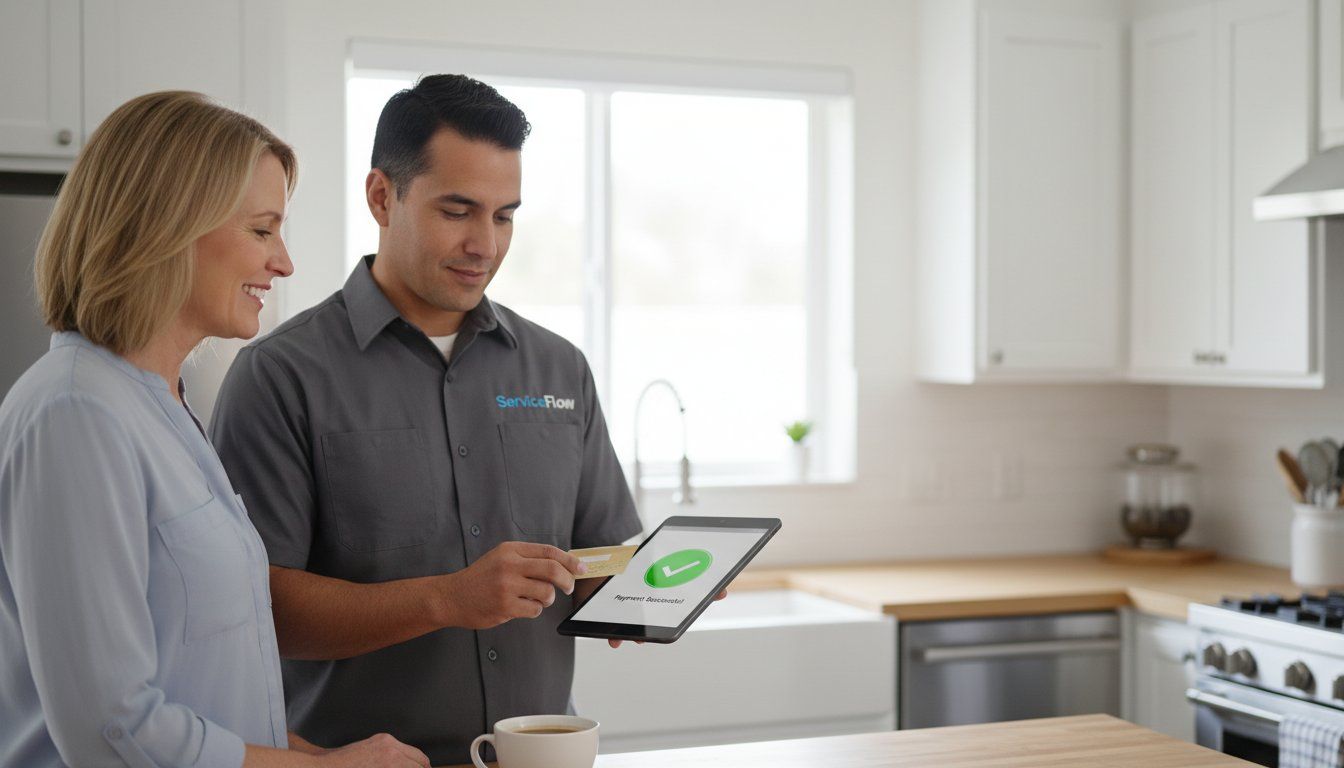
Why are you still handing over $175 to a credit card processor every time you close a $5,000 installation? If you’re like the 68% of service providers still manually reconciling paper checks, you know that waiting ten days for a payment to clear is just as painful as the fees themselves. Selecting the right merchant account for service business shouldn’t feel like a choice between losing your margins or losing your mind. You’ve spent years building your reputation, so it’s frustrating when outdated payment systems eat your profits before the money even hits your bank account.
This 2026 buying guide shows you how to implement a system that eliminates processing fees entirely while providing professional invoicing that gets settled instantly. We’ll help you cut your payout time from five days down to less than 24 hours using tools specifically designed for field operations. We’re breaking down the top-rated providers that offer mobile integration and automated workflows to help you reclaim that 3.5% lost revenue. You’ll learn exactly how to modernize your office and field operations for maximum profit starting today.
Key Takeaways
- Understand how a specialized merchant account for service business differs from retail by prioritizing high-ticket security and virtual terminal flexibility.
- Learn how to automate your monthly cash flow using recurring billing and remote payment tools designed for field and office operations.
- Discover the mechanics of the “Zero-Fee” model and how surcharging can help your business reclaim the 3% margin typically lost to processing fees.
- Access a streamlined 2026 checklist to navigate the underwriting process and get your processing account approved quickly with the right documentation.
- Explore how an API-first approach integrates payment processing directly into your existing workflows to eliminate administrative friction and streamline payments.
Table of Contents
- What is a Merchant Account for Service Business and Why is it Different?
- Essential Features to Look for in a Service-Based Merchant Account
- The Cost Revolution: Surcharging and Zero-Fee Models
- How to Set Up Your Merchant Account: A 2026 Checklist
- Why Strictly is the Strategic Choice for Modern Service Providers
What is a Merchant Account for Service Business and Why is it Different?
A Merchant account is a specialized bank account that allows your company to accept and process electronic payment cards. It isn’t the same as your standard business checking account. While your checking account holds your liquid cash, a dedicated merchant account for service business acts as a critical intermediary that verifies funds and manages the risk of every transaction. Without this specific setup, you can’t process credit cards or digital wallets securely or efficiently.
Service industries operate differently than traditional retail shops. Retailers usually handle hundreds of small transactions daily. Service providers often manage fewer, higher-ticket invoices that can range from $500 to $15,000. Banks use Merchant Category Codes (MCC), such as 1711 for HVAC contractors or 7311 for advertising services, to monitor these patterns. If you use a generic account and suddenly process a $10,000 transaction, the bank might flag it as suspicious and freeze your funds for 30 days or more. Having the correct MCC ensures the bank understands your high-ticket nature from day one.
To better understand how these processing structures and fees impact your business operations, watch this helpful video:
Retail vs. Service Merchant Accounts
The primary difference lies in risk management. Service businesses often deal with “card-not-present” transactions. This happens when you take a deposit over the phone or send a digital invoice. Because the physical card isn’t swiped in person, the risk of fraud or chargebacks is statistically higher. You’ll need a secure payment gateway to bridge the gap between your client’s device and your bank. Service-specific accounts are also built to handle complex billing, allowing you to take a 30% deposit upfront and bill the remainder once the project is complete.
The Shift Toward Omni-Channel Service Delivery
Today’s clients expect an omni-channel experience. They want to book a service online, pay a deposit via a mobile link, and perhaps pay the balance in person using a tablet in the field. A unified merchant account for service business tracks these interactions in one place. Industry reports from 2023 show that service providers using integrated omni-channel tools reduce their payment collection time by an average of 4 days. For more context on building these systems, check out our guide on omni-channel payment processing. Having a single source of truth for client history across all touchpoints prevents billing disputes and keeps your cash flow predictable.
Essential Features to Look for in a Service-Based Merchant Account
Evaluating a merchant account for service business requires looking beyond basic swipe rates. Service providers often operate without a physical storefront, meaning your payment tools must be as mobile and flexible as your team. According to the SBA guide to merchant accounts, these specialized accounts are foundational to your business banking structure; they allow you to manage cash flow while providing professional payment options to your clients.
Virtual terminals are a non-negotiable feature for anyone taking orders over the phone. These web-based interfaces turn any laptop or tablet into a secure credit card machine. For businesses managing monthly retainers or maintenance contracts, recurring billing automation can reduce administrative labor by 15 hours per month. Instead of chasing checks, you set the schedule and the software handles the rest. When selecting a merchant account for service business needs, mobile compatibility should be a top priority for your field staff. Using Bluetooth card readers or NFC-enabled smartphone apps allows your team to collect payment the moment a job finishes. This immediate settlement eliminates the risk of forgetful clients and keeps your ledger balanced in real-time.
Virtual Gateways and Remote Billing
A robust virtual gateway provides a secure environment for keyed-in transactions, protecting sensitive data through high-level encryption. One of the most powerful tools for repeat service clients is the Card on File feature. This allows you to store encrypted payment details for future use, making one-click billing possible for follow-up appointments. Integrating these gateways with accounting platforms like QuickBooks or Xero ensures that every transaction syncs automatically, which can reduce manual entry errors by up to 95%.
Smart Invoicing and Payment Links
Traditional paper invoices are slow and often lead to 30-day wait times. Payment links sent via text or email are replacing them because they accelerate cash flow significantly. Data shows that 60% of digital invoices are paid within 24 hours of receipt. You can customize these invoices with specific service descriptions, terms of service, and your company branding. Using SMS-based payments is particularly effective for field services. Sending a Pay Now button via text message allows customers to settle their balance on their mobile device before your technician even leaves the driveway. If you want to optimize your current setup, you should explore modern processing solutions that prioritize these rapid settlement features.
The Cost Revolution: Surcharging and Zero-Fee Models
Traditional processing costs usually consume 2.5% to 4% of gross revenue. For a merchant account for service business owners, this translates to thousands of dollars lost every year. The zero fee credit card processing model flips this script. Instead of the business paying the interchange and markup fees, the cost is passed to the consumer as a small service fee at the point of sale. This shift allows businesses to offset nearly 100% of their processing overhead.
Comparing models helps clarify the financial impact. Interchange-plus offers transparency by charging the base cost plus a fixed markup, while flat-rate models simplify costs but often at a higher 2.9% plus $0.30 premium. Surcharging is different. As Forbes explains merchant accounts are necessary for accepting digital payments, but they don’t have to be a profit drain. On a $1,000 service invoice, a traditional 3% fee costs you $30. With a zero-fee model, you keep that entire $1,000 in your bank account.
By 2026, legal frameworks have stabilized across the United States. While states like New York and Maine have specific disclosure requirements, surcharging is legal provided you follow card brand rules. Most modern platforms cap surcharges at 3% or 4% to remain compliant with Visa and Mastercard regulations. You must also provide clear signage at the entrance and the point of sale to stay within legal boundaries.
Surcharging vs. Dual Pricing
Surcharging adds a specific fee to credit card transactions only. Dual pricing presents two distinct prices to the customer: a lower price for cash and a slightly higher one for cards. A Smart Pricing Engine is vital for this process. It detects the card type and location in real time to apply the correct fee automatically. Service businesses, like HVAC companies or legal firms, are uniquely positioned for this. Clients often prioritize the convenience and rewards of credit cards over a small 3% fee, leading to minimal customer friction.
Calculating Your Potential Savings
Understanding the true cost of credit card processing requires looking beyond the base percentage. You should watch for $20 monthly PCI non-compliance fees, $15 statement fees, or $0.25 batch header charges that inflate your bill. A merchant account for service business providers should aim to eliminate these “junk” fees entirely. Using a savings calculator usually shows that a business processing $50,000 monthly can recover roughly $18,000 a year by switching to a zero-fee platform. This extra capital can be reinvested into equipment or marketing.
How to Set Up Your Merchant Account: A 2026 Checklist
Securing a merchant account for service business operations requires more than just a digital application. In 2026, processors prioritize transparency and digital verification. You must gather your Employer Identification Number (EIN), a valid business license, and your most recent three months of business bank statements. If you’re a new entity, personal bank statements may suffice, provided they show consistent liquidity. Underwriters look for stability. They analyze your “time to fulfillment,” which is the gap between payment and service delivery. Shorter gaps generally lead to faster approvals and lower reserve requirements.
Documentation and Underwriting Nuances
Service businesses face unique hurdles during underwriting because they don’t ship physical goods. You must provide a clear “Terms of Service” document on your website. Statistics from 2025 show that 82% of service-related chargebacks are won by merchants who display clear refund and cancellation policies at the point of sale. You also need a dedicated business bank account. Mixing personal and professional funds is a red flag that causes 40% of applications to be rejected immediately. If your business handles high-ticket invoices over $5,000, specify this during the application to prevent automated fraud freezes on your first large transaction.
Security and PCI Compliance
Maintaining PCI DSS compliance is a non-negotiable legal obligation. For service providers, this often involves PCI DSS 4.0 standards, which emphasize continuous monitoring. Tokenization is your best defense for recurring billing. It replaces sensitive card data with a unique identifier, ensuring that even if your CRM is breached, client data remains useless to hackers. By 2026, AI-driven fraud prevention has become standard. These systems analyze 150+ data points, such as IP velocity and typing patterns, to flag suspicious bookings before they hit your merchant account for service business processing queue.
Once your documentation is approved, the integration phase begins. You’ll connect your payment gateway to your existing website or CRM via an API key or a pre-built plugin. Don’t skip the testing phase. Run a $1.00 transaction using a real card to verify the data flow. Check your merchant dashboard to ensure the funds settle within the promised 24 to 48-hour window. This simple test prevents embarrassing technical glitches when your first high-value client tries to pay.
Beyond payments, many service businesses are also streamlining other on-site operations. For those managing workshops, appointments, or events, a professional QR code check-in system can be invaluable. You can explore such a solution at secureevent.online.
Similarly, for businesses in the care industry, managing client needs around the clock is a major operational challenge. It can be beneficial to explore 24/7 On-Call Triage solutions to ensure continuous support without overburdening your primary staff.
Ready to streamline your payment operations? Contact our experts to find the right merchant solution today.
Why Strictly is the Strategic Choice for Modern Service Providers
Service providers often lose 3% of their top-line revenue to processing fees. This margin leak isn’t a fixed cost of doing business; it’s a structural inefficiency that erodes your bottom line. Strictly solves this through an API-first platform designed to integrate directly into your existing service workflows. Whether you run a local plumbing company or a national home services franchise, choosing the right merchant account for service business operations determines your net profitability. We don’t just process payments. We act as a growth partner by providing the infrastructure to manage partner relationships and automate financial compliance across every territory you serve.
The Smart Pricing Advantage
Strictly’s automated engine identifies debit cards in real-time. This distinction is vital because surcharging debit cards violates federal regulations under the Durbin Amendment. Our system ensures you remain 100% compliant by only applying surcharges to eligible credit transactions. You can monitor every transaction and fee breakdown through the Strictly dashboard, which offers 24/7 transparency into your cash flow. The Smart Pricing Engine is a 100% compliant way to recoup 3% of every credit card sale.
Scale Your Service Business with Strictly
Scaling a service company requires managing complex payouts and maintaining high customer lifetime value. ClearSplit™ automates commission tracking for field sales teams or regional partners. This tool reduces administrative overhead by an average of 15 hours per month for mid-sized firms by eliminating manual spreadsheet reconciliations.
Retention is the other side of the growth equation. ChurnIQ™ analyzes payment patterns and billing health to identify at-risk clients before they cancel their service contracts. This proactive data allows you to intervene early, helping many service providers maintain a 92% or higher retention rate. Selecting a merchant account for service business growth means looking beyond the swipe. It means choosing a platform that protects your margins and provides the data needed to expand.
Eliminate your processing fees today with Strictly.
Take Control of Your Bottom Line in 2026
The payment landscape for service providers has shifted permanently toward transparency and efficiency. Choosing the right merchant account for service business means you don’t have to sacrifice 3% or 4% of your hard-earned revenue to traditional banking fees. By implementing a modern surcharging model, you can reinvest those funds back into your operations immediately. Success in 2026 depends on your ability to automate compliance while maintaining a seamless experience for your clients.
Strictly provides the ultimate edge for service-based companies. You can eliminate 100% of your processing fees while staying fully compliant across all 50 states. If you ever run into a hurdle, their 24/7 US-based support team is available to assist you at any hour. Don’t let outdated fee structures drain your profits for another billing cycle.
Ready to keep every dollar you earn? Start saving today with Strictly Zero-Fee Processing. Your business deserves a financial partner that prioritizes your growth as much as you do.
Frequently Asked Questions
How much does a merchant account for a service business cost?
Expect to pay between 1.5% and 3.5% per transaction plus fixed monthly fees. Monthly maintenance costs usually range from $10 to $30 depending on your provider. Flat-rate processors like Square charge 2.6% plus $0.10 for in-person sales, while interchange-plus models can save high-volume businesses 0.5% on average. You should also budget for a $15 to $25 monthly PCI compliance fee.
Can I pass credit card processing fees to my customers legally?
Yes, surcharging is legal in 48 U.S. states, excluding only Connecticut and Massachusetts as of 2024. You’re required to follow Visa and Mastercard rules, which limit surcharges to 4% or your actual cost of acceptance. You must provide 30 days’ notice to card brands and display clear signage at your point of sale to remain compliant with federal regulations.
What is the difference between a payment gateway and a merchant account?
A merchant account is a specialized bank account that holds your funds, while a payment gateway is the software that securely transmits transaction data. You need both components to manage a merchant account for service business transactions online. The gateway acts as the digital version of a physical card reader, encrypting sensitive data during the 2 to 3 seconds it takes to authorize a payment.
How long does it take to get approved for a service-based merchant account?
Most service businesses receive approval within 24 to 72 hours after submitting their digital application. High-risk industries like HVAC or legal services might face a 5 to 7 day manual underwriting period. Providing 3 months of bank statements and a valid business license speeds up the process by roughly 40%. Once you’re approved, hardware typically arrives within 3 to 5 business days.
Do I need a physical credit card terminal to accept payments for my service business?
No, you don’t need a physical terminal because you can use virtual terminals or mobile apps to process payments. Over 65% of field service providers now use mobile card readers or “tap to pay” features on smartphones. If you primarily invoice clients via email, a digital payment link allows you to collect funds instantly without any hardware costs or maintenance.
How does a zero-fee merchant account actually work?
A zero-fee merchant account uses a surcharge or cash discount model to shift the 2% to 4% processing cost to the customer. The technology automatically calculates the fee at checkout so you receive the full invoice amount. This setup can increase your net profit margin by 3% immediately. It’s a popular choice for a merchant account for service business owners where labor costs are high and margins are tight.
What happens if a customer disputes a service-related charge?
The bank initiates a chargeback, which immediately withdraws the disputed amount plus a fee ranging from $15 to $50 from your account. You’ll have about 20 days to submit evidence like signed contracts, timestamps, or photos of completed work. Statistics show that businesses with detailed service agreements win 60% more disputes than those who rely on verbal handshakes or undocumented work orders.
Is surcharging or dual pricing better for my business model?
Dual pricing is often better because it’s legal in all 50 states and offers a clear “cash price” versus “card price” to the client. Surcharging only applies to credit cards, which can confuse the 15% of customers using debit cards. Dual pricing transparently shows both totals on the invoice. This reduces checkout friction and eliminates the risk of state-level legal compliance issues for traveling service providers.