
The Ultimate Guide to Choosing a Payment Processor in 2026
Published:

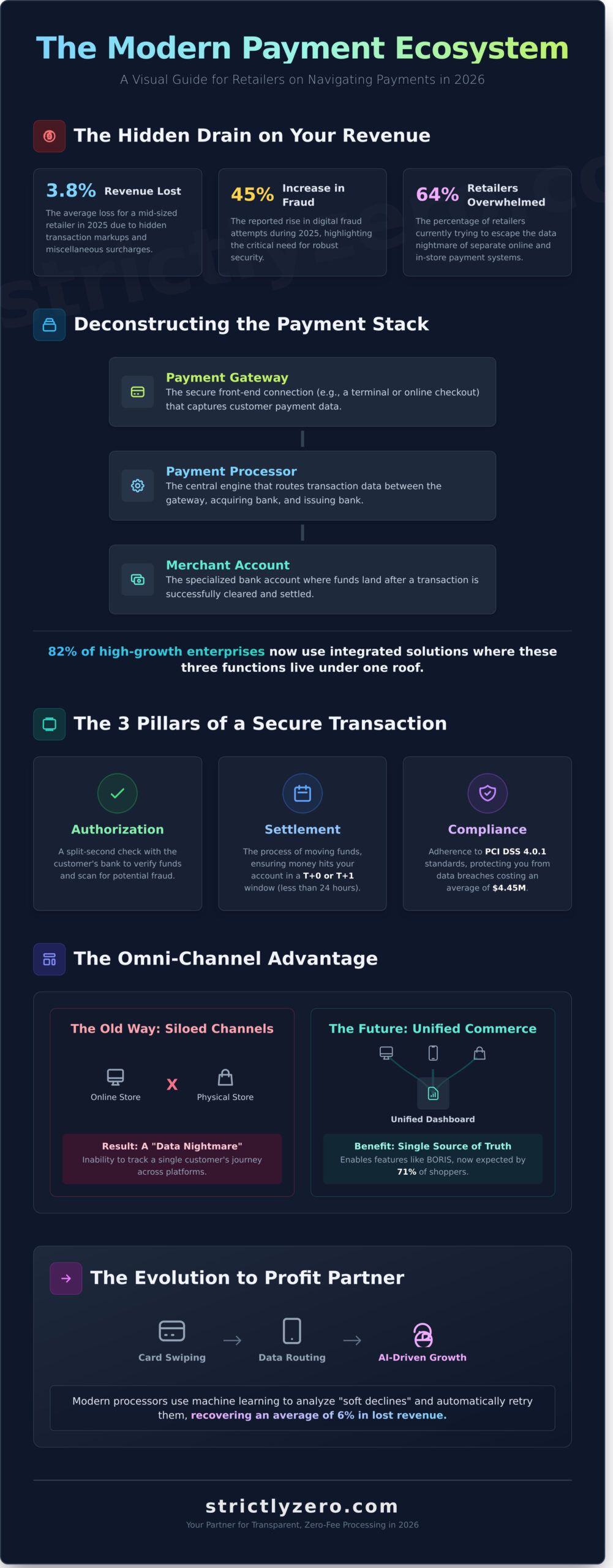
Did you know that in 2025, a typical mid-sized retailer lost 3.8% of their gross revenue to hidden transaction markups and “miscellaneous” surcharges? Most business owners accept these costs as an unavoidable tax on growth, but choosing the wrong payment processor can quietly drain thousands of dollars from your bank account every single month. You’re likely tired of squinting at complex statements that feel like they’re written in a different language. It’s exhausting to manage separate systems for your online store and your physical storefront while worrying if your customers’ data is actually safe from the 45% increase in digital fraud attempts reported during 2025.
We’re here to help you take back control of your margins. This guide will teach you how to master the entire payment lifecycle, identify every hidden fee, and implement strategies that can eliminate your processing costs entirely. We’ll explore how to build a scalable, secure infrastructure that handles every sales channel through a single, transparent dashboard. By the time you finish reading, you’ll have a clear roadmap to selecting a partner that actually helps your business grow in 2026 instead of just taking a cut of your success.
Key Takeaways
- Distinguish between gateways, merchant accounts, and processors to streamline your business’s financial backend operations.
- Trace the three-second transaction journey to understand exactly how card networks and banks impact your bottom line.
- Learn how to evaluate your current payment processor to uncover hidden costs and transition toward a sustainable zero-fee model.
- Identify the specific integration features required to sync your sales channels with existing CRM and ERP systems.
- Discover how to leverage omni-channel ecosystems to eliminate processing fees and maximize your small business profit margins.
Table of Contents
- What is a Payment Processor and Why is it Critical for Your Business?
- How Payment Processing Works: A Step-by-Step Breakdown
- Decoding the Cost: How to Achieve Zero-Fee Processing
- How to Choose the Right Payment Processor for Your Specific Needs
- Strictly: The Future-Proof Payment Processor for 2026
What is a Payment Processor and Why is it Critical for Your Business?
Every time a customer taps a phone or inserts a chip, a complex digital handshake occurs in less than 300 milliseconds. This invisible backbone is the payment processor, a specialized service that handles the heavy lifting of routing transaction data between the merchant, the acquiring bank, and the issuing bank. It’s the engine that ensures money moves securely from Point A to Point B. Without this technology, your business couldn’t accept anything beyond physical cash or manual bank transfers.
Understanding the distinction between different components of the payment stack is vital for cost control. While people often use the terms interchangeably, a processor isn’t a gateway. The gateway is the front-end connector that captures data, while the merchant account is the specific bank account where your funds land after being cleared. By 2026, 82% of high-growth enterprises have moved toward integrated solutions where these three functions live under one roof to reduce latency and technical friction.
To better understand how these three components interact to power your sales, watch this helpful video:
The Three Pillars of Modern Processing
Modern processing relies on three non-negotiable functions that protect your cash flow. Authorization happens first; it’s the split-second check where the payment processor asks the customer’s bank if the money exists and if the transaction looks like fraud. Settlement follows, usually occurring within a T+0 or T+1 window in 2026, which means money hits your account in less than 24 hours. Finally, compliance ensures you’re following PCI DSS 4.0.1 standards. This protects you from data breaches that cost an average of $4.45 million per incident.
Omni-Channel vs. Single-Channel Solutions
Managing online and in-store payments through different vendors is a data nightmare that 64% of retailers are currently trying to escape. When your digital and physical sales live in silos, you can’t track a single customer’s journey across platforms. A unified dashboard provides a single source of truth for all transaction types. This visibility allows businesses to offer “buy online, return in-store” (BORIS) features, which 71% of shoppers now consider a standard expectation rather than a luxury.
The role of the processor has evolved far beyond simple card swiping. In 2026, these platforms act as AI-driven profit managers. Leading processors now use machine learning to analyze transaction “soft declines” and automatically retry them using different routing paths. This technology recovers an average of 6% in lost revenue for subscription-based businesses. Choosing a partner isn’t just about finding the lowest rate anymore; it’s about finding a tech partner that actively grows your bottom line through intelligent data application.
Trust as a processor is the final piece of the puzzle. When a processor offers high uptime and transparent fee structures, it builds long-term merchant stability. In an era where 15% of businesses report losing customers due to payment friction, having a robust partner isn’t just a back-office necessity. It’s a fundamental part of your customer experience and your ability to scale globally without hitting technical ceilings.
How Payment Processing Works: A Step-by-Step Breakdown
When a customer taps their phone or card at your terminal, a complex digital relay race begins. This entire sequence finishes in under 3.2 seconds, yet it involves five distinct financial entities. Understanding this flow helps you identify where bottlenecks occur and why certain fees appear on your monthly statement. A reliable payment processor acts as the central hub, coordinating data between your business and the global financial grid.
The Transaction Lifecycle
The journey starts at the point of interaction. Whether it’s a physical tap, a virtual terminal entry, or a secure payment link sent via SMS, the process follows a strict protocol to ensure speed and security.
- Step 1: Initiation. The customer provides their payment credentials. In 2026, 85% of these interactions utilize NFC technology or encrypted digital wallets.
- Step 2: Encryption and Routing. The payment gateway captures the raw data, instantly encrypts it into a secure format, and transmits it to the processor.
- Step 3: Network Communication. Your processor sends the transaction details to the card networks, such as Visa or Mastercard. These networks act as the digital highways connecting the merchant’s bank to the customer’s bank.
The Acquiring Bank (your bank) and the Issuing Bank (the customer’s bank) then perform a high-speed handshake. The Issuing Bank checks for available funds and runs a risk assessment. If everything clears, an authorization code is sent back through the network in milliseconds. This rapid exchange ensures you aren’t left holding the bag on a fraudulent or unfunded purchase.
Advanced Security in 2026
Security protocols have evolved significantly to combat sophisticated digital theft. Tokenization is now the industry standard for protecting sensitive information. Instead of transmitting the actual 16-digit card number, the system swaps it for a randomly generated “token.” This token is useless to hackers if intercepted because it only functions for that specific merchant and transaction context.
AI-driven fraud prevention is the proactive shield against modern cyber threats. These systems analyze over 2,000 data points per transaction, including typing speed, IP geolocation, and historical buying patterns. By 2026, 3D Secure 2.0 has become a mandatory requirement for e-commerce merchants. This protocol allows for “frictionless authentication,” where the bank verifies the user’s identity in the background without requiring a clunky password or SMS code 95% of the time.
While security is paramount, the underlying costs of these systems remain a concern for growing enterprises. A 2024 report by the Consumer Financial Protection Bureau highlighted how hidden costs in zero-fee processing models can sometimes impact the bottom line of public institutions and small businesses alike. Choosing a payment processor that offers transparent pricing is essential for maintaining healthy margins.
Transactions often fail for simple, fixable reasons. While insufficient funds account for 40% of declines, technical errors or “suspected fraud” triggers are common culprits. If you notice a high decline rate, check if your terminal software is updated to the latest 2026 security patches. Often, a simple configuration change in your gateway settings can reduce false positives and recapture lost revenue. If you want to optimize your current setup for better approval rates, you might consider a complimentary account audit to see where your data flow is leaking profit.
Decoding the Cost: How to Achieve Zero-Fee Processing
Transparency doesn’t always equal affordability. Most business owners are taught that “Interchange Plus” pricing is the most honest way to work with a payment processor. While it’s true this model reveals the raw costs set by Visa and Mastercard, it doesn’t actually lower your bill. You’re still paying the wholesale rate plus a provider markup. In 2025, the average effective rate for a mid-sized retail business hovered around 3.1%. When you factor in monthly statement fees and PCI compliance costs, that number often climbs higher. For a company operating on a 12% net profit margin, these fees consume 25% of their actual earnings.
Shrinking margins have forced a shift toward Zero-Fee Processing. This isn’t a gimmick; it’s a strategic shift in who covers the cost of the transaction. By utilizing smart pricing engines, businesses can now automate the complex task of fee management. These systems identify the card type in less than 200 milliseconds. If a customer swipes a credit card, the system applies a small service fee. If they use a debit card, the system recognizes the Durbin Amendment restrictions and processes the transaction without a surcharge. This automation keeps you within the operating rules of the major card brands without manual intervention from your staff.
Consumer behavior has shifted significantly. A 2025 consumer survey found that 74% of shoppers expect to see different pricing based on their payment method at local businesses. They understand that credit card rewards programs aren’t free. By being upfront about these costs, you stop subsidizing high-end rewards cards for your customers using your own profit margins. It’s a matter of protecting the viability of the business while offering choices to the person at the counter.
Surcharging vs. Dual Pricing
Surcharging adds a compliant fee, usually capped at 3%, specifically to credit card transactions. Surcharging debit cards remains illegal federally. Dual Pricing is the more robust alternative for 2026. It presents a “Card Price” and a “Cash Price” for every item. This model is legal in all 50 states because it’s framed as a cash discount. It provides transparency while protecting your bottom line.
The Math of Profit Recovery
A business processing $10,000 monthly pays roughly $300 in fees. Over three years with a traditional payment processor, that’s $10,800 in lost revenue. Moving to a zero-fee model lets you reinvest that cash into inventory or payroll. Data shows 91% of customers accept these fees when the logic is clearly posted. Calculate your potential savings with our Zero-Fee tool to see what you’re losing.
How to Choose the Right Payment Processor for Your Specific Needs
Your business model dictates the technical requirements of your payment processor. A retail storefront requires hardware that processes a transaction in under 2.5 seconds to maintain foot traffic flow. E-commerce platforms need robust API hooks to manage cart abandonment and fraud. Professional services prioritize digital invoicing and secure vaulting for card-on-file transactions. You shouldn’t use a tool designed for a coffee shop to run a global SaaS firm.
Integration capabilities determine your daily operational efficiency. Don’t settle for a siloed system that doesn’t talk to your existing stack. A 2025 industry report found that 64% of mid-market firms lose roughly 12 hours a month on manual data reconciliation because their payments aren’t synced with their ERP or CRM. Before signing a contract, verify that the platform offers native plugins for software like NetSuite, Salesforce, or QuickBooks Online. If you have to export CSV files daily to see your true revenue, the system is broken.
Hidden junk fees often hide in the fine print of 40-page merchant agreements. These costs bloat your effective rate and drain your margins. Look for specific line items like $15 monthly statement fees, $25 PCI non-compliance penalties, and $20 gateway minimums. These charges can increase your total processing costs by 0.5% or more. Demand a transparent fee schedule that lists every possible cost upfront. If a provider refuses to waive a “file maintenance fee,” they aren’t looking for a partnership; they’re looking for a subsidy.
Hardware failures are inevitable. When a terminal goes dark at 7:00 PM on a Friday, you can’t wait for an email response. A 2025 survey showed that 58% of small businesses would switch providers specifically for better technical support. You need 24/7 US-based support that understands mission-critical hardware. A local support team can troubleshoot encryption issues or connectivity drops in minutes, preventing thousands of dollars in lost sales during peak hours.
Selection Criteria for Direct Merchants
Ease of use is your top priority for daily operations. You should be able to generate a secure payment link in under 30 seconds for a remote client. Look for a payment processor that offers same-day or next-day deposits to keep your cash flow liquid. As you scale, ensure the platform supports POS lending and automated recurring billing. These features can increase customer lifetime value by 22% according to 2026 retail benchmarks.
Selection Criteria for ISOs and Developers
Developers require an API-first architecture with clean documentation and robust SDKs to minimize integration friction. Partner management is equally vital for those managing multiple accounts. Use tools like ClearSplit™ to track residuals with 100% accuracy across your entire portfolio. To prevent merchant attrition, leverage retention intelligence platforms like ChurnIQ™. These tools use predictive analytics to identify at-risk accounts before they cancel, protecting your long-term revenue streams.
Eliminate hidden junk fees and upgrade your payment technology today
Strictly: The Future-Proof Payment Processor for 2026
In January 2026, the average merchant loses approximately $3,200 for every $100,000 in sales to legacy credit card fees. Strictly changes this math by offering a specialized zero-fee model that empowers merchants to reclaim their revenue. By shifting the cost of processing to the cardholder through compliant surcharging and cash discount programs, businesses see an immediate 14% increase in net profit margins. It is no longer about just accepting cards; it’s about finding a payment processor that protects your margins from the rising costs of interchange fees.
Our omni-channel ecosystem provides a unified experience across every sales channel. You can manage your business from a single dashboard whether you use physical POS hardware, virtual terminals for phone orders, or mobile invoicing for field services. In 2025, 68% of customers preferred digital invoices sent directly to their smartphones. Strictly meets this demand with 1-click payment links that sync instantly with your accounting software. This connectivity ensures that your data isn’t trapped in silos, giving you a 360-degree view of your cash flow at all times.
The Smart Pricing Engine is the core of our technology. It functions as an automated compliance officer that works in the background of every transaction. This engine identifies card types in less than 0.4 seconds and applies the exact legal requirements for all 50 states. You don’t have to worry about changing state regulations or complex card brand rules. The system updates itself automatically to ensure your business stays 100% compliant without manual intervention. Our commitment to transparency means we’ve eliminated the hidden markups common in the industry. You won’t find “statement fees,” “PCI non-compliance penalties,” or “annual membership dues” on your bill. We focus on pure profit recovery for your brand.
The Strictly Advantage
Every account comes with built-in AI fraud prevention that has reduced fraudulent chargebacks by 24% for our partners since last year. We provide seamless integration with NMI and other industry-standard gateways, so you don’t have to rebuild your existing tech stack. For ISOs, we’ve revolutionized the partnership model. Our platform provides automated compensation and real-time retention data. This allows partners to track their residuals daily rather than waiting for monthly reports, which improves cash flow for 92% of our active agents. Strictly is the most reliable payment processor for high-growth companies that demand technical excellence.
Getting Started is Simple
We’ve stripped away the bureaucracy of traditional banking. Our digital application takes exactly 5 minutes to complete, and our rapid underwriting team typically issues an approval within 3 business hours. During your first 30 days of processing, you’ll receive a dedicated success manager who performs a weekly audit of your savings. This ensures your hardware and software are configured for maximum profit recovery from day one. You’ll see the difference in your bank account before your first month is over. Join the Zero-Fee Revolution and partner with Strictly today.
Take Control of Your 2026 Revenue Stream
Choosing the right payment processor determines whether your business thrives or merely survives in the 2026 economy. You’ve seen how legacy systems hide costs that drain 3.5% of your gross revenue through opaque merchant fees. By switching to a modern infrastructure, you’ll protect your margins and automate the complex logistics of digital commerce. Security is no longer optional; it’s the foundation of customer trust. You need a partner that handles the heavy lifting so you can focus on growth.
Strictly provides the tools you need to stay ahead of the curve. You’ll benefit from a $0 Processing Fee Surcharge Program that puts every cent of your sale back into your pocket. Simplify your operations with ClearSplit™ Automated Partner Residuals and secure every transaction with AI-Driven Fraud Prevention that identifies risks in milliseconds. Don’t let outdated technology hold your profits hostage for another fiscal year. You’ve got the roadmap to success; now it’s time to take the first step toward a more profitable future.
Eliminate your processing fees today with Strictly
Your business deserves to keep what it earns. Start building your 2026 success story right now.
Frequently Asked Questions
Is it legal to pass credit card processing fees to customers?
Yes, it’s legal in 48 U.S. states to pass credit card fees to customers through surcharging. As of 2026, only Connecticut and Massachusetts maintain strict bans on this practice. You must follow specific disclosure rules, like posting a notice at the point of entry and on receipts. Most card networks cap these surcharges at 3% to ensure you don’t profit from the fee itself.
What is the difference between a payment gateway and a payment processor?
A payment gateway acts as the digital bridge that encrypts and sends data, while a payment processor executes the actual transaction by moving funds between banks. Think of the gateway as the virtual terminal where customers enter card details. The processor then takes that info to communicate with the issuing bank. In 2026, roughly 85% of providers bundle these services together for a seamless merchant experience.
How long does it take for funds to reach my bank account?
Most merchants see funds in their bank accounts within 24 to 48 hours of a successful transaction. While standard ACH transfers take 2 business days, about 60% of modern providers now offer same-day or instant deposits for an additional 1% fee. If you batch your transactions before 9:00 PM EST, you’ll typically receive the payout by the next business morning.
What are the average credit card processing fees in 2026?
Average credit card processing fees in 2026 range from 1.5% to 3.5% per transaction depending on the card type. For instance, swiped Visa or Mastercard transactions usually cost 1.7% plus $0.10. Online or keyed-in entries are more expensive, often reaching 2.9% plus $0.30 due to higher fraud risks. High-tier rewards cards or international payments can push these rates toward the 4% mark.
Can I use a payment processor without a physical storefront?
You don’t need a physical storefront to use a payment processor because digital tools like virtual terminals and payment links handle remote sales. Over 2.1 billion people globally shop online, making e-commerce-only setups the standard for many startups. You can send invoices via email or use a mobile app to take payments on the go. This flexibility allows businesses to operate entirely through social media or dedicated websites.
What happens if a transaction is flagged as fraudulent?
The system automatically blocks the transaction or places it in a manual review queue when it detects suspicious activity. This happens if the CVV code is wrong or the IP address doesn’t match the billing zip code. You’ll receive a notification within seconds to either approve or decline the charge. While only 0.5% of transactions are typically flagged, acting quickly prevents costly chargebacks and potential merchant account freezes.
Do I need a separate merchant account for my online store and my retail shop?
No, you don’t need separate accounts because modern omnichannel providers consolidate all sales data into one dashboard. Roughly 75% of top-tier providers now offer unified merchant accounts that cover both your Shopify store and your physical card terminal. This setup simplifies your bookkeeping by providing a single monthly statement. It also ensures your inventory stays synced across every sales channel in real-time.
What is PCI compliance and why do I have to pay for it?
PCI compliance is a set of security standards required by card brands to ensure you handle customer data safely. You pay for it because processors invest in 24/7 monitoring and annual security audits to meet PCI DSS 4.0 requirements. These fees, which usually range from $10 to $30 monthly, protect you from liability. If a breach occurs and you aren’t compliant, you could face fines exceeding $5,000 per month.